Get Full Government Meeting Transcripts, Videos, & Alerts Forever!
Get email alerts on the Attorney General Confirmation topic
No spam. Unsubscribe anytime.
Senate Judiciary Committee forwards Steven Cox nomination after heated confirmation hearing
Summary
The Alaska Senate Judiciary Committee voted to forward Attorney General designee Steven Cox to a joint session after a lengthy confirmation hearing that featured sharply divided public testimony and sustained questioning about the volume of multistate amicus briefs, voter-data sharing, and priorities such as missing and murdered indigenous people and consumer protection.
Steven Cox, the governor's nominee for Alaska attorney general, won a committee recommendation to advance to a joint session following a confirmation hearing on May 1 before the Alaska Senate Judiciary Committee.
Cox, who introduced himself and members of his family at the hearing, framed his tenure so far around the rule of law and cross-jurisdictional coordination. "This job is about the rule of law, what the law requires, how it is applied, and how we exercise the state's power within those limits," he told the committee, outlining priorities that include quality-of-life crime responses in Anchorage, domestic violence and sexual-assault prosecutions, and stepped-up consumer-protection enforcement.
The hearing revealed sharp divisions. Former Attorney General Bruce Botello testified in opposition, saying the office "must be the state's chief legal officer, not its chief cultural warrior" and criticizing Cox for relitigating the Katie John line of cases and for what Botello described as "ideological" multistate amicus activity. "Based on his record of office up to now, I don't believe that Mister Cox's conduct meets what the public should expect," Botello said.
By contrast, supporters including John Sturgeon and attorney Stefan Rauch urged confirmation. Sturgeon said Cox had helped break an interagency logjam on federal navigable-waters titling and "has spent his career" aligning federal, state and local officials to advance Alaska's interests. "Alaska needs that kind of leadership and skill," Sturgeon said.
Public testimony that followed the invited witnesses ran both for and against the nomination. Jennifer Johnson, a survivor of child trafficking, said agencies lack coordination and opposed confirmation. David Godstein alleged serious failures in investigations of charitable fraud and said Cox had not acted; Godstein's remarks included claims that a large sum intended for charity had been lost and that the attorney general's office had blocked an investigative grand jury petition.
Committee members probed several topics at length. On the Department of Justice's multistate amicus briefs, Senator Tobin and other members pressed Cox on why Alaska had joined numerous briefs and whether the state had sufficient staff capacity to take a lead role. Cox said the department's review process is narrow and often constrained by tight timelines: "We have probably received over the last 7 years, over 1,000 requests to join multistate briefs," he told the committee, adding that many reviews take only a few hours and that he expects an in-house state solicitor general to coordinate work when Alaska authors or leads briefs.
Senators also questioned Cox about the department's role on sensitive issues including the presidential executive order on elections and a memorandum of understanding (MOU) to provide confidential voter information. Regarding edits his team proposed to the MOU, Cox testified that the Justice Department declined to accept state edits and that Alaska proposed a cover letter to clarify state statutory protections. Senator Kiel expressed concern that the MOU's cited federal law can permit sharing with congressional committees.
Civil and local litigation work drew interest as well. Cox described assisting the Municipality of Anchorage in settlement discussions with federal agencies over a long-running port contract dispute and said his prior experience at the Department of Justice gives him familiarity with federal settlement processes.
On questions about the Fourteenth Amendment and birthright citizenship'a flashpoint raised by several senators'Cox described his interpretive approach as informed by long-standing legal debate and recent scholarship. He said he believes the narrow issue presented in a pending U.S. Supreme Court matter is whether jus soli alone is dispositive and acknowledged room for disagreement among scholars and justices.
Cox repeatedly said he relies on the Department of Law's career attorneys for legal expertise and that, on contentious policy briefs, he consults the governor's office. "Our job is to present the guardrails of what is lawful," he said, adding that difficult prosecutorial decisions require both judgment and deference to the office's lawyers.
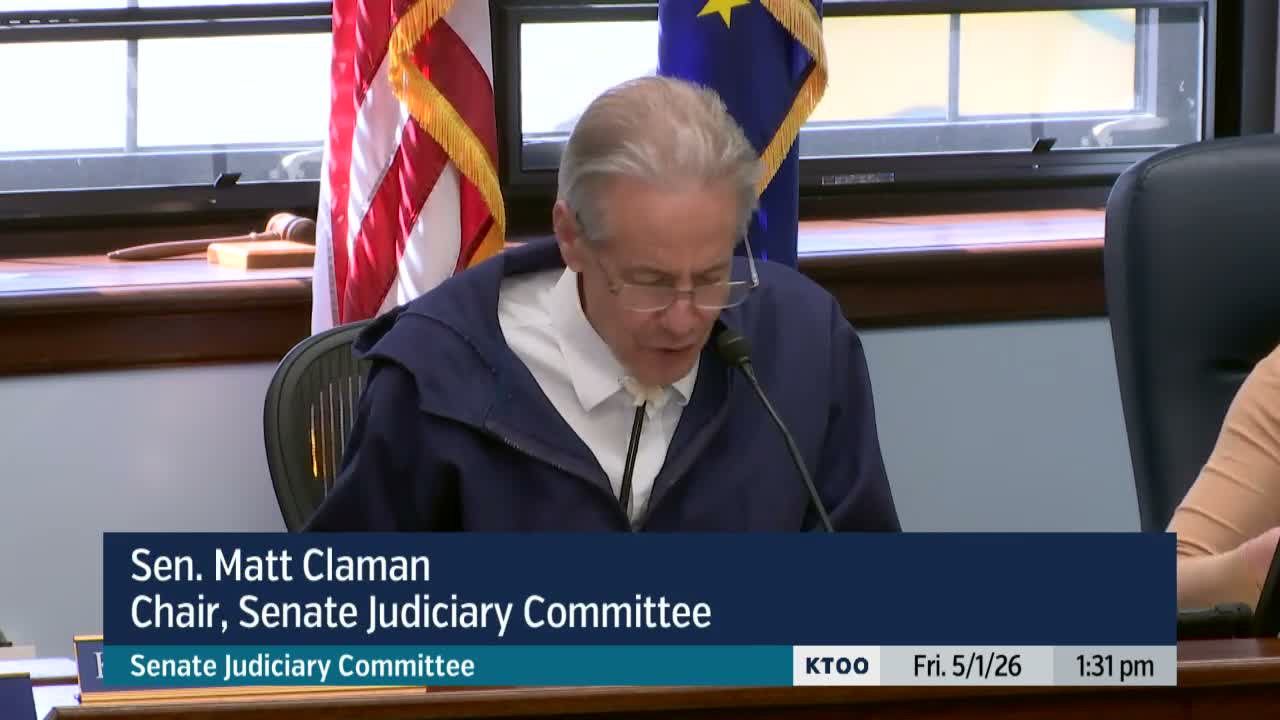
After the final round of questions, Senator Kiel moved that the committee forward Cox's name to a joint session for consideration. With no objections recorded, Chair Klayman announced the committee would forward the nomination.
The nomination now moves to a joint session for a confirmation vote.