Get AI Briefings, Transcripts & Alerts on Local & National Government Meetings — Forever.
AHFC outlines Last Frontier Housing initiative, land purchases to speed rural unit delivery
Summary
AHFC told the House Finance Committee it used a targeted 'Last Frontier Housing' approach in five hub communities to accelerate buildout, securing extra units in Saxman and manufacturing units for Nome, and it closed on just over 600 acres through a Lands to Housing Catalyst effort funded two years earlier. AHFC said procurement and local capacity were key success factors and that final units are coming online this summer.
Alaska Housing Finance Corporation officials on May 1 described a place‑based strategy to accelerate housing delivery in rural hub communities, saying local decisions and tailored support helped move projects from concept to occupancy faster than a one‑size‑fits‑all approach.
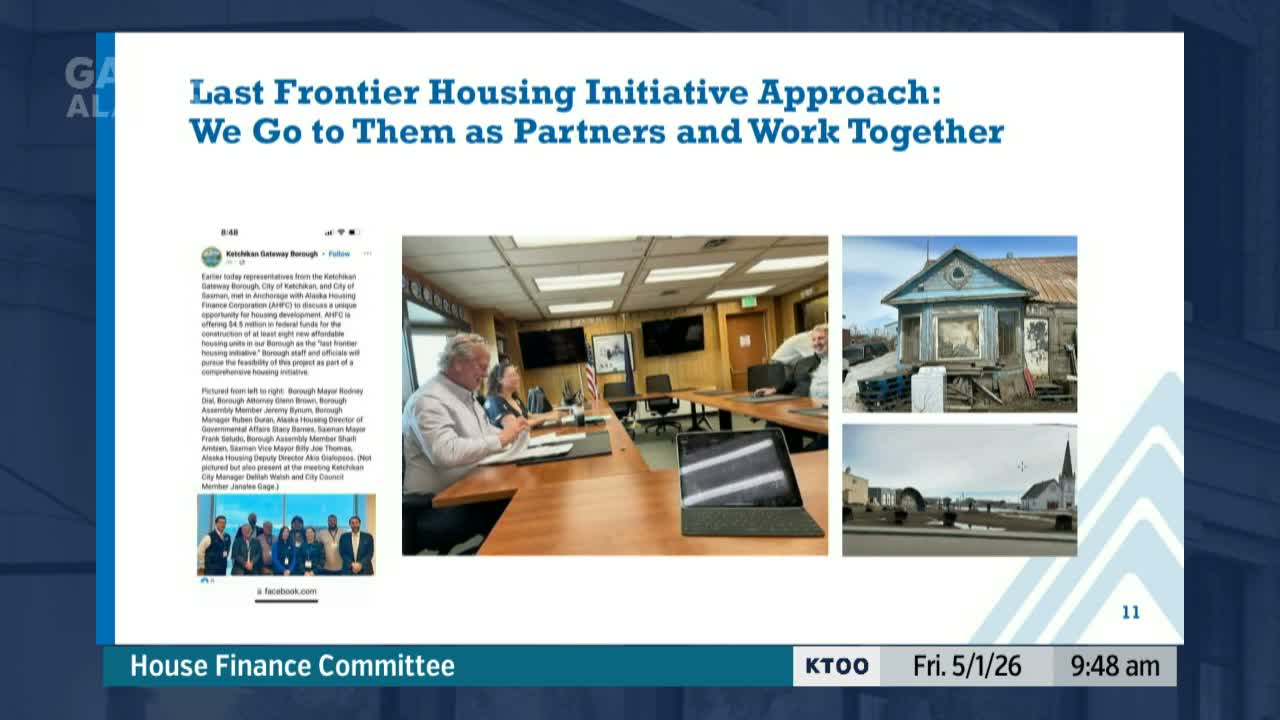
"We just went to the five communities directly, and we said here's a target. How many number of units we wanna see? What is it gonna take to get there?" Planning Director Daniel Delfino told the House Finance Committee. Delfino said the Last Frontier Housing initiative worked with each community to remove specific barriers — procurement, land, local capacity — and provided hands‑on assistance when needed.
Delfino gave examples: Saxman, where AHFC asked for eight units and the community delivered 14 after local governments and the borough coordinated procurement and provided land; Sitka, where AHFC managed procurement and partnered with a local housing authority; Bethel, which used aggressive local contracting and local labor; Nome, where manufactured units built near Big Lake (by a contractor associated with NANA) were shipped and are expected to come online this year; and Kotzebue, where multiple local stakeholders coordinated around limited city land and school‑district land to house staff.
AHFC said the approach was driven in part by expiring federal authorities that required shovel‑ready projects and by a desire to avoid imposing restrictions that could retard delivery. Delfino described follow‑on work under a Lands to Housing Catalyst initiative: two years ago the legislature and executive provided $4,000,000 to identify and clear legal, environmental and capacity barriers to making public land developable. AHFC reported it closed on slightly more than 600 acres in several communities and launched a procurement phase that drew more than 30 letters of intent for development proposals.
Representative Bynum asked about long‑term operating costs; he cited Saxman’s units as lacking heat‑pump installations and urged future projects to account for energy costs. AHFC acknowledged that in an urgency‑driven phase some longer‑term operating features were deprioritized and said lessons were applied to later phases and the Lands to Housing Catalyst work.
AHFC said it expects many of the Last Frontier units to be online this summer and that it will continue to provide procurement and technical assistance to communities that lack staffing or legal capacity. The committee did not take formal action; AHFC will provide additional written details and the broader housing assessment later in 2026.