Get Full Government Meeting Transcripts, Videos, & Alerts Forever!
Get email alerts on the Education Funding topic
No spam. Unsubscribe anytime.
House Finance Committee questions bill to smooth school funding with three‑year averaging; DEED says it lacks modelling capacity
Summary
The House Finance Committee heard House Bill 261, which would let districts establish July 1 funding baselines using a three‑year average (or the prior year if larger) to reduce midyear budget shocks. Members pressed sponsor Rep. Andy Story and Department of Education staff about a roughly $113 million FY27 fiscal note, DEED’s capacity to model impacts, and special‑education and hold‑harmless mechanics.
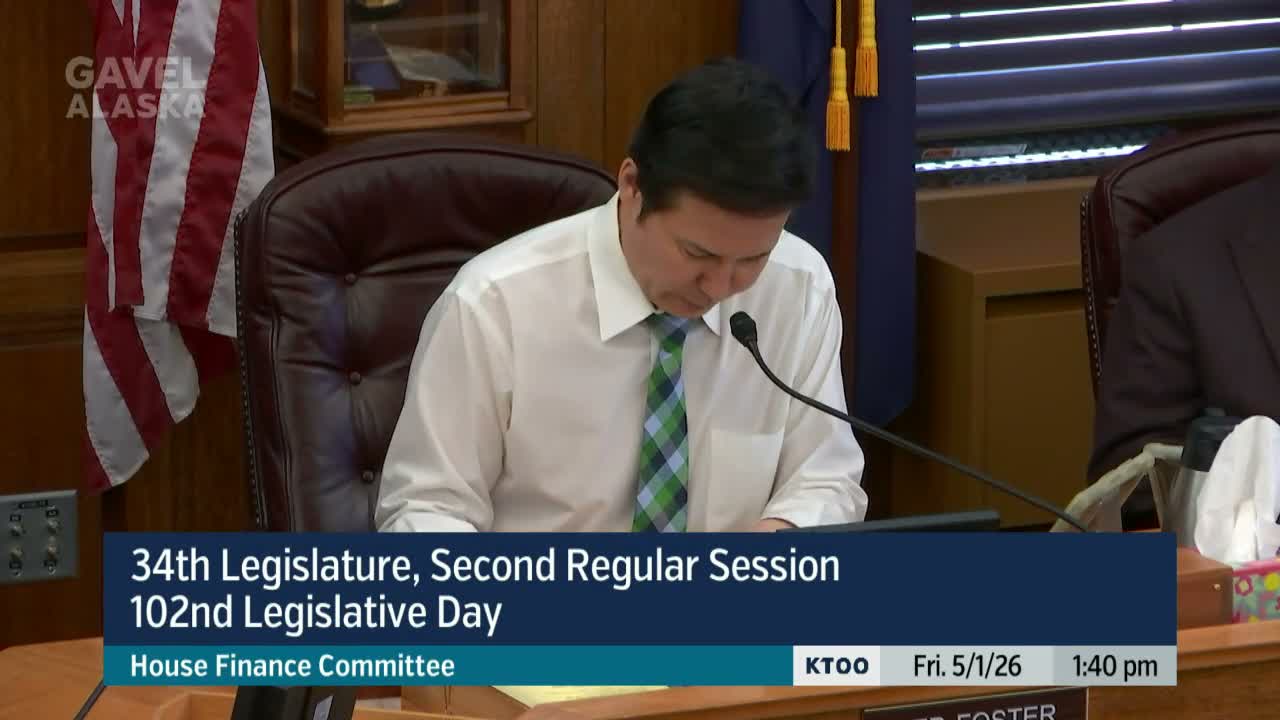
The House Finance Committee on May 1 heard Representative Andy Story’s bill (House Bill 261) to give school districts earlier budget certainty by letting them start the fiscal year on July 1 with a student‑count baseline based on a three‑year average or the previous year’s count, whichever yields more funding.
"What if schools knew their budget before the school year started?" Story asked, summarizing the bill’s aim to let districts finalize staffing and avoid the repeated layoff notices that follow late student‑count verification.
Story said the bill would smooth funding swings that can hit small and rural districts hard and that it was designed so districts experiencing growth could use the more recent count while districts with declining enrollment would be protected by averaging. He cited recommendations from a 2015 review of Alaska’s funding (authored by Justin Silverstein and referenced in committee materials) that advocated three‑year averaging to reduce volatility.
Committee members focused on three practical risks. First, several lawmakers raised hold‑harmless and "phantom student" concerns — whether the proposal could lead to some portion of a student being counted in more than one district across years or to duplicate payments when students move or enroll in correspondence programs. Story read a technical response from the outside reviewer indicating no student would be fully counted twice in a single year but that portions of a student could be allocated across districts under averaging.
Second, members repeatedly asked about the committee’s ability to model fiscal impacts. Representative Ballard and others said they wanted projections showing how often districts would select the higher prior‑year count versus the three‑year average and how student movement would affect the state cost. DEED staff confirmed they had not produced projection modeling for the committee. "We have not done any projection modeling," said Heather Heineken, director of finance and support services at the Department of Education, adding DEED had provided detailed ADM data files to the sponsor’s office but that producing trend projections would require significant staff resources.
Third, lawmakers pressed how special‑education funding and the intensive student multiplier would interact with averaging. Sponsor staff and DEED officials said federal rules require continuity of services when a student with an IEP transfers districts and that DEED’s finance team does not directly manage student records; Tammy Smith, sponsor staff and a longtime special‑education teacher, explained parents drive many transfers and timing varies. DEED’s school‑finance manager, Laurie Weed, told the panel that the October 20‑day count leads to OASIS submissions, a data‑cleanup process and January ADM reports, and that special‑education intensives and appeals extend finalization into March–April — the timing complication HB261 aims to address.
The bill’s fiscal note, built on FY27 projections, estimates an annual cost in the range of about $113 million beginning in FY27; Heineken told the committee that DEED’s FY27 estimate is based on available data and that projecting beyond FY27 would require modeling assumptions and historical trend work.
Sponsor Story said the change is intended to give districts the certainty to offer teacher contracts earlier in the cycle and avoid disruptive staffing notices. Several members said they supported the goal of stability but called for more modelling and documentation before committing to the bill’s fiscal assumptions or to preserving the current "greater of" clause that lets districts take the higher prior‑year count in growth years.
Committee members asked DEED to explore pullable data on student transitions between districts and correspondence programs so the fiscal effects and potential for gaming (districts choosing the option that maximizes revenue) could be better understood.
The committee agreed to keep the bill under active consideration and return it to the calendar; the panel recessed and Co‑chair Foster said the next meeting was scheduled for Monday, May 4. The bill will be taken up again for further questions and potential amendments.