Get Full Government Meeting Transcripts, Videos, & Alerts Forever!
Get email alerts on the Lesc Research Roadmap topic
No spam. Unsubscribe anytime.
LESC unveils interim research roadmap: 21 projects on CTE, AI, teacher workload, governance
Summary
Jessica, presenting for LESC staff, laid out a four‑area research roadmap with 21 studies this interim — including CTE formula design, literacy/math implementation, AI in schools, teacher workload, attendance, distance learning and governance — and invited member feedback and working‑group participation.
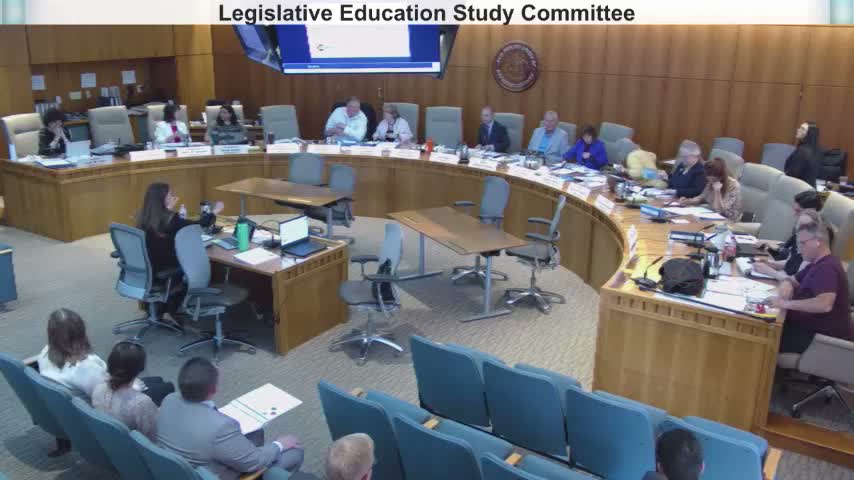
Jessica, a lead analyst for LESC staff, told the committee LESC will pursue 21 research projects over the interim organized into four roadmap areas: educator ecosystem, academic design, whole‑child supports and overarching systems.
“We have 21 distinct research projects for our team this year,” Jessica said, framing the work as part of an “adaptive policy making cycle” that combines stakeholder engagement, national research synthesis, original data analysis and targeted deliverables to inform future legislation and budgets.
The educator ecosystem bucket includes three projects led by Annie Armitage: an educator career continuum (career ladders and advancement pathways), an educator workforce analysis (integrating datasets on vacancies, turnover and teacher characteristics), and a teacher workload study that will examine time allocation, statutory requirements and impacts on teacher well‑being and retention.
Whole‑child supports include studies on access to arts, physical education and library resources; an Indian Education Fund allocation review tied to a recent $30 million, three‑year appropriation; and an analysis of student health professionals (counselors, nurses, psychologists, social workers) and workforce shortages.
Academic design contains eight projects: AI regulatory landscape and classroom implications; a bilingual education study with a working group; career and technical education (CTE) formula design (working group to propose categorical funding aligned to program quality); the distance‑learning study required under house bill 2 53; literacy and math implementation monitoring; special education variability analysis; and others.
Overarching systems projects include assessments and accountability, a capital outlay formula review (in partnership with LFC and PSFA), an education governance and long‑term planning study (House Memorial 30), health insurance consolidation/80‑20 analysis and transportation funding work.
Members pressed for specifics and stakeholder inclusion. Representative Baca asked for superintendent and student panels and for metrics tied to Yazzie‑Martinez investments; Jessica said staff will include working groups and outreach to districts, and will partner with PED on federally required studies. Representative Cohen asked whether LEAs will be part of the transportation study; Jessica confirmed an LEA and partner working group is planned for June–August 2026 and that the team will include districts with known transportation strains such as Rio Rancho.
Staff provided a data point requested by lawmakers: “Our current chronic absenteeism rate for school year '25 is 33 percent,” Jessica reported when asked about attendance trends, and she emphasized that attendance is being threaded through multiple research projects rather than treated solely as a separate item.
Multiple members urged LESC staff to prioritize policy levers that produce actionable, legislative‑ready proposals rather than only presentations. Jessica responded that many projects already include deliverables and that staff will produce memos and convene working groups to support members’ legislative priorities.
Jessica and staff closed by requesting committee feedback on study design and participants; several members offered to bring local data and suggested topics for the interim work plan.