Get AI Briefings, Transcripts & Alerts on Local & National Government Meetings — Forever.
LESC staff walk lawmakers through 2026 education budget: $4.575B for SEG, $35M for CTE, $15.3M for tutoring
Summary
Daniel, who covers public school finance for the LESC, told the committee how to read the 2026 General Appropriation Act and highlighted major appropriations: roughly $4.575 billion for the State Equalization Guarantee, $35 million for a new CTE pilot, and $15.3 million over three years for high‑impact tutoring.
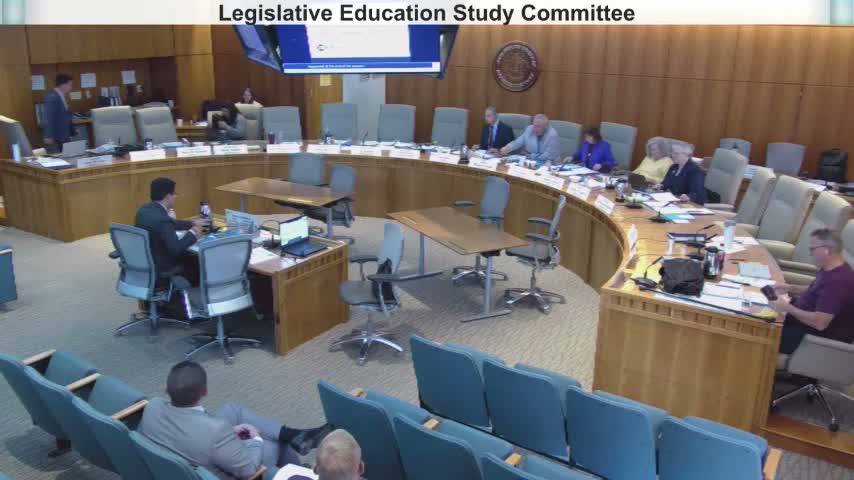
Daniel, who covers public school finance for the Legislative Education Study Committee (LESC), opened the committee’s briefing by walking members through how to read the 2026 General Appropriation Act and the staff post‑session review.
The presentation focused on where recurring and nonrecurring education appropriations appear in House Bill 2 and the post‑session review, and how to interpret the five funding columns. Daniel said the bill’s public school support subsection appropriates roughly $4,575,000,000 to the State Equalization Guarantee (SEG) for fiscal year 2027, including a small driver’s‑license fee line. “You all appropriated, almost $4,600,000,000 to the SEG, for FY27… for a total appropriation in House Bill 2 to the SEG 4,575,000,000,” he said.
Staff explained that the SEG is a distribution mechanism that sends legislative appropriations to school districts and charter schools based on the public school funding formula; it does not itself generate new revenue. Daniel also flagged that compensation increases this session were packaged partly outside House Bill 2: “that 1% average increase in compensation” was funded in a separate vehicle, identified in the presentation as senate bill 1 51, which contains $36,043,000 to fund a 1% average increase in public school personnel compensation.
Members pressed staff about several major line items. Daniel outlined how some new recurring and categorical appropriations are displayed in the bill and the post‑session review: $14,000,000 for early literacy, $42,200,000 for universal school meals, and a new $2,000,000 recurring appropriation for literacy coaches. He also reviewed the new preliminary unit value for FY27 — $7,117.10 — which staff said reflects a $240 increase from the FY26 final unit value.
On career and technical education (CTE), staff said the session created a $35,000,000 pilot for FY27 split across funds: $17,000,000 from the general fund and $18,000,000 from other state funds (the presentation identified the Public Education Reform Fund as the source for part of the $18M). Daniel said those dollars appear in multiple places in the high‑level budget and House Bill 2, which is why staff created the one‑page guide: “CTE is funded in multiple different areas…it got pretty complex this last session around how things are funded.”
The presentation also listed several other major FY27 appropriations to watch: $36,000,000 for compensation actions, $73,200,000 for the 80/20 health insurance match, $29,000,000 for reading and math interventions (expanded to include math), and $20,000,000 for out‑of‑school time programming.
Committee members asked how the public and legislators can read the spreadsheets in the bill. Daniel and staff repeatedly directed members to the post‑session review appendix — described as a one‑page quick guide plus linked page numbers — and said the review includes the full statutory text for the SEG and the categorical appropriations and shows vetoed language in red strikethrough for clarity.
Members pressed staff to follow up on several oversight items. Representative Bakken asked how tracking will work if the CTE pilot is meant to transition to recurring categorical funding; staff said districts can use program codes (vocational and technical education) and that the committee’s interim work plan includes a project to develop a categorical funding model for CTE. Representative Baca asked for a tally of dollars tied to the Yazzie‑Martinez remedies; staff said they will pull historical totals and report back.
Senator Azel asked for the total GAA number for 2026; Daniel reported $11,165,000,000 and said that represents a $340,100,000 increase over FY26, funded largely from permanent funds, severance taxes and income taxes.
The committee will continue oversight and interim monitoring. Staff promised to track PED’s use of the new line items throughout the interim and to provide follow‑up numbers on specific requests, including how CTE pilot funds are spent and historical Yazzie‑Martinez allocations.
The committee did not take formal votes during this presentation; staff identified follow‑up assignments and monitoring responsibilities for the interim.