Get Full Government Meeting Transcripts, Videos, & Alerts Forever!
Get email alerts on the Budget topic
No spam. Unsubscribe anytime.
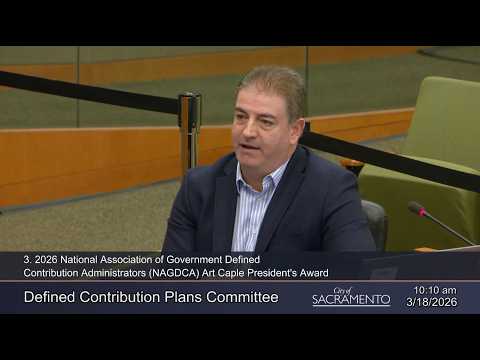
Committee adopts amended 2026 administrative allowance budget, discusses fee holiday and participant education
Summary
The Good Defined Contribution Plans Committee adopted an amended administrative allowance budget for 2026 and approved a proposed 2027 budget after staff corrected prior reporting errors and noted an unallocated surplus that prompted discussion of a temporary fee waiver or targeted participant education.
The Good Defined Contribution Plans Committee voted March 18 to adopt an amended administrative allowance budget for calendar year 2026 and to approve a proposed budget for 2027.
Acting Chair presided as staff walked the committee through two budget presentations showing corrected prior-year accounting and a smaller-than-expected consulting fee after the selection of Fiduciary Consulting Group. Nationwide’s and staff’s reconciliations showed interest income and timing shifts in invoices that increased the committee’s unrestricted balance by about $118,000 at year‑end, with a potential $136,000 projection for the following year.
"We have more money in the administrative allowance account than we think we're going to need for the next number of years," the acting chair said during the discussion, noting the committee’s obligation under its fee and expense policy to keep unallocated funds near zero. Staff explained that the consulting contract included an RFP cost built in, removing a previously budgeted line item and that an invoicing timing issue reduced actual spending in the most recent year.
Committee members discussed options for the unallocated funds, including identifying specific participant education projects, increasing the percent reserved for unanticipated expenses, or temporarily suspending the monthly explicit asset fee of $1.50 charged to 457 participants. Staff noted that changing the fee would require consultation with labor relations because several labor agreements specify that the fee is charged monthly.
Member Kang moved to approve the amended 2026 budget and proposed 2027 budget; the motion was seconded by member Zolasky and passed by voice vote. The committee instructed staff to bring back options for (1) targeted participant education spending and (2) any legally permissible approach to fee reductions, recognizing that a labor-relations process may be required for fee changes.
The committee also noted that Fiduciary Consulting Group’s lower-than-expected fee and internal corrections to the spreadsheet format reduced the need for some previously budgeted line items, and staff said the RFP expenses for record-keeper procurement are funded through the consultant going forward.
What’s next: staff will return with more detail on recommended education projects, potential impacts of a temporary fee reduction, and any labor-relations constraints before the committee considers a fee change.