Get Full Government Meeting Transcripts, Videos, & Alerts Forever!
Get email alerts on the Environmental Policy topic
No spam. Unsubscribe anytime.
Cook County committee urges Climate Superfund, opposes fossil‑fuel immunity and backs polystyrene ban
Summary
The Legislation and Intergovernmental Relations Committee unanimously approved a bundled package urging passage of a Climate Superfund Act, urging Congress to reject legal immunity for fossil‑fuel companies, and supporting a statewide ban on polystyrene food containers; the motion carried on a roll call reported as 13 ayes, 4 absent.
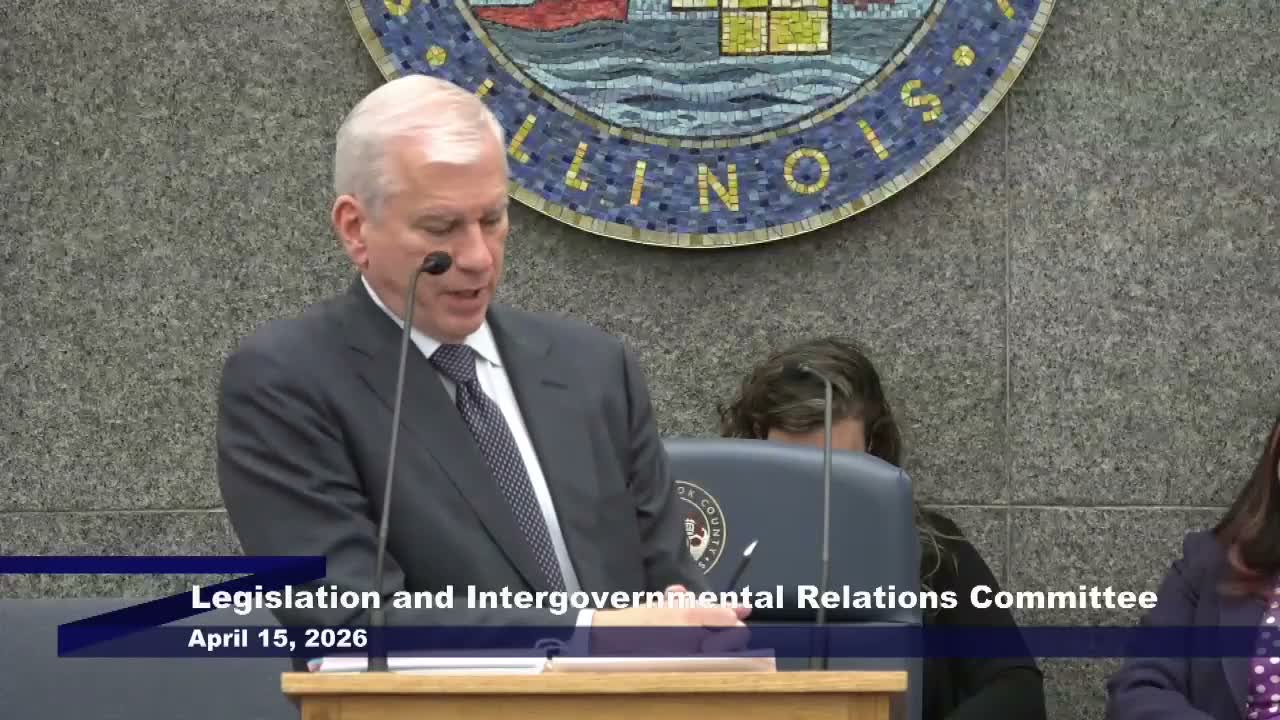
The Legislation and Intergovernmental Relations Committee of the Cook County Board approved a bundled motion to urge passage of the Climate Superfund Act, to urge Congress to reject efforts to create legal immunity for fossil‑fuel companies, and to support the Disposable Food Service Container Act (a polystyrene ban).
Vice Chair Degnan, who sponsored the resolutions, framed the action as a local effort to hold polluters accountable and to fund resiliency work. "If corporations knowingly sell a harmful product and lie about it, we should be able to take them to court to hold them accountable," Vice Chair Degnan said, describing state bills S.B. 2981 and H.B. 4773 as mechanisms to assess fees on major polluters and direct the proceeds to climate resilience programs.
The nut of Degnan’s pitch was financial and moral accountability: he told the committee that rising costs for homeowners and local governments are driven in part by extreme weather and that a small number of companies are responsible for a disproportionate share of global climate damage. "We can send a clear message today that we support climate accountability," Degnan said.
Speakers who testified during the public comment period reinforced the resolutions. Reverend Brian Sowder, president and CEO of Faith and Place, described local flooding and the cost to schools and homeowners and said, "If you make a mess, you clean it up." Senator Graciela Guzman, participating remotely, said the Climate Superfund Act and the county’s opposition to fossil‑fuel immunity would protect local avenues for redress and recovery. "Cook County offers the right of states to pursue accountability," Senator Guzman said.
The Disposable Food Service Container Act, identified in committee discussion as Senate Bill 1531, would ban polystyrene single‑use containers; proponents said Illinois would join other states in restricting a material that studies show does not readily biodegrade and that contributes to microplastics. Supporters told the committee the measure would reduce environmental contamination and protect the Great Lakes.
After discussion and with leave of the body to change the motion, the chair instructed a roll call vote on the bundled package. The clerk reported 13 ayes and 4 absent, and the chair declared the motion passed.
What happens next: the committee’s action is advisory; resolutions of this type urge state or congressional action and signal county policy priorities. The passage adds Cook County to a slate of local governments publicly supporting state legislation for polluter fees, opposing federal preemption that would shield fossil‑fuel companies from litigation, and favoring limits on polystyrene food containers.