Get Full Government Meeting Transcripts, Videos, & Alerts Forever!
Get email alerts on the Public Safety topic
No spam. Unsubscribe anytime.
Police budget highlights drone program, field fingerprinting and new investigative tools funded largely by grants
Summary
Chief Riley presented a police budget that reduces personnel costs due to pension funding changes, highlights $1M+ in grant revenue, and includes a $145K grant-funded drone-as-first-responder program, $20K on-site fingerprinting, a $67K Peregrine investigative license and planned radio upgrades.
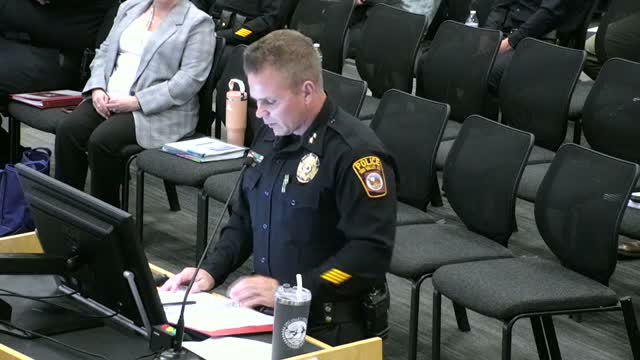
Police Chief Riley presented the Oro Valley Police Department's recommended FY27 budget and supplemental programs during the council's May 4 study session. Riley said the department's personnel line is lower next year largely because of lower excess PSPRS contributions after actuarial funding improved, while operations and grant-funded projects increase.
On new operational programs, Commander Young and Commander Gracie outlined specific items. Commander Gracie emphasized the drones-as-first-responder initiative, saying it will "improve our operational awareness" and "improve our response times." Staff reported the drone program cost at about $145,000 and that it is funded through a state grant; Gephardt and department staff said the program would stop if grant funding ends.
Commander Young described on-site fingerprinting to increase capture of full fingerprints into state criminal-history systems so habitual offenders are tracked across the county; he said the field-capable system is different from a single-fingerprint rapid scan and will help document repeat shoplifting convictions. The on-site fingerprinting platform cost is approximately $20,000 and Commander Young said the equipment was funded by a donation from the Southern Arizona Law Enforcement Foundation.
On investigative and technology investments, Commander Gracie explained a $67,000 Peregrine license (a state grant-funded informational linking tool among law enforcement agencies) to improve case linking and intelligence sharing, and described radio replacement and encryption needs, which the department is pursuing as grants or phased replacements due to vendor lifecycles. Commander Gracie called encryption "a no-brainer" for operational security but said finding funding is the challenge.
Council members asked how stable grant funding is for programs such as drones and SROs. Chief Riley and staff said many grants are multi-year (some 3-year awards) and that losing grants would reduce special deployments and visibility (for example DUI or STEP overtime deployments), not immediately remove core officers from schools or patrol, but that staff will continue to seek supplemental funding. Gephardt said the budget preserves core staffing and would address grant losses through priority decisions rather than automatic reductions.
Council and staff also discussed an on-site police wellness "recharge room," which staff said will be procured through a University of Arizona discount and aims to improve officer resilience, sleep and recovery after critical incidents; staff estimated the recharge room at about $22,000 under the discounted arrangement.
The council did not take votes on funding decisions during the study session; staff recorded follow-ups including a request to show grant amounts linked to specific programs in future slides and to clarify the ongoing costs if a grant were to end.