Get Full Government Meeting Transcripts, Videos, & Alerts Forever!
Get email alerts on the Housing Policy topic
No spam. Unsubscribe anytime.
Assembly Housing Committee advances a package of housing measures; bond, CEQA streamlining, factory-built housing and EV rules debated
Summary
The Assembly Housing and Community Development Committee heard testimony on a wide slate of housing bills, including oil-well disclosure and methane-monitoring requirements, CEQA streamlining for public-university housing, supports for factory-built housing, a pause on tougher EV readiness rules for 100% affordable projects, and a $10 billion housing bond; most measures were passed to appropriations for further consideration.
The Assembly Housing and Community Development Committee heard eight hours of testimony and moved several housing bills to the Assembly Appropriations Committee after public and expert testimony Thursday in Room 126 at the State Capitol.
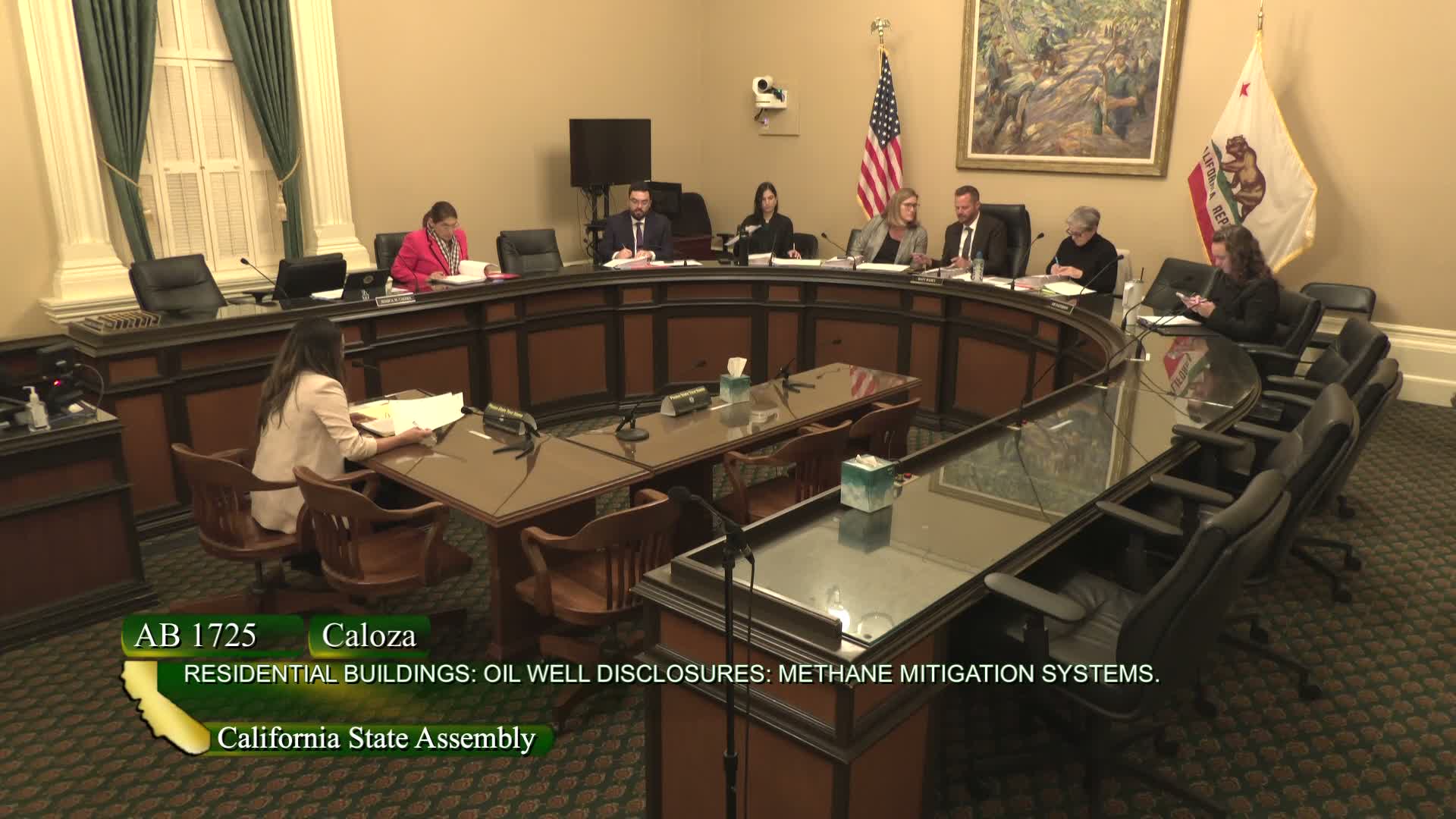
Assemblymember Colosa opened the hearing with AB 17 25, a measure aimed at requiring consistent statewide disclosure of oil wells and functioning methane monitors near schools, hospitals, parks and residences. Nicholas Gardner of Sunrise Movement Los Angeles testified for the bill, saying, “My name is Nicholas Gardner, and I'm a senior organizer and the chair emeritus of the Sunrise Movement Los Angeles,” and describing conditions in Vista Hermosa Heights, where residents report methane alarms and oil odors. Supporters cited testimony that “66% of active and idle wells leak methane,” and urged the committee to adopt the bill’s monitoring and disclosure standards to protect low-income and frontline communities.
Opponents from industry groups — including Deborah Carlton of the California Apartment Association — urged additional work with the author, saying the measure did not fix the underlying responsibility for capping orphaned wells and that state action to cap abandoned wells should be a priority. The committee did not take a final floor vote on AB 17 25 at the hearing; the author accepted committee amendments and asked to move forward when quorum allowed.
The committee also considered AB 17 32, which would extend CEQA streamlining to public university housing projects (University of California, CSU and community colleges). Tyler Ayoola, representing the University of California, said the bill “will help the university build this housing faster, more efficiently” while preserving labor and environmental protections. Committee members discussed a remaining technical concern about preserving a 100% affordable exemption; the author accepted committee changes and indicated continued negotiation with natural resources stakeholders.
Several bills targeting construction and finance policy drew sustained discussion. AB 21 85 and a related package would update state multifamily affordable-housing programs to better accommodate factory-built (off-site) construction; sponsors argued the changes would lower costs and speed delivery of units. Supporters included industry and labor witnesses who said modernizing funding and bonding rules would help factories scale production. AB 18 15, a related measure, would prohibit local jurisdictions from imposing standards above state minimums on factory-built housing projects, with advocates saying standardization is essential for factories to achieve economies of scale.
The committee heard competing views on AB 27 48, which would delay higher EV readiness requirements in the California Green Building Standards Code for 100% affordable housing developments and keep the earlier 40% standard through 2035. Affordable-housing developers warned the 2026 increase could add thousands of dollars per unit and imperil project financing; clean-air and transportation equity groups opposed the rollback, saying it would reduce residents’ access to clean transportation and increase retrofit costs later.
Senator Cabaldon presented SB 4 17, a $10 billion statewide affordable-housing bond the committee backed to send to the Assembly Appropriations Committee. Witnesses including Housing California and Related California described the bond as needed to preserve a pipeline of shovel-ready projects and to produce tens of thousands of units statewide. Committee members pressed for allocation details — including requests for dedicated funding for student housing, CalHome, and interim shelter — and the author said negotiations on allocations would continue.
Environmental groups and the Coastal Commission expressed strong opposition to AB 17 40, which would, as amended, allow the city of Santa Monica to opt in to local permitting authority on a limited set of low-impact activities in urban coastal areas. Opponents said the bill risked eroding public beach access and would create an unprecedented carve-out from the Coastal Act unless amended; the author said the bill was narrowed and that amendments protect sensitive resources and public parking.
Beyond major policy bills, the committee advanced smaller but consequential items: AB 21 46 would let applicants self-certify homelessness for state-funded housing referrals and create a backstop for units vacant more than six months; AB 20 94 would create a social housing coordinator at HCD to plan and scale social housing; AB 21 10 would allow local tax-increment financing districts for workforce housing under an 80/20 targeting rule. Several measures received coauthor amendments and were passed out of committee to Appropriations for further fiscal review.
Votes at a glance - SB 4 17 (housing bond): Motion passed to Assembly Appropriations; further allocation negotiations to follow. (Vote recorded in committee transcript; detailed roll-call tallies are in the official record.) - AB 17 40 (Santa Monica Coastal Act changes): Passed as amended to Assembly Appropriations after debate and amendments protecting beach parking and sensitive resources. - AB 21 46 (self-certify homelessness / vacancy backstop): Passed to Appropriations. - AB 20 94 (social housing coordinator): Passed to Appropriations. (Where committee roll calls were taken, the hearing transcript records the motions and the committee’s recorded ayes/ayes by name; exact tallies and the official roll-call are in the committee’s minutes.)
What comes next Many of the bills the committee moved are now headed to the Appropriations Committee for fiscal analysis and potential amendments. Authors and stakeholders indicated they will continue negotiating technical fixes — on student-housing exemptions, Coastal Act protections, and EV timing and funding — before floor consideration.
Reporting notes Quotes and attributions in this report come directly from the committee transcript and speakers who identified themselves on the record. When speakers provided organizational affiliation, that affiliation is shown with their testimony; when a name or role was not stated on the record, the committee transcript label was used.