Get Full Government Meeting Transcripts, Videos, & Alerts Forever!
Get email alerts on the Land Use Zoning topic
No spam. Unsubscribe anytime.
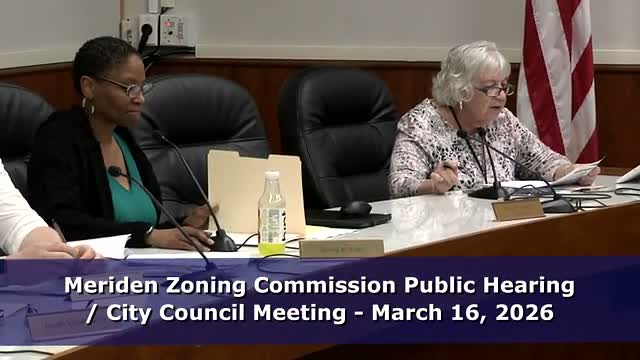
Meriden council declines citywide zoning change to expand self-storage uses
Summary
After public testimony and staff input, the Meriden City Council voted against a proposed text amendment that would have defined self-storage and allowed it by right in industrial zones and by special exception in commercial zones. Councilors cited Plan of Conservation & Development alignment, land-use tradeoffs and procedural concerns.
The Meriden City Council declined a proposed zoning text amendment on March 16 that would have added a definition for “self storage facility” and allowed the use by right in M-1 through M-4 industrial zones while treating it as a special-exception use in C-2 and C-3 commercial zones.
Attorney Dennis Sanneviva, representing the applicant, told the zoning commission that the amendment was needed because the current regulations do not explicitly list self storage. He presented a client proposal for 19 North George Street (the former Russell Hall building) and cited industry demand and a feasibility analysis showing local supply below national averages.
Megan, the city’s planning director, told the council the planning staff’s position was neutral. She noted that Connecticut case law disfavors using variances to authorize a use that is not listed in the regulations and that the commission must evaluate whether the amendment is consistent with the Plan of Conservation & Development (POCD). Planning staff also warned that while self-storage can reactivate vacant industrial property, it tends to use land without generating many jobs — a factor in assessing community benefit.
Council debate focused on two main threads: (1) whether approving the amendment citywide would inappropriately remove site-by-site review in industrial areas, and (2) whether the change would support broader economic-development goals the POCD advances. Several councilors argued a denial would preserve the status quo while the amendment, if adopted, could allow more properties to convert to storage without the same level of public review.
Councilor Scaramuzzo proposed an amendment to require a special-exception review in both commercial and industrial zones so each site would be subject to case-by-case approval; that amendment resulted in a tied vote and failed. After further discussion the council voted on the applicant’s original proposal; the motion to adopt the zoning text change did not pass and the proposed amendment was not adopted.
The hearing record includes staff testimony that about 18 variances have been granted historically for storage uses (some of which may no longer operate) and that variances “run with the land,” meaning prior approvals remain effective unless the underlying ordinance changes. Planning staff recommended caution about loosening advertised restrictions and suggested any motion include an effective date after the 15-day appeal period if the council chose to approve.
Public commenters urged reuse of vacant buildings and noted demand for storage space created by increased apartment construction, but councilors weighing downtown economic vibrancy and limited commercial/industrial acreage said those factors weighed against an across-the-board liberalization of the use.
The council did not adopt the applicant’s proposed zoning change. The zoning rules and existing variances remain in place; applicants who seek new storage projects must continue to follow existing processes, which may include variance requests where permitted, site-plan reviews and other permitting steps.