Get Full Government Meeting Transcripts, Videos, & Alerts Forever!
Get email alerts on the Martinez Yazzie topic
No spam. Unsubscribe anytime.
Court will decide whether PED’s remedial plan meets Martinez‑Yazzie orders after plaintiffs press for clearer timelines and benchmarks
Summary
After PED submitted a year‑one remedial action plan, plaintiffs filed objections saying it lacks measurable goals, timelines and cost estimates; PED defended its process and described implementation steps across math, literacy, special education and tribal consultation. The matter is fully briefed before the First Judicial District Court.
The First Judicial District Court has received plaintiffs’ filings and plaintiffs’ reply and will next evaluate whether the Public Education Department’s (PED) remedial action plan satisfies constitutional requirements set out in the Martinez‑Yazzie consolidated education sufficiency ruling.
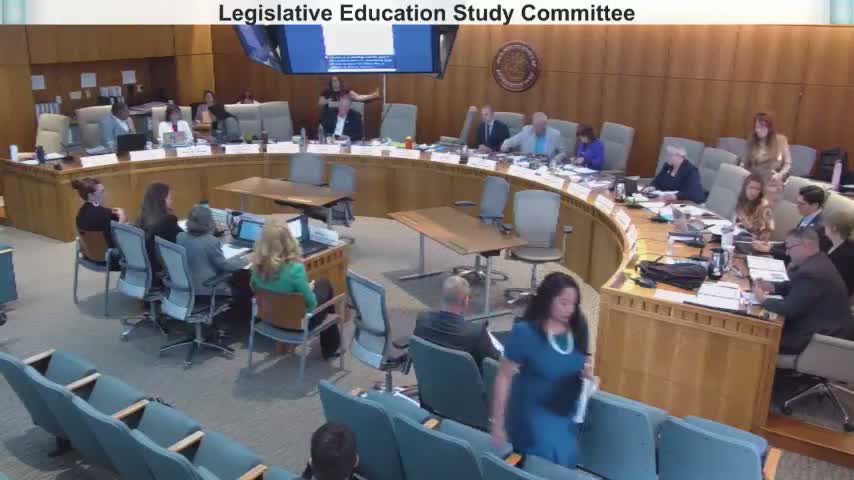
"The matter is now fully briefed with the court," Jessica Hathaway told the committee as she summarized filings that followed PED’s October and November submissions. Plaintiffs filed separate complaints in February alleging the plan remains "not a true remedial plan," citing a lack of measurable goals, timelines, enforceable benchmarks, clear baselines, implementation steps, identified responsible parties and a funding strategy.
PED officials told legislators the department developed its plan through extensive stakeholder engagement, including more than 1,000 participants at 12 regional community meetings and more than 1,200 online survey responses, and that it submitted a draft in October 2025 and a final plan in November 2025. The department argued in court filings that some objections reflect formatting or style disputes and urged that the appropriate judicial remedy would be targeted edits rather than rejection of the plan in its entirety.
Dr. Jacqueline Castales, PED’s executive director, described year‑one implementation work across four priority areas: improving mathematics instruction through a statewide leadership framework and strengthened teacher preparation; accelerating literacy implementation under SB 37, including an early‑adopter literacy coaching model with roughly 90 schools; expanding Multilayered System of Supports (MLSS) pilots (11 LEAs, 55 embedded support leads); and embedding supports for students with disabilities and English learners. "We are moving with urgency, partnering closely with practitioners, and focusing on implementation that is both evidence based and deeply responsive to the needs of our New Mexico students," Castales said.
Deputy Secretary Jill Weiss told the committee that Senate Bill 64 codified an Office of Special Education led by a deputy secretary and advanced a statewide IEP template being built in Synergy; PED plans a phased rollout with Phase 1 of the online IEP going live this fall and Phase 2 midyear. Assistant Secretary Katie Ann Wanico, who identified herself as assistant secretary for Indian Education, described actions to strengthen tribal consultation and a student needs assessment process required under the Indian Education Act, with district submissions due Oct. 15 and training and modules planned this summer.
Legislators pressed PED on key implementation details and monitoring. Representative Roybal Caballero echoed plaintiffs’ criticisms, saying the submission reads like "a collection of ongoing initiatives and aspirational goals" rather than a remedial plan with concrete timelines and named experts. Representatives and senators asked for clearer success metrics, more consistent assessments and evidence that the department can sustain reforms across leadership changes. PED officials said student outcomes — attendance, behavior and academic proficiency — are the ultimate measures and that many action items have monthly tracking and staff accountability.
Lawyer/advocacy organizations representing plaintiffs were identified by staff as the New Mexico Center on Law and Poverty and MALDEF; plaintiffs’ filings ask the court to order PED to revise the plan in collaboration with plaintiffs and subject‑matter experts and suggested a 5–7 year implementation timeline where PED’s plan currently sets a three‑year timeline for many actions.
Committee members also asked about workforce and assessment issues. PED reported roughly 700 teacher vacancies and said average superintendent tenure is about 18 months in many districts; PED pledged to provide additional percentage data. Members raised concerns about the Amira reading assessment and whether it accurately serves students with IEPs, dialects or speech needs; PED said Amira can adapt to individual students, that the department trained instructional coaches, and that teacher judgment will default when the AI recommendation and teacher expertise diverge.
The committee requested follow‑up on several items, including the status and timely use of a $1,000,000 teacher‑pipeline allocation, detailed vacancy percentages, and technical documentation on assessment tools. For now, the immediate procedural development is judicial: the court will determine whether PED’s plan meets the May 2025 order’s requirements or whether further remedial work — possibly a revised plan or court‑ordered collaboration with experts — is necessary.
The committee adjourned for lunch with members noting ongoing oversight responsibilities and the need for additional technical follow‑up from PED.