Get Full Government Meeting Transcripts, Videos, & Alerts Forever!
Get email alerts on the Storm Relief Utility Credit topic
No spam. Unsubscribe anytime.
Council defers vote on one-time water/sewer bill credit after lengthy debate over cost and targeting
Summary
Council deferred BL 2026-1294—a proposed one-time water and sewer credit tied to the January 2026 winter storm—to the next meeting and re-referred it to Budget & Finance after extended floor debate about fiscal impact, universal versus targeted relief, and use of ARPA funds.
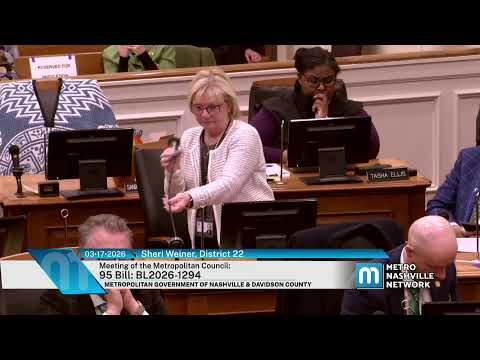
After nearly two hours of floor debate on March 17, the Metropolitan Council voted to defer consideration of a proposed one-time water and sewer bill credit (BL 2026-1294) intended to provide relief to customers affected by the January 2026 winter storm. The motion to defer included a re-referral to the Budget & Finance Committee for further review.
Sponsor Toombs and administration staff answered detailed questions about funding sources and cost estimates. Mary Jo Wiggins, speaking for the administration, said $930,000 in previously obligated ARPA funds had been reallocated to Metro Action Commission (MAC) to provide targeted rent, mortgage and utility assistance for households experiencing income loss related to the storm; Wiggins said MAC’s program prioritizes households at or below 80% of area median income and that an application period would open for additional utility assistance.
Council member Johnston contested some administrative figures and said his discussion with Metro Water yielded a different fiscal estimate. “The actual fiscal note is $5,984,853,” Johnston said on the floor, describing how the aggregate credit across classes of customers adds up and noting Metro Water’s cost structure (including wastewater treatment costs). Administration later described the high-end estimate of direct excess-water cost as roughly $880,000, which it characterized as returning unexpected revenue rather than a net expense to ratepayers.
Council members debated policy trade-offs: proponents of a universal credit said many residents experienced inconvenience and higher bills and may not apply for means-tested relief; others argued the credit would distribute funds to many who were not harmed while leaving some harmed households under-served, and urged using targeted ARPA-funded relief already allocated to MAC. Several members asked for written fiscal analyses and clarified whether customers served by other water utilities (e.g., Madison Suburban Water) would benefit; committee chairs clarified those customers would not receive Metro Water credits because they are served by separate providers.
After competing motions (including a motion to call the previous question that failed) the council voted by voice and determined the one-meeting deferral with a re-referral to Budget & Finance carried. The clerk recorded that the bill (BL 2026-1294) will be deferred one meeting and returned with written fiscal information and committee review before a final vote.