Get Full Government Meeting Transcripts, Videos, & Alerts Forever!
Get email alerts on the Open Meetings Brown Act topic
No spam. Unsubscribe anytime.
City attorney warns youth commissioners about Brown Act 'daisy chains' and explains follow-up-log process
Summary
Sacramento City Attorney staff advised the Youth Commission on when and how to place requests on the commission’s follow-up log and warned that informal serial communications can violate the Ralph M. Brown Act; staff urged commissioners to use public agenda time to avoid creating unintentional meetings.
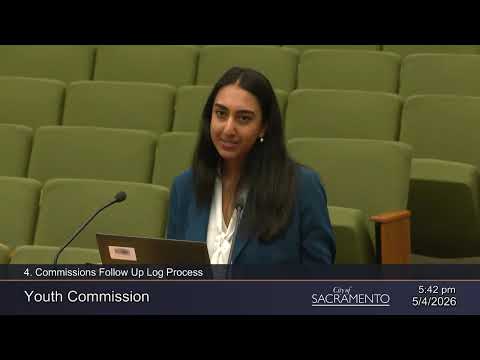
Harveen Gill, an attorney in the Sacramento City Attorney’s Office, told the Sacramento Youth Commission on May 4 that commissioners must take care when discussing commission business outside meetings to avoid violating the Ralph M. Brown Act.
"So going back to my ... animal husbandry example ... before you know it, we've had accidentally created a serial meeting where enough people on our commission are aware of this desire," Gill said, describing a "daisy chain" scenario in which sequential private contacts among commissioners can amount to a prohibited quorum. She described a second common pitfall — a "hub-and-spoke" pattern — where one person contacts several commissioners and the effect is the same.
Gill walked commissioners through the mechanics of the follow-up log, which members may use at the end of a meeting during the "commissioner comments, ideas, questions" portion to request future agenda items or presentations. She said staff will review log entries and determine whether an item should go on a future agenda and when, noting some commissions are subject to charter requirements that would require voter action to change membership rules.
The attorney emphasized a conservative approach to out-of-meeting communications. "The Brown Act ... is the cornerstone of everything municipal, local government," Gill said, and the commission should assume the public business belongs in public view. She also cited the city’s "sunshine" posting practices and said staff generally aim to exceed minimum state posting requirements to increase transparency.
Commissioners asked whether informal focus-area discussions constitute an exception; Gill said ad hoc committees and properly noticed community meetings can be exceptions but urged commissioners to consider perception as well as intention. She advised that if a commissioner has an idea to pursue, the appropriate time to request it for the follow-up log is at the end of a publicly noticed meeting so staff can treat it as a public action.
The commission received the item for information; no vote was required.
What happens next: Commissioners and staff will use the follow-up log process to place requests for future presentations and agenda items. Staff will review and schedule requests when appropriate, and commissioners were encouraged to use public comment or the follow-up-log process rather than private serial communications.