Get Full Government Meeting Transcripts, Videos, & Alerts Forever!
Get email alerts on the City Budget topic
No spam. Unsubscribe anytime.
Chesapeake Council discusses 3¢ personal property cut but holds rate after straw poll
Summary
City Manager presented scenarios showing a 3¢ personal property tax reduction is feasible this year but council’s thumb poll favored keeping the current rate; staff warned the change would reduce reserves amid state budget uncertainty and possible collective bargaining costs.
Chesapeake’s City Council spent much of its April 28 work session weighing whether to trim the city’s personal property tax and how to allocate roughly $234,677 in available funds in the FY27 proposal.
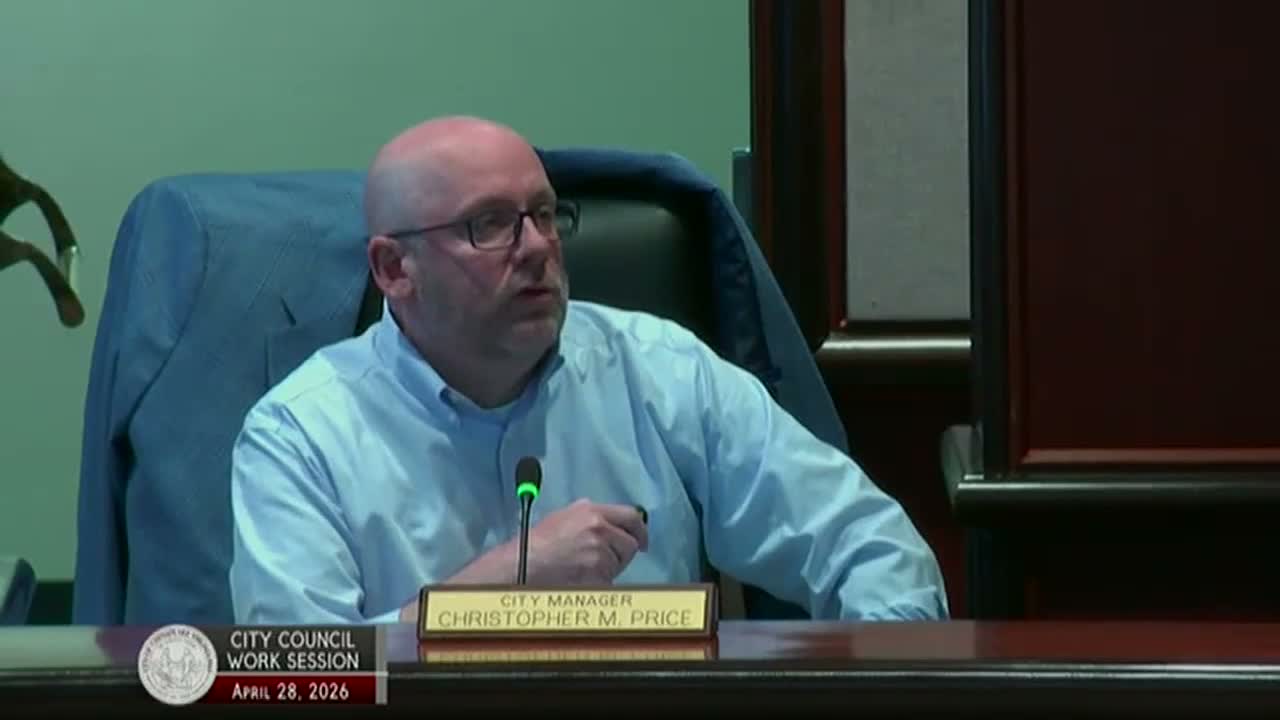
City Manager Mr. Price told council that, after amendments the body has already endorsed, the city’s uncommitted balance stood at about $234,677 and that staff had left a $1,000,000 reserve to address potential short‑term impacts from the state General Assembly. He offered three scenarios for a personal property tax cut — a 2¢, 3¢ or 4¢ reduction — and said the staff recommendation was that a 3¢ reduction could be accommodated in FY27 using anticipated technical amendments in June, though it would reduce the city’s flexibility.
"Our current balance ... with an available balance of $234,677," Mr. Price said while walking members through the numbers. He warned elected officials the city faces several unknowns — including collective bargaining outcomes and fuel price volatility — that could create budgetary pressure later in the fiscal year.
Several council members said they favored relief for taxpayers. Councilmember Whitaker said he was “very much in favor of a 3¢ reduction” if it can be done without “rocking the boat.” Other members asked whether a one‑year credit or refund could be issued instead of a permanent rate cut as a way to preserve policy flexibility.
Mayor West and others urged caution. "For me, I think it’s ... leave things as they are," the mayor said, pointing to the city’s long‑term capital commitments and uncertainties from Richmond.
Rather than adopt a permanent change, council conducted a thumb poll when Mr. Price asked members whether they wanted to "leave the rate the same." Staff counted six members indicating they preferred to keep the rate unchanged for now. That informal straw poll will inform revisions ahead of a formal vote on the budget at upcoming meetings.
Votes and routine actions at the same meeting included unanimous approvals on several procedural items: certification of a closed meeting (8–0), approval of the meeting agenda (8–0) and adoption of multiple consent‑agenda items. The council also approved a $340,000 transfer to cover special election costs and accepted Human Services appropriations for interagency consortium funds; each measure passed 8–0.
What happens next: staff will bring revised budget language and technical amendments in June after additional state guidance; council members indicated they may revisit tax relief or focused credits later in the fiscal year depending on revenue and the outcome of collective bargaining.