Get Full Government Meeting Transcripts, Videos, & Alerts Forever!
Get email alerts on the Niz Finance topic
No spam. Unsubscribe anytime.
ANISDA presentation: NIZ has channeled development and tax revenue to downtown projects, staff say
Summary
ANISDA Executive Director Steve Bamford told a special Allentown meeting that the Neighborhood Improvement Zone (NIZ) has driven more than $1.2 billion in downtown investment and that nearly all NIZ tax receipts are state taxes applied to debt service and public improvements; council members pressed staff on displacement, affordable housing and how excess funds are allocated.
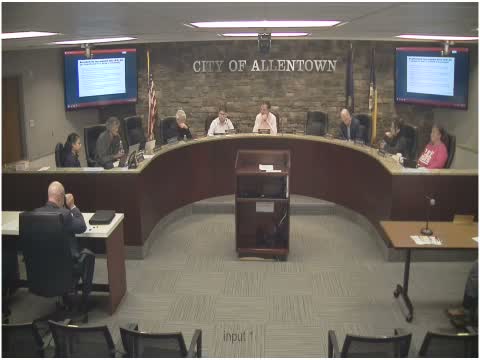
Steve Bamford, executive director of the Allentown Neighborhood Improvement Zone Development Authority (ANISDA), laid out how the NIZ finances development and public improvements during a special Allentown City meeting on April 22.
Bamford said state legislation authorized a roughly 130‑acre Neighborhood Improvement Zone and ANISDA was created to administer financing and improvements within it. He said the NIZ has enabled what he described as more than $1,200,000,000 in downtown investment and that revenues generated inside the zone are applied to debt service and public‑improvement financing rather than to city operating budgets.
Citing figures shown on slides, Bamford said the NIZ revenue mix is heavily weighted toward state taxes: for the most recently completed certification cycle he described (2024 revenue used in 2025), certified receipts included a little over $98 million in state taxes plus about $5 million in locally certified taxes, for roughly $103 million remitted to ANISDA’s escrow agent. He said about $66.5 million of those certified dollars were applied to developer debt service, and $12,565,500 was applied to principal and interest on bonds issued for PPL Center. Under ANISDA’s agreements, Bamford said the authority returns the first $22,000,000 of excess receipts to the Commonwealth when such an excess exists; in 2025 the authority also made a $5,000,000 payment on a revolving line of credit used to fund public‑improvement projects.
Bamford described ANISDA’s role as a funder: the authority can finance design and construction for public improvements but — he said — cannot fund maintenance or ongoing operational costs under the NIZ statute. He described the standard tri‑party arrangement used on public‑improvement projects: the authority provides funding, the public property owner (usually the City of Allentown or the Allentown Parking Authority) holds the land, and a project sponsor manages construction and turns the asset over to the public owner after an initial maintenance period.
As examples of the program’s effect on the tax base, Bamford presented pre‑ and post‑development assessments for projects including 3 City Center, Strata West and the Moxie Hotel; the post‑development values, he said, generated substantially larger real‑estate tax collections for the city, school district and county than existed before the projects were built.
On funding mechanisms for public improvements, BAMFORD said ANISDA uses a $10,000,000 revolving line of credit (People’s Security Bank & Trust) to finance approved projects and repays that line with excess revenues as they become available. He said ANISDA has approved more than $27,000,000 in public‑improvement projects to date and that those projects go through at least two advertised public meetings: an initial public‑review committee hearing and then a full board meeting.
Why it matters: Bamford framed the NIZ as a financing tool that channels state and locally certified business taxes generated in a defined central area into debt service and capital projects intended to support downtown redevelopment. The structure, he said, preserves city, county and school district real‑estate tax receipts while allowing the authority to fund public improvements within the NIZ footprint.
What to watch next: Bamford and staff noted a shrinking time window for allocating NIZ tax revenues — the program’s statutory allocation period runs through 2042 — and that timeline is a factor in evaluating future projects and amortization schedules.
Quotes: Bamford said, “virtually all state and local business taxes generated from businesses in this 130 acre zone… can be applied to debt service on debt incurred to do development in the zone.” He also noted that “no tax revenue is used for our operations” and that the authority “retains a target of 20%” of project revenues for its pledged obligations.
Ending: The presentation closed with questions about program administration, and Bamford said the authority posts annual financial audits on its website and that a 2025 audit was underway and expected to be presented at a public authority meeting in June.