Get Full Government Meeting Transcripts, Videos, & Alerts Forever!
Get email alerts on the Sidewalk Vending topic
No spam. Unsubscribe anytime.
Board introduces sidewalk vending ordinance, asks staff to detail fees, outreach and enforcement
Summary
On first reading July 10, Alameda County introduced an ordinance to license and regulate sidewalk vending to align with state law; staff described permit, ADA, restroom, buffer zone and enforcement proposals and supervisors pressed for one‑stop application options, clear outreach, and definitions distinguishing small roaming vendors from larger pop‑ups.
The Alameda County Board of Supervisors held a first reading July 10 of a proposed ordinance to license and regulate sidewalk vending in unincorporated areas, directing staff to develop fees, outreach and regulations to implement the program.
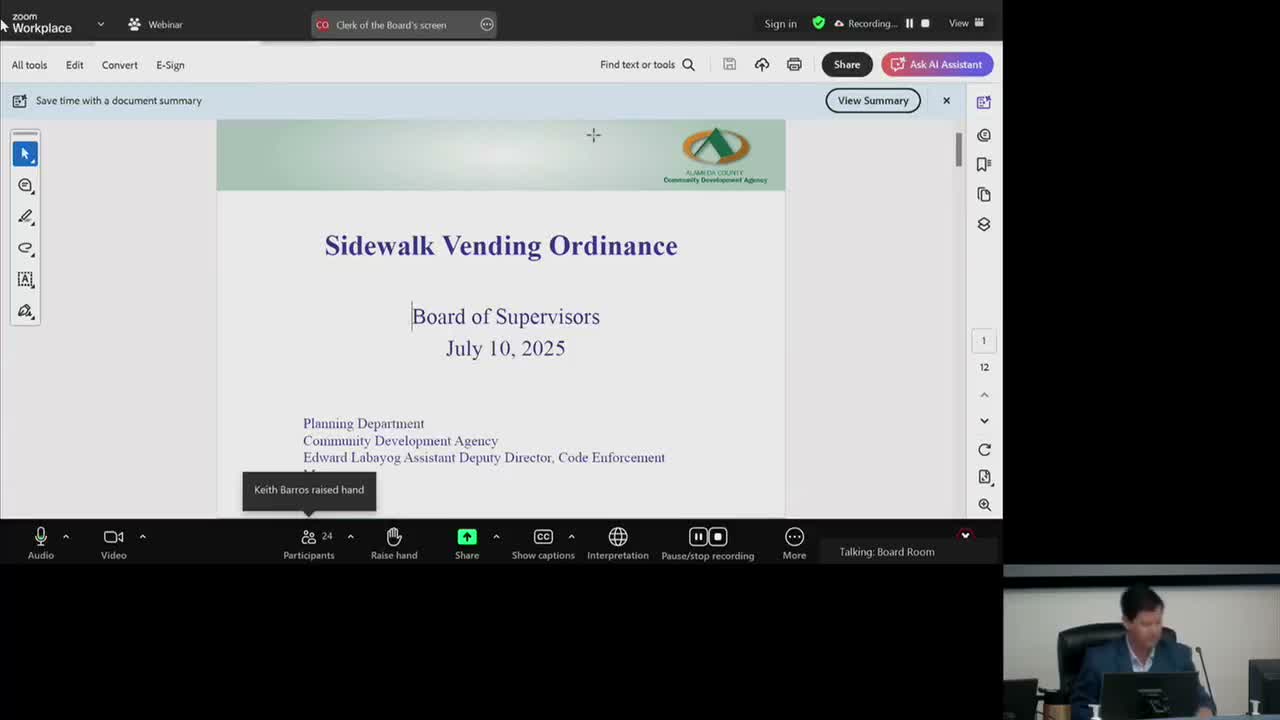
Ed Labayag, the county’s Code Enforcement Manager, told the board the ordinance aims to align local rules with state laws (SB 946 and SB 972) by focusing on objective health and safety standards while encouraging vendor compliance through an accessible permitting system. Labayag summarized key elements in the draft: permit issuance by the Planning Department, business‑license and liability insurance requirements, buffer zones near schools and intersections, a 4‑foot pedestrian clearance, explicit ADA protections, prohibited product categories (alcohol, cannabis, tobacco, obscene material), and an education‑first enforcement approach followed by escalating fines allowed by state law.
Environmental Health staff said food vendors will first need environmental health approval before obtaining a sidewalk vending permit and that the local requirement for restrooms (typically within about 200 feet) will be handled in the environmental health application. Antonio Gold of Environmental Health described coordinated enforcement steps (education followed by joint field responses with code enforcement and the sheriff when necessary) and acknowledged after‑hours enforcement presents staffing and safety challenges.
Public commenters urged clearer definitions and transparency. Keith Barrows asked that roaming hours be corrected in draft language (the draft currently read as allowing roaming only between 6 p.m. and 9 a.m., which he said was the inverse of the intended hours) and called for public disclosure when administrative fee waivers are granted. Jorge Espinosa, a payroll business owner, asked for a finer distinction between protected street vendors and larger pop‑up operations that involve grills and tables.
Supervisors asked staff to develop accessible permitting options (one‑stop in Hayward or pop‑up kiosks), translation and outreach strategies, and clearer fee and waiver processes. Several supervisors asked for follow‑up reporting on enforcement capacity, staffing costs and how economic development programs might help vendors transition to brick‑and‑mortar businesses.
The board voted to waive the full second reading and introduce the ordinance for first reading, with direction to post implementing regulations online for public comment and to refine fee and outreach proposals. The motion passed on a roll call vote; Supervisor Fortunato Bas was excused.