Get Full Government Meeting Transcripts, Videos, & Alerts Forever!
Get email alerts on the Climate Action Plan topic
No spam. Unsubscribe anytime.
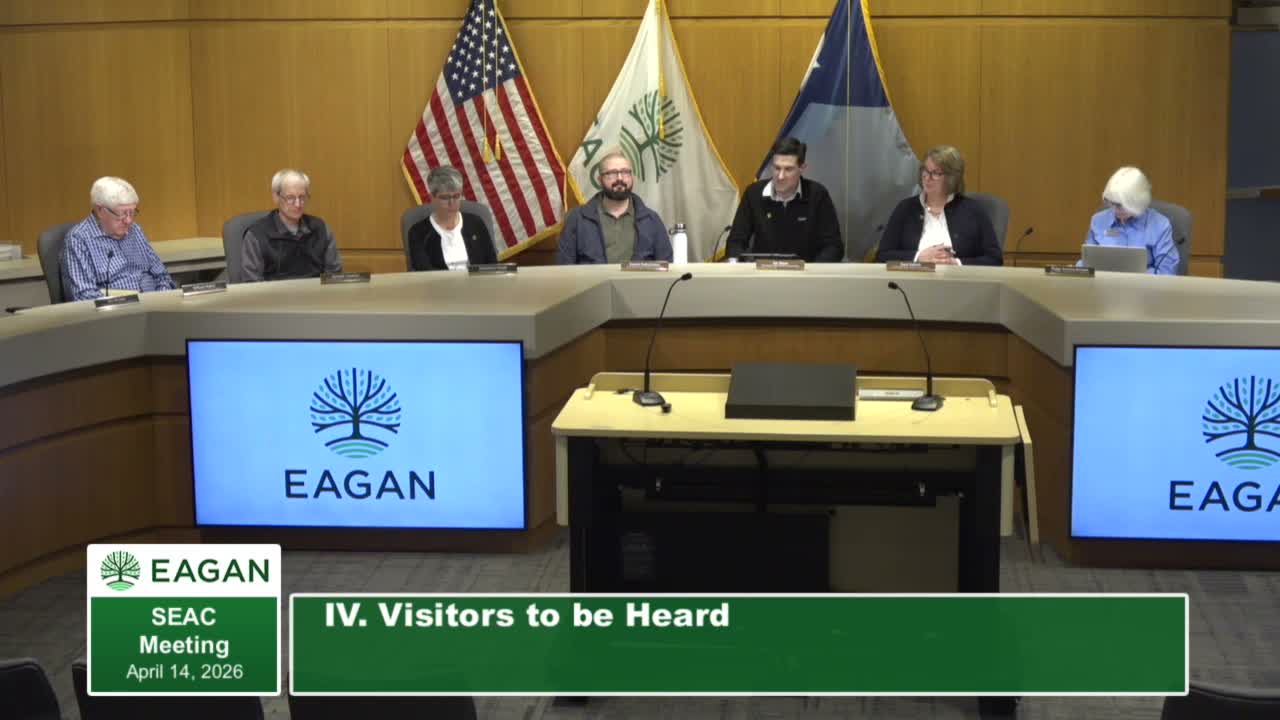
Eagan sustainability staff outline climate action progress, utility partnerships and outreach plan
Summary
City sustainability staff told the Sustainable Eagan Advisory Commission on April 14 that the city's 10-year Climate Action Plan is underway with actions in eight sectors, utility partnerships and new public resources; staff highlighted measurable progress in several sectors while noting gaps in tracking for others.
The Sustainable Eagan Advisory Commission on April 14 heard a detailed status update from the city's sustainability coordinator on implementing Eagan's 10-year Climate Action Plan, adopted roughly one year ago and designed to reduce greenhouse gas emissions 55% by 2035.
Coordinator Catano summarized a phased, two-year implementation approach and walked commissioners through progress across eight plan sectors. Staff reported many actions are underway or complete in buildings and energy, green space, health, transportation and waste; however, several targets still lack baseline data for tracking progress.
Catano said staff is working to ‘‘build internal capacity, launch foundational programs, engage the community and prepare for scaling up in phase two.’’ On buildings and energy, the city aims to raise customer-owned renewable energy from about 1% to 10% of citywide electricity use by 2035. Catano reported 402 on-site renewable installations in Eagan and nearly 650 electricity accounts purchasing renewable energy; she said staff is developing methods to convert those counts into a citywide percentage.
The coordinator described a new utility partnership structure involving four local energy companies (two electric providers and multiple gas providers) that meets quarterly to align programs. One product of that work is a decision tree and QR code residents can use to find home energy audit resources. Catano also said staff plans an incentive program to match some utility rebates, but that action is not yet in progress.
On fuel switching, the plan sets a 15% communitywide electrification target by 2035. Catano said staff has no established baseline for that metric yet and is pursuing education and workshops through a partnership with the Center for Energy and Environment and the Electrify Everything Minnesota program, including a four-workshop series slated for fall 2026.
Municipal operations are a central focus: staff is targeting a 7.5% electricity reduction and 12.5% natural gas reduction across city buildings by 2035, and an audit of all facilities is planned by 2028. Catano said municipal energy usage rose slightly from 2024 to 2025 and that an energy management standard operating procedure and audit schedule are in place to improve tracking.
The city has also set fleet-conversion goals. Staff reported roughly 10 electric vehicles in the municipal fleet (about a dozen nonemergency vehicles) and a draft fleet study that staff leadership will review in April and present to the City Council in May with recommended transition steps.
In green-space goals, staff described a target of a 10% tree canopy increase and noted a roughly 3.5% decrease in canopy from 2024 to 2025. Catano cited emerald ash borer as a likely factor and said staff will follow up with forestry staff to clarify causes and recovery strategies. Actions to expand tree sales, public education and an urban forestry management plan are scheduled, with a citywide canopy assessment to recur every 10 years (start window provided in the presentation as 2026'027).
Staff also highlighted a 5% target for native prairie conversion, work on a Central Park pilot, and the rollout of an updated managed-landscaping permit to align local rules with recent Minnesota legislation that expanded resident eligibility for alternative landscapes.
On waste and organics, Catano noted Dakota County is studying curbside organics collection consistent with a Minnesota requirement for cities over 5,000 residents by 2030; Eagan's most recent organics diversion rate was reported at 30%, and staff is evaluating potential drop-off sites and county partnerships to increase diversion.
Water-conservation efforts include a residential per-capita reduction target of 5% (no specific target year in the plan); Catano said residential water use has risen about 3% in the last two years and that staff is expanding education and grant programs to encourage conservation. Stormwater and integrated planning are also being updated to reflect current climate modeling.
Catano emphasized community engagement: staff tallied more than 36,000 points of engagement in 2025 through events, the Sustainable Eagan Academy and communications, and is developing a condensed resident-facing printed guide as well as an interactive climate-action webpage expected to launch in 2026.
Commissioners praised the work and asked clarifying questions; one commissioner asked whether the emerald ash borer-related losses were included in the canopy calculation and Catano said she would follow up with forestry staff to confirm. The meeting closed with staff recognition of departing commissioners (Robichaud, Patrick, Visatka, Hook and an absent Nikolai) and a listing of upcoming events including an Earth Day celebration at Blackhawk Park, an April 23 Sustainable Eagan Academy session at Westcott Library and partner events through late spring and early summer.
Procedural items: the commission approved the meeting agenda and the Feb. 10 minutes by voice vote at the start of the meeting and later moved to adjourn by voice vote.