Get Full Government Meeting Transcripts, Videos, & Alerts Forever!
Get email alerts on the Consent Searches topic
No spam. Unsubscribe anytime.
Council hears early data on consent searches; department says use is rare but racial gaps merit study
Summary
Montgomery County Police reported 134 consent-search requests in a six-month rollout tied to a new app; 119 were granted and two firearms were recovered. Staff and council members agreed data are too limited for firm conclusions and urged longer analysis and possible academic partnerships to study racial disparities.
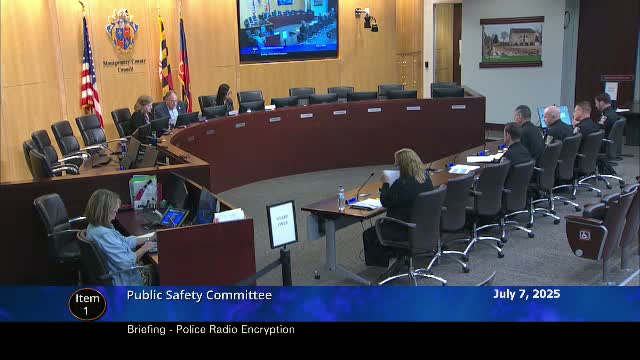
Montgomery County police briefed the County Council’s public safety committee on July 7 about their consent-search policy, which requires officers to advise motorists of the right to refuse, record consent interactions in a new app, and undergo supervisory review.
Chief Mark Yamada said the department has strengthened training, documentation and oversight to ensure searches are voluntary and constitutional. “Our goal as chief is to ensure the constitutional rights of the community members are upheld,” he told the committee.
What the six-month app data shows: department presenters reported 134 consent-search requests recorded in the app over six months; 119 of those requests were granted, and two firearms and other contraband were recovered. That represents consent being sought in roughly 0.45% of traffic stops during the period, the briefing said. The department also said about 43 officers used the tool out of several hundred patrol officers.
Oversight and complaints: presenters said complaints referencing consent searches were few. For 2024 there were six complaints in which a consent search was part of the interaction; four went to the Advisory Commission (ACC) and were exonerated, two remained under adjudication. In 2025 two additional complaints were open and under investigation.
Racial disparities and statistical limits: Council staff noted racial patterns in the small dataset and recommended further analysis. A council analyst summarized early hit-rate comparisons across race categories and said the small sample makes statistical significance unlikely at this stage; she and department leaders recommended a longer window and potential academic partnerships to develop robust benchmarks and regression analyses.
Training and practice: commanders said consent-searches are used infrequently and are often performed by specialized teams (DCAT/SAT) with focused training; body-worn cameras, the new app, supervisory review within five working days, and random video audits together support oversight. Commanders and council members discussed best practices for documenting reasonable articulable suspicion, and department staff said officers are taught to narrate key observations on body cameras when safe and practicable.
What’s next: the department said it will complete a 12-month analysis and continue training and app refinements; the committee asked for continued updates, recommended monitoring complaint pathways to ensure accessibility, and discussed whether additional resources are needed for redaction and public records processing.