Get AI Briefings, Transcripts & Alerts on Local & National Government Meetings — Forever.
Glendale staff detail grid‑preparedness plan, mobile substation and how they would weigh large data‑center requests
Summary
Glendale Water and Power staff told commissioners they are balancing feeders, upgrading transformers and seeking a 15 MVA mobile substation to respond to outages and support electrification; staff said two exploratory data‑center inquiries (about 50 MW and 25 MW) would require major transmission work and possibly new rate classes.
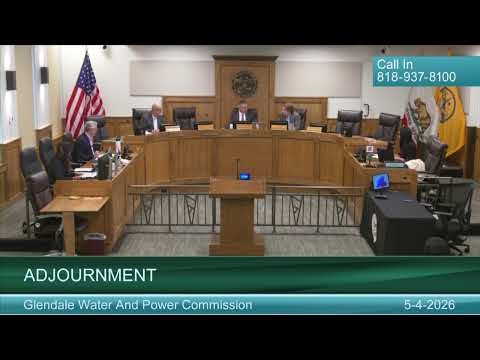
Ofse Bakhardarian, Glendale Water and Power’s electrical engineering manager, told the commission at its May 4 meeting that staff are pursuing a three‑part load‑planning approach—substation balancing, feeder transfers and transformer‑level monitoring—to keep the system reliable as electrification increases. He said SCADA and PI Vision tools flagged phase and transformer imbalances that crews correct with targeted outages and equipment upgrades.
Bakhardarian said crews are also pursuing a mobile substation procurement to give the utility flexible capacity during emergencies and planned upgrades. The unit being procured is a 15 MVA mobile substation that staff estimate could enter service by 2028; an engineering estimate supplied at the meeting put the project baseline at about $3.2 million and bid closing occurred the same day. “This option gives us a flexible, movable transformer that you can deploy at the site where we have a lost transformer and connect it to the grid,” Bakhardarian said.
Commissioners asked how Glendale would handle substantial new loads. Staff said the utility has approved smaller customer projects—13 projects totaling about 8.25 MW—but that two exploratory data‑center inquiries (one for roughly 50 MW and another for roughly 25 MW) are still at the preliminary stage. “At this point it’s exploratory,” Bakhardarian said. He and other staff explained that Glendale’s 4 kV and 12 kV distribution system cannot serve hyperscale data‑center loads without subtransmission or transmission interconnections and significant substation upgrades.
When commissioners asked who would pay for upgrades, staff said the standard model is that developers pay interconnection and required upgrade costs; the utility could also consider a dedicated rate class for very large, continuous loads. A city staff member noted that planning‑stage applications can be subject to public‑records requests but that account‑level or meter usage data remain confidential under the Public Records Act.
Public commenter Kate Unger, who identified herself during the meeting’s public‑comment period, urged commissioners to seek more information on potential data centers—asking about likely load profiles, whether centers would support artificial‑intelligence workloads, on‑site backup generators and how residents would be informed. “This is not something we should just take lightly,” Unger said.
Commissioners and staff also discussed managed‑charging strategies to reduce peak requirements at transit depots and for multifamily housing, proactive transformer replacement and the need to map feeder capacity before issuing privatized EV‑charging RFPs. Staff said an RFP for privatized EV‑charger infrastructure is planned and that they intend to identify feeder locations with available capacity for vendors, while also considering social‑equity distribution.
The meeting produced no formal action on data‑center policy; commissioners asked staff to bring more information back and suggested the city council may need to consider broader policy and permitting implications if such projects move forward.
Next steps: staff said they will review procurement bids for the mobile substation, continue transformer and feeder monitoring, and return with more details if a developer’s proposal for a large load becomes formal.