Get Full Government Meeting Transcripts, Videos, & Alerts Forever!
Get email alerts on the Emergency Services topic
No spam. Unsubscribe anytime.
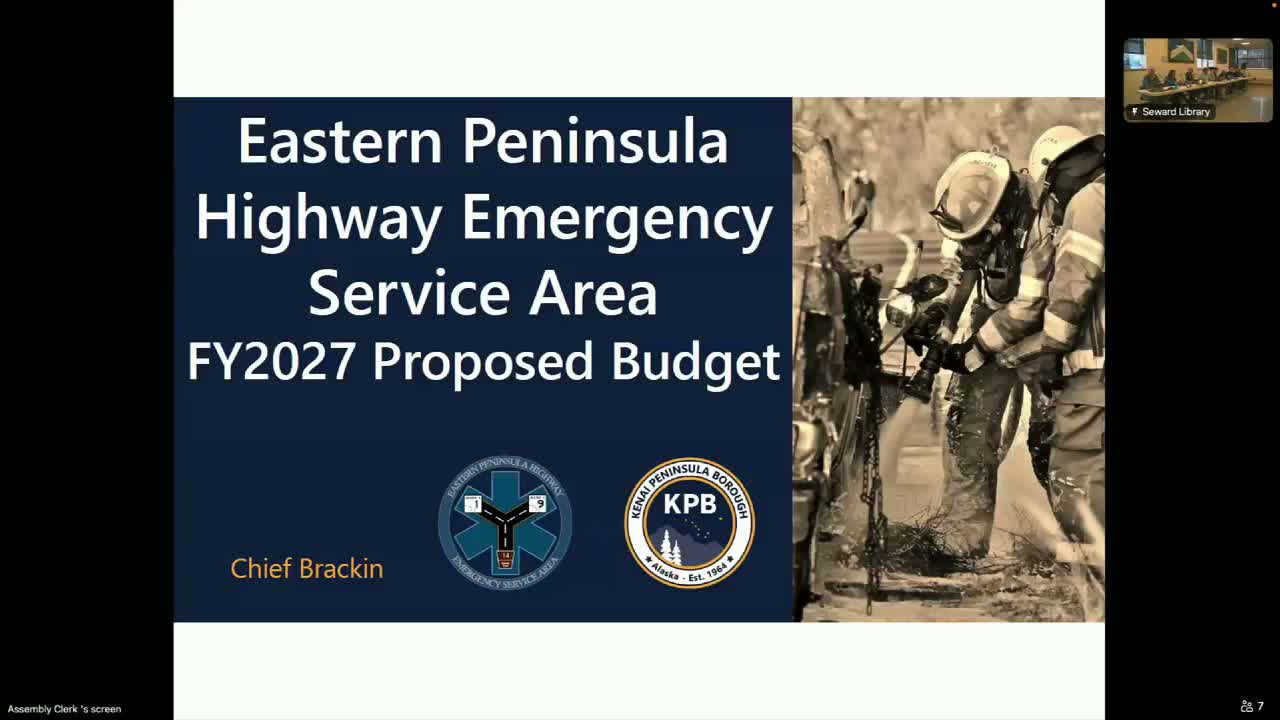
Chief Bracken presents AFISA FY27 plan: tiered payouts and benchmark stipends for highway response
Summary
Chief Richard Bracken outlined the Eastern Peninsula Highway Emergency Service Area (AFISA) FY27 budget and program structure, explaining PILT funding, a six‑segment response plan along about 103 miles of highway, tiered incident payouts ($300/$600/$800) and a $5,000 benchmark stipend for interior agencies that meet a sub‑15‑minute dispatch benchmark.
Chief Richard Bracken told the assembly that the Eastern Peninsula Highway Emergency Service Area (AFISA) provides coordination and financial performance incentives across roughly 103 miles of highway on the Kenai Peninsula’s east side and that AFISA is funded by payment in lieu of taxes (PILT).
Bracken described AFISA’s structure: a contracted 0.55 FTE split between two Bear Creek employees, a five‑member service area board serving three‑year terms and a six‑segment response plan. He explained a tiered payout schedule intended to incentivize response: $300 for initial first‑responder actions, $600 for transport, and $800 when extrication or fire suppression is required. Bracken said interior agencies receiving these incentives include Cooper Landing, Hope, Moose Pass and Seward Volunteer Ambulance Corps.
The presentation emphasized performance incentives: a time benchmark (currently under 15 minutes from call to apparatus departure) qualifies interior agencies for a $5,000 mid‑year payout; this year all four interior agencies met the benchmark and received stipends. Bracken said AFISA’s discretionary stipend program may also reward agencies that consistently meet benchmarks by January 1.
On new initiatives, Bracken said AFISA wants to match legislative requests to construct a communications tower under the Turnagain Pass communications segment and to start a three‑year grant program to establish adequate water sites in Cooper Landing, Hope and Moose Pass. He emphasized that communications improvements and consistent coordinated responses remain ongoing priorities.
Assembly members asked whether mileage from a planned Cooper Landing bypass could be included in AFISA; Bracken said he intends to add that mileage into the service area and make Cooper Landing the primary responding partner for that segment. Members also clarified AFISA has no mill rate and is funded via PILT.
No formal action was taken at the work session; the presentation was followed by questions and comments from assembly members.