Get Full Government Meeting Transcripts, Videos, & Alerts Forever!
Get email alerts on the Environment topic
No spam. Unsubscribe anytime.
Kenai Peninsula partners outline elodea treatment at Crescent Lake, warn of 2027 funding gap
Summary
KP CISMA partners told the assembly they treated about 41 surface acres of elodea at Crescent Lake in 2025 using diquat and fluridone, monitored minimal non‑target impacts, but said existing grant funding will not cover a needed third treatment in 2027 and they are seeking nonfederal matching funds.
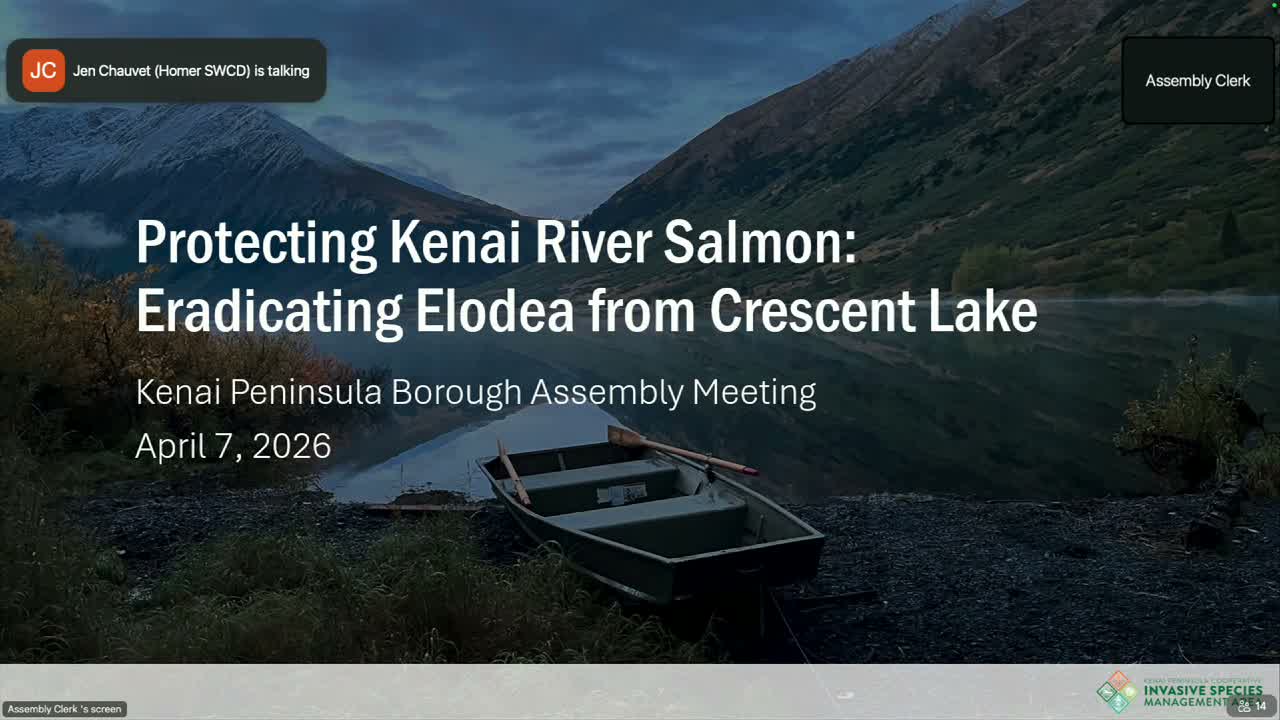
Jen Chauvet of Homer Soil & Water (KP CISMA), Peter Frank (Chugach National Forest) and Cody Jacobson (Alaska DNR Division of Agriculture) briefed the assembly on the discovery and treatment of invasive elodea at Crescent Lake.
Chauvet said the peninsula first documented elodea in 2012 and that a previously unknown population was found at Crescent Lake in 2023, with infestations covering roughly 11 acres in the western half and outlet. The partnership developed a treatment plan in 2024 and secured Alaska Sustainable Salmon Fund money to begin spot treatments in 2025.
Jacobson described the 2025 treatment logistics: crews spot treated approximately 41 surface acres across three zones (northern bay, southern, and the outlet), using diquat as a contact herbicide to knock down biomass followed by fluridone (a systemic herbicide) to treat roots, with repeat applications spaced about three weeks apart (three treatments total). The outlet received a liquid treatment (Sonar A.S.) applied via a drip unit. Because the work is remote, product and crews were transported by float plane; Jacobson said roughly 6,000 pounds of herbicide pellets were distributed by electric spreaders during the season.
Monitoring reported high efficacy and minimal non‑target impacts; post‑treatment water sampling maintained herbicide concentrations well below EPA drinking‑water limits, and no harmful residues were found in fish flesh, Jacobson said: "They are safe to eat." Frank added that surveys of downstream Crescent Creek found no rooted elodea during final late‑August inspections.
Presenters told the assembly the 2025 work would need follow‑up in 2026 and another treatment year in 2027 to achieve eradication. Chauvet said the current funding package does not cover the third year and the partnership is seeking nonfederal match and additional grants to complete the work. She urged local support and suggested the borough could help identify match sources or in‑kind contributions.
Why it matters: Crescent Lake connects to Quartz Creek and the Kenai River watershed; partners warned that unchecked downstream spread could threaten aquatic habitat, salmon resources, subsistence uses and local economies.
Ending: Presenters left contact information and materials and asked for help locating additional match funding; no formal assembly action was taken at the meeting.