Get Full Government Meeting Transcripts, Videos, & Alerts Forever!
Get email alerts on the Emergency Services topic
No spam. Unsubscribe anytime.
Austin Fire Department: fewer calls after reclassification; vacancies remain a focus
Summary
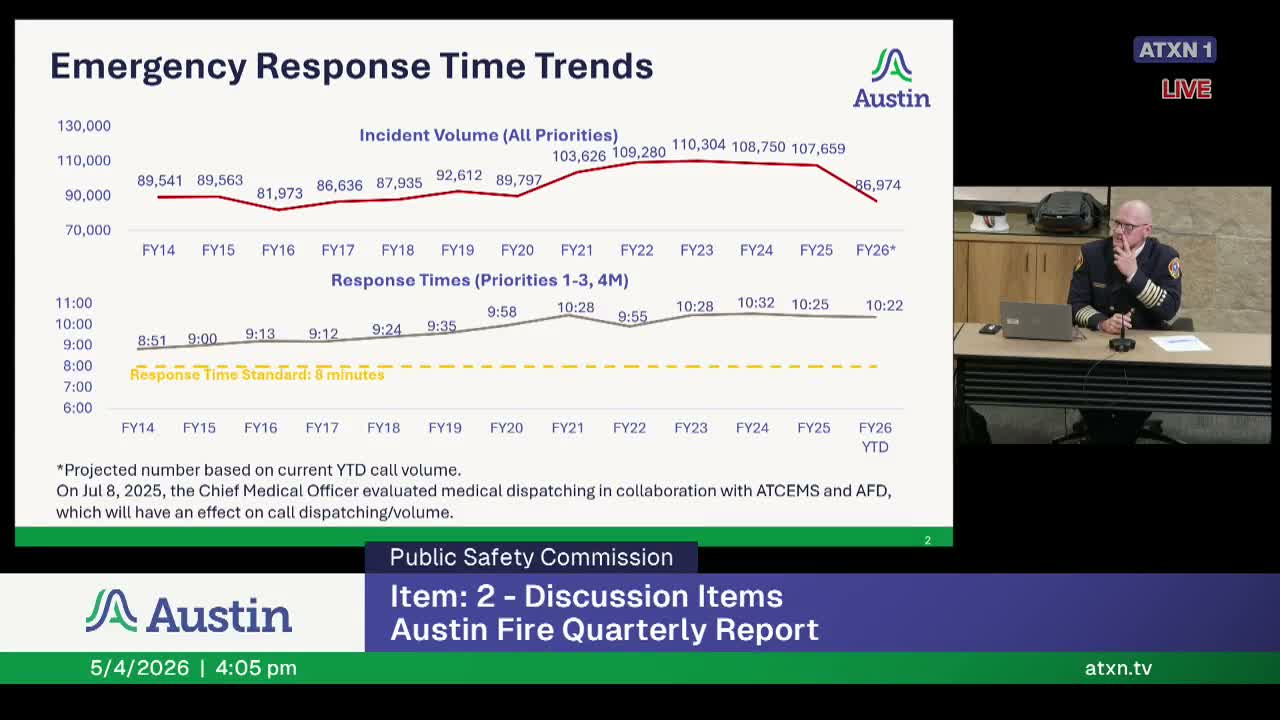
Assistant Chief Tom Bokey told the commission AFD expects roughly 20,000 fewer calls this year after EMS call reclassifications and said median response time is ~10:22; staffing vacancies (54 sworn) and station refreshes were discussed along with outreach to people experiencing homelessness.
Assistant Chief Tom Bokey, chief of staff at the Austin Fire Department, presented the department's quarterly report and highlight trends in emergency response and staffing.
Tom Bokey said the department expects to run about 20,000 fewer calls this year, largely as a result of changes to call priorities implemented with the medical director's office. "We think that's going to reduce our total call volume by around 20,000 for the year," he said, and reported a median response time of about 10:22.
Bokey described completed remodels at Fire Stations 17 (South 1st Street) and 33 (Northwest Austin) and said three additional stations are planned or will start construction soon, including Station 6 on South Congress. He reviewed automatic aid examples (including a large fire near Decker Lake that mobilized units from ESD 11 and Manor Fire), arson‑investigation clearance rates (~44% in the last quarter), and community outreach efforts including partnerships with the Red Cross for smoke‑alarm installations.
On staffing, Bokey reported 54 sworn vacancies (civilian vacancies reported at three) and described recruiting efforts including lateral hiring and an academy class targeted to start in July. Commissioners asked for more detail on Narcan distribution metrics and outreach touch points for people experiencing homelessness; Bokey clarified that the Narcan map shown reflected locations where Narcan was administered, not a distribution count, and said AFD coordinates with the Homeless Strategy Office for outreach and trainings.
David Gerard, president of the Austin Firefighters Association, told the commission that fully funding AFD is a public‑safety imperative and urged the city to honor labor agreement commitments that codify staffing levels. Gerard also warned that a city IT centralization effort (OATS) could inadvertently move critical GIS and prevention staff out of AFD operations, potentially affecting wildfire and prevention work.
The commission requested follow‑up reports with data on Narcan administration versus distribution, outreach touch points for unhoused populations, and more specifics on recruiting goals for female firefighters and the schedule‑reduction plan tied to the collective bargaining agreement.