Get Full Government Meeting Transcripts, Videos, & Alerts Forever!
Get email alerts on the School Construction topic
No spam. Unsubscribe anytime.
CUSD 201 officials present plan to build new K–5 at Miller site, trade Manning property to offset costs
Summary
CUSD 201 officials described a proposal to consolidate elementary grades into a new K–5 school at the Miller site, financed partly by selling or exchanging the Manning property and long-term tax-increment financing (TIF) benefits. Officials estimated a roughly $70 million build cost, cited $600,000 annual operating savings and sought public feedback on displacement and development concerns.
CUSD 201 officials laid out a proposal to replace two elementary campuses with a single K–5 school at the Miller Elementary site and to use proceeds from the Manning property and future downtown tax-increment financing (TIF) to help offset costs.
A district official opened the meeting by framing it as a community listening session and said the plan is preliminary: "No decisions have been made, but we want to get input," the official said. The district described the Miller option as the product of years of study and public feedback and said earlier concerns about eminent domain and traffic helped steer other possibilities in past years.
Spencer Parker, assistant village manager, described how a downtown TIF could contribute long-term revenue: "We're looking at saying that potentially, that would be roughly $800,000 that would be going to the government to support the services they provide to all of you without increasing your taxes," Parker said, adding the money would eventually flow to the schools, library, parks and county once development investments are repaid.
Rob, an architect from Leggett hired to test-fit the site, presented a conceptual layout for a roughly 90,000-square-foot, two-story school with classrooms on two floors and a gym, cafeteria and support spaces. "The intent is to tear it down and build a brand new building," Rob said, explaining the plan sites the new building to allow the existing middle school to remain operational during construction and locates parent drop-off, bus access and staff parking to reduce traffic impact.
Officials repeated a planning-level estimate of about $70 million to build a new Miller-area K–5 in 2026–27 and said renovating both existing elementary buildings would cost an estimated $45–50 million each in aggregate with greater long-term maintenance risk. A district official argued consolidation would reduce maintenance and utility costs and result in lower staffing through attrition, producing operating savings the district estimated at about $600,000 per year.
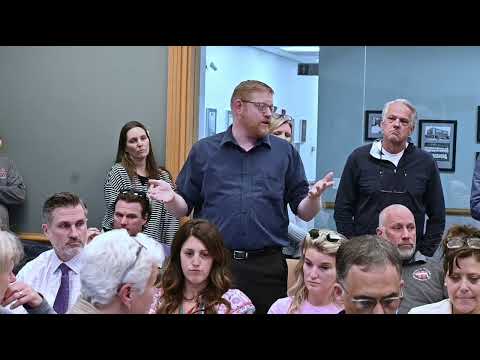
Not all residents embraced the plan. One longtime educator who identified herself as having worked in education since 1999 warned that acquiring seven single-family homes for the expanded Miller footprint would displace affordable single-family housing in the township: "If we were to buy the same home today... our mortgage would increase by $1,000 a month, which is not tenable," she said, urging officials to explore alternatives that preserve single-family homes.
The district acknowledged those concerns and said preliminary outreach suggested five of the seven property owners were "very amenable," one was "still considering" and a seventh had not yet been reached. Officials also emphasized that a formal TIF and developer investment would be required for long-term revenue, and that the $800,000 figure described by the village is a long-term estimate, not an immediate cash infusion.
Joe Smith, introduced by the district as a person with fiscal experience, summarized the financial dilemma facing the district: "We can't bail ourselves out of this situation with the funding we have available," he said, arguing the district’s options are limited to expensive full renovations of aging buildings or a larger upfront investment in a new consolidated facility that would generate operating savings over decades.
Officials said no referendum or formal vote had been scheduled; they invited residents to provide contact information for follow-up, announced a subsequent Zoom meeting, and took an informal show-of-hands to gauge support. The district emphasized the plan remains preliminary, that negotiations or appraisals for the Manning property were not complete, and that decisions would follow further study and public input.
What happens next: the district will continue stakeholder outreach, refine cost estimates and hold additional public meetings; officials said a November referendum could be an option but no final decision about timing or ballot measures had been made.