Get Full Government Meeting Transcripts, Videos, & Alerts Forever!
Get email alerts on the State Legislation topic
No spam. Unsubscribe anytime.
County hears Annapolis wrap-up; officials flag attorney‑fee and assessment risks in new state laws
Summary
County legislative representatives Steve Wise and Bruce Beriano briefed Caroline County commissioners on key 2026 state laws, raising concerns about prevailing‑party attorney‑fee language in a new state voting‑rights act and possible fiscal impacts of changes to agricultural assessment rules for community solar.
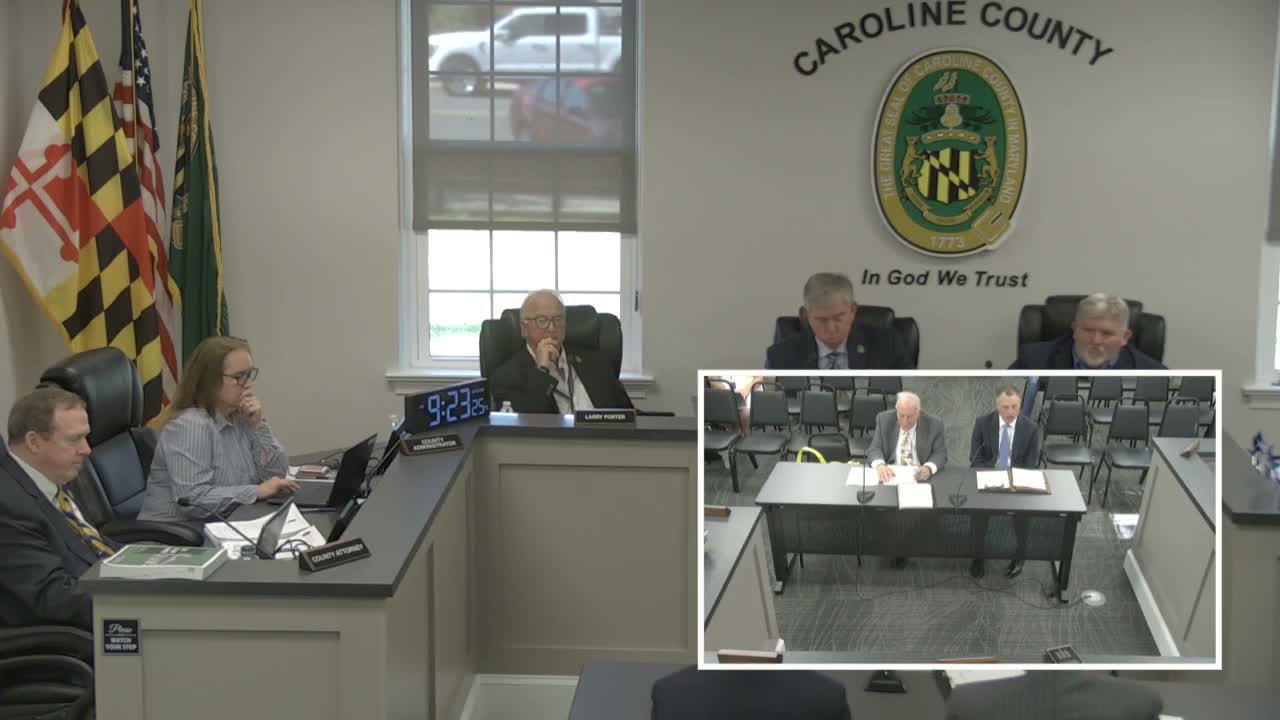
Caroline County commissioners heard a legislative wrap-up on May 5 from the county’s Annapolis representatives, who summarized several 2026 state bills and warned of potential costs for local governments.
Steve Wise, who represents the county in Annapolis, described two county-requested housekeeping bills that passed this year (cleaning up dog‑licensing language and clarifying who serves as the county’s liquor inspector) and said the delegation helped get them introduced. He also highlighted a newly enacted Maryland voting‑rights statute and flagged a provision allowing courts discretion to award attorney fees to the prevailing party. Wise said that provision could expose counties to significant legal costs if sued and losing plaintiffs obtain fees. “The attorney’s fee provisions in that bill … it’s a prevailing‑party provision,” he said.
Bruce Beriano, the county’s other Annapolis representative, said the Maryland Supreme Court’s decision issued the day after the state law was signed may affect how the law operates in practice, but county officials should watch the law closely. He also pointed to recently passed measures affecting school board compensation and an extension of certain agricultural assessment rules tied to community solar through 2030 (Senate Bill 734), which could change property‑tax treatment in agricultural zones.
Commissioners expressed concern about state preemption and cost shifting. Commissioner Porter said the trend toward statewide mandates risks imposing costs and structural changes on counties, and he described efforts to protect county governance structures and fiscal stability. Chair Jay Travis Breeding asked staff to follow up on the solar/agricultural assessment language to understand any revenue implications: “If it goes into a commercial assessment and they delay that by 5 years, we could be talking about…property‑tax revenue that we’re foregoing,” he said.
Representatives repeatedly urged the county to monitor interim task forces created by the legislature — including a task force to modernize county and municipal revenue structures — and to coordinate with local governments’ associations. Beriano recommended that county staff and legal counsel continue evaluating legislative language that could require county action or expose the county to new liabilities.
The presentation included Q&A about septic permitting and housing policy; commissioners and representatives agreed staff would follow up on specific bills and report back to the board. The session concluded with thanks to the two representatives for their work in Annapolis.