Get Full Government Meeting Transcripts, Videos, & Alerts Forever!
Get email alerts on the Sewer Rates topic
No spam. Unsubscribe anytime.
Waterloo outlines wastewater projects — including a $10M anaerobic lagoon — and proposes 5% sewer-rate increase
Summary
Public Works described multiple wastewater projects (emergency East Side interceptor repair, anaerobic lagoon redesign, lift station reconstructions and plant upgrades) with multi‑million dollar price tags; Finance Director Bridget Wood proposed a 5% annual sewer rate increase (about $1.99/month) to fund operations, reserves and capital work.
Public Works and finance officials told the Waterloo City Council on May 4 that a series of wastewater projects — some already underway — justify continuing a 5% annual sewer-rate increase.
Randy Bennett, Public Works Division Manager, reviewed active and planned work: an emergency sewer repair on the East Side interceptor (Nevada Street) following a partial collapse; design work and planned rehabilitation of an anaerobic lagoon (constructed in the 1990s, used heavily by major industrial users such as Tyson); reconstruction of the Cattle Congress lift station (originally installed in 1961); Airline Highway lift-station and force-main work to serve growth near that corridor; and a multi-stage liquid-improvements and nutrient-reduction program for the treatment plants.
Bennett gave cost estimates for major pieces: the anaerobic lagoon design and rehabilitation is "just a little over $10,000,000," the Cattle Congress lift station project estimate is about $3,000,000, and the Airline Highway project is approximately $3,600,000 (with some support anticipated from TIF). He said the larger plant treatment-side upgrades had been studied previously and that design work on parts of that program would be about $3,000,000 with a total program estimate previously in the range of about $50,000,000 for the portions discussed.
"We are really close to finalizing the vendor" for a biogas element tied to the lagoon project, Bennett said, adding that capturing biogas royalties could offset operating costs.
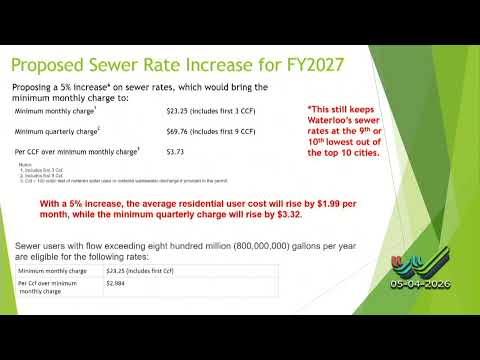
Finance Director Bridget Wood proposed a continued 5% annual sewer-rate increase to maintain operating funding, increase reserves and reduce the need for debt financing. Wood said the 5% increase equates to roughly $1.99 per month for a typical residential account and noted that moving to monthly billing (from quarterly) changes the appearance of convenience fees that customers have raised concerns about.
Councilmembers asked whether the water and sewer charges would be combined on the same monthly bill and whether convenience or electronic-withdrawal fees would apply; staff confirmed the utility bill would be combined and that the convenience fee structure referenced by constituents is a Water Works billing policy and not a council-set fee. One councilmember said residents were concerned the monthly convenience arrangement could add about $36 per year compared with prior quarterly billing; staff noted that convenience-fee mechanics are determined by Water Works.
Wood said even with the 5% increase the city would remain among the lower sewer rates for comparable Iowa cities in the top 10. Council did not take a vote on the rate at the work session; staff will proceed with planned follow-up materials and outreach.
The meeting adjourned after the sewer discussion.