Get Full Government Meeting Transcripts, Videos, & Alerts Forever!
Get email alerts on the Land Development Sps topic
No spam. Unsubscribe anytime.
Abington commissioners weigh SPS Technologies’ waiver request as residents press for creek access and enforceable conditions
Summary
The Abington Board of Commissioners heard a lengthy presentation from SPS Technologies and its design team on a waiver of land development for a rebuilt manufacturing campus after last year’s fire; residents and advisory commissions urged conditions to preserve creekside corridors, require enforceable environmental measures and memorialize community access discussions.
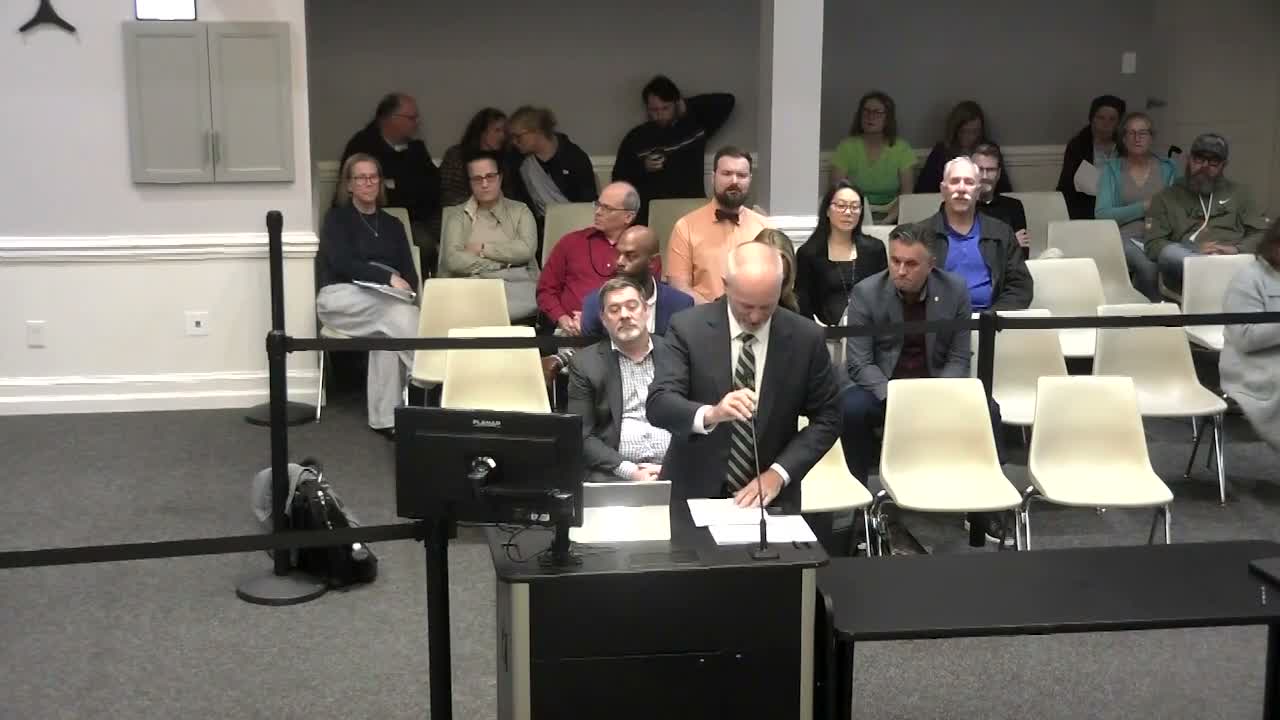
Rob Lewis, counsel for SPS Technologies, told the Abington Township Board of Commissioners on April 30 that the company seeks a waiver of land development to expedite reconstruction after a "catastrophic fire" that "effectively destroyed SPS" and to rebuild a modern, code-compliant facility on about 20 acres south of Highland Avenue. Lewis said the waiver accelerates procedural steps but does not forgo compliance with the township's substantive ordinances and that SPS has worked with township staff, consultants, the Shade Tree Commission and the Environmental Advisory Council (EAC).
Kyle Litsky of PRECIS, the project's architect, presented site plans showing a reduced footprint (from roughly 414,000 sq ft to about 344,000 sq ft), expanded landscape buffers and stormwater management interventions. "The roof has about 188,000 square feet of solar panels," Litsky said, adding that the design covers roughly 85% of the roof with solar and pursues LEED certification and bird‑friendly glass. He described underground basins and above‑grade bioretention areas to control runoff and improve water quality where none exist today.
Residents and advisory‑board representatives urged the board to make SPS’s commitments enforceable and to preserve public‑access options along the Tookany/Tucanee Creek corridor. Patricia Gallagher, co‑chair of the Shade Tree Commission, said the STC’s latest review letter (March 16) recommends conditional approval "contingent on SPS meeting all the conditions set forth in our review letter" and asked that the board formally document those conditions in any approval.
Ross Abel, representing a Tiffany Creek/TTF working group, asked the board to require three conditions before a final vote: preserving the widest feasible corridor along the creek, avoiding design choices that would foreclose future restoration or public access, and ensuring a good‑faith process discussion with the township and partners about the plausibility of future restoration or easements. Abel said that without clear, written conditions, current design choices could "foreclose future restoration, maintenance access, and any realistic public greenway option."
Several commissioners pressed SPS on enforceability and plan detail. Commissioner Weingrad said she wanted to see consultant recommendations and commitments written into plan sheets and recordable documents rather than as informal promises. Rob Lewis and SPS’s team said the final, enforceable improvements will be shown on resubmitted plan sheets and incorporated into the land development agreement; the township engineer, Cal, confirmed that improvements must be shown on the plan and can be enforced through the land‑development agreement and the plan recordation and that the project will not be closed out until required improvements are implemented.
Board members also raised operational concerns. Vice President Vahey asked that construction detours be communicated in advance and requested that work not start before 7 a.m. Vahey also asked about chemical storage safety; SPS replied that hazardous materials will be stored in a prefabricated, four‑hour fire‑rated enclosure with spill containment and that the reconstruction includes safer containment than the prior site.
Commissioner Spiegelman said SPS’s parent company, Precision Castparts, indicated willingness to provide a community relations contact and to allow controlled, conservation‑oriented access for groups such as watershed partners, potentially memorialized in a memorandum of understanding. SPS representatives characterized planned access as controlled for safety and security reasons and said a separate Phase 2 of the project (north of Highland Avenue) could be the area for additional community benefits such as trails or park improvements, but that Phase 2 is approximately two years away.
President Hecker said the item will return to the board in May for a vote after SPS resubmits plans that respond to outstanding consultant comments. No waiver vote or final land development approval occurred at the April 30 meeting.
Ending: The presentation and Q&A spanned multiple commissioners' concerns about enforceability, stormwater and creek stewardship; the board directed staff to continue review and scheduled the item for a forthcoming meeting in May.