Get AI Briefings, Transcripts & Alerts on Local & National Government Meetings — Forever.
Shoreline council hears frustration after Meridian bike lane removed from TIP as staff cite grant- and capacity-related constraints
Summary
At a May 4 public hearing on the 2027–2032 Transportation Improvement Plan, residents and councilmembers pressed staff after the Meridian Avenue bike lane was removed from the TIP when the city returned a near‑term federal grant the city could not deliver on due to staffing shortages; staff said the grant window was missed and the city can reapply in the next cycle.
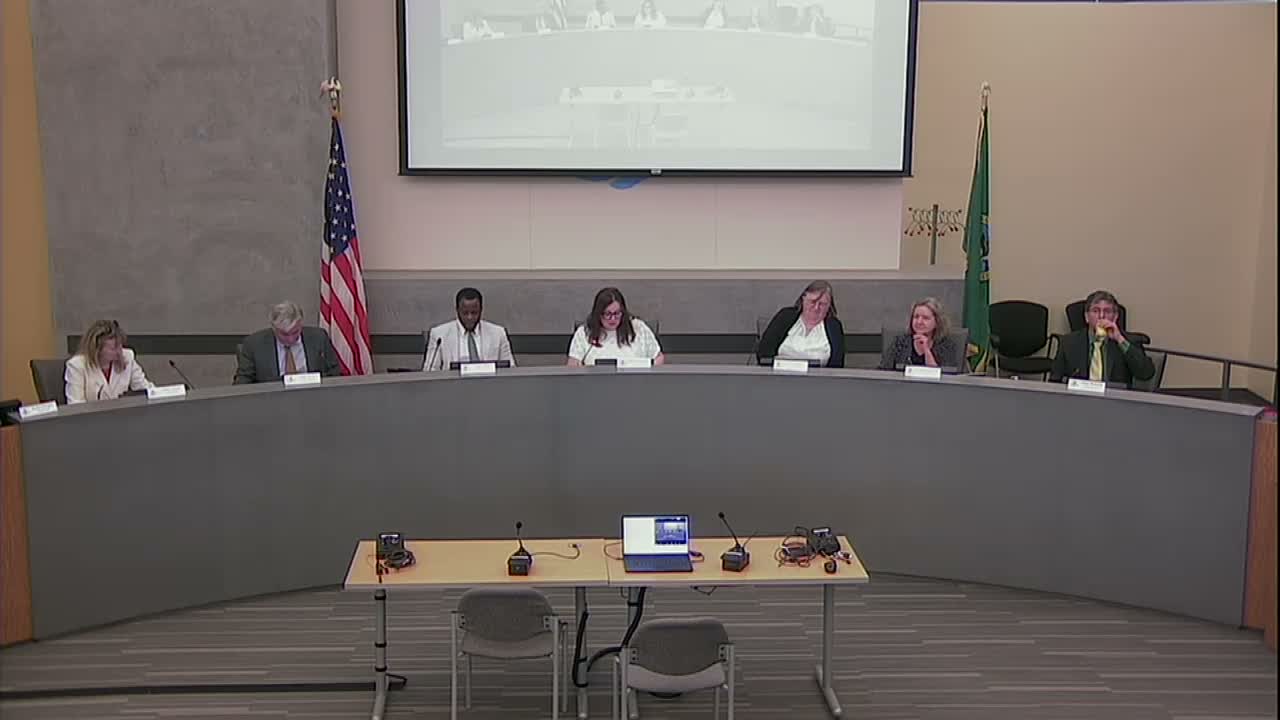
Shoreline’s city council opened its May 4 meeting with a proclamation for Mental Health Awareness Month and then spent the evening examining the city’s 2027–2032 Transportation Improvement Plan, where a planned Meridian Avenue bike lane was removed after the city returned a federal grant because it lacked the project management capacity to deliver the work on schedule.
At a public hearing, Lee Lambert, executive director of Cascade Bicycle Club and Washington Bikes, told the council he was surprised to see Meridian removed from the TIP and asked what funding was returned and whether the city could reinstate the project. Resident Oliver J. Moffett echoed those concerns and asked why simple pavement‑marking projects can carry six‑ or seven‑figure price tags. "Why does it cost so much? Why does it take so long? Why do we even need a project manager to put paint?" Moffett said.
Senior transportation planner Alan Buddy and Transportation Manager Kendra Dodinski told the council the TIP is a six‑year plan required by state law and that it informs the capital improvement program but does not itself guarantee grant funding. Dodinski said the Meridian project was a grant‑driven item with a near‑term schedule; the city missed the award window and returned the grant. "We missed that window," Dodinski said, noting the particular grant is biannual and the city could apply again.
Councilmembers pressed staff about whether returned grant funds could be recovered and how the loss happened. Dodinski and Buddy said chronic vacancies in the engineering capital delivery group — especially project management positions — hampered the city’s ability to meet the grant’s schedule and administrative requirements. Dodinski said the department is framing a budget request to convert a limited‑term position to a full‑time role to improve delivery capacity.
Norbert Steele, a Shoreline resident who said he had reviewed staffing levels across comparable Washington cities, said Shoreline appears roughly 41% below the average in full‑time employees per 1,000 residents and urged the council to hire more staff or consider contracting work. "If we're returning hundreds of thousands of dollars in grants because we can't staff our transportation department, maybe we should be asking why," Steele said.
Staff described the broader funding picture in the TIP: roughly $124.4 million in projects are funded for 2027–2032 and projects beyond that window represent about $148 million in estimated costs. Dodinski said about 45% of the six‑year funding window comes from non‑local sources (largely grants) and that preservation programs such as pavement, sidewalk and signal rehabilitation are generally underfunded — about $1.2 million annually for preservation work, or roughly $11 million over six years.
Councilmembers asked for clarity about similar projects and funding pots: staff said the Meridian grant was distinct from a locally funded protected bike lane on 200th Street (Ashworth to Meridian), which remains in the plan for later years. They also explained that only portions of the real estate excise tax (REET) are available for preservation (about $500,000 a year dedicated to preservation), while vehicle license fee (VLF) revenue must be used for preservation work.
Several councilmembers said they would prefer keeping the Meridian project visible on the TIP as an unfunded line item so it remains on record and can be considered when funding or staff capacity allows. Mayor Betsy Robertson and several colleagues asked staff to return in June with options to restore Meridian to the unfunded list or otherwise identify how the project might be prioritized without displacing the city’s established project prioritization.
The council did not take a formal vote on the TIP itself; staff recommended the TIP return next month for formal adoption. The meeting concluded after additional discussion of sidewalk rehabilitation, ADA planning and grant administration; staff said an updated ADA transition plan is expected by the end of summer.
"We could keep it there unfunded and look for future funding opportunities," Dodinski said of Meridian; several councilmembers urged that approach so community concerns remain visible in the plan.