Get Full Government Meeting Transcripts, Videos, & Alerts Forever!
Get email alerts on the Literacy topic
No spam. Unsubscribe anytime.
Crooked Billet leaders outline literacy program tied to ‘science of reading’
Summary
Crooked Billet Elementary Principal Kelly Bridal and Assistant Principal Dr. Bob Campman told the Hatboro‑Horsham School Board on March 23 that the school is aligning daily instruction with the five pillars of reading and Scarborough’s Reading Rope and is using schoolwide events — a readathon, Reading Olympics and a Women’s History Month program — to encourage student engagement.
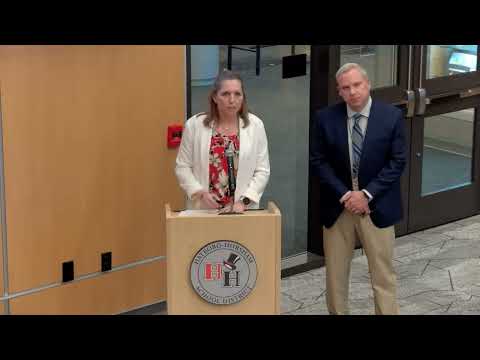
Principal Kelly Bridal and Assistant Principal Dr. Bob Campman presented Crooked Billet Elementary School’s approach to literacy on March 23 during the Hatboro‑Horsham School District board meeting.
“As Mr. Brown mentioned, I am Kelly Bridal, principal of Crooked Billet,” Bridal said, describing classroom instruction built around the five pillars of reading — phonemic awareness, phonics, fluency, vocabulary and comprehension — and Scarborough’s Reading Rope. She said teachers meet students where they are on that continuum and explicitly teach each skill in grades K–5.
Dr. Bob Campman said classroom videos the presenters shared illustrate both whole‑group and small‑group instruction, and that strategies such as choral reading and echo reading build fluency. “Choral reading provides every student with the opportunity to engage with the text,” Campman said, describing how teachers model rate and expression and then have students practice together.
Bridal and Campman also described several schoolwide activities designed to boost reading engagement: a peer‑buddy program that pairs older and younger students; an annual readathon tied to the book fair that drew about 80 students this year; a Reading Olympics for grades 4–5 requiring teams to read roughly 25 books and compete at the high school; and a Women’s History Month “March Madness” read‑aloud bracket run by the fourth grade team.
Bridal said the school’s events and instruction intentionally align with district literacy priorities and the “science of reading,” and she invited questions from the board before concluding. Board members thanked the presenters for concrete examples of classroom practice and activities meant to make reading fun and build skills.
The presentation was part of the meeting’s Section 2 agenda; no formal action was required.