Get Full Government Meeting Transcripts, Videos, & Alerts Forever!
Get email alerts on the Quality Assurance topic
No spam. Unsubscribe anytime.
Actura Health outlines QA plan and NCCHC path for Santa Rita Jail; supervisors press on sustainment and timing
Summary
Actura Health presented its quality‑assurance and continuous improvement model for Santa Rita Jail, focusing on NCCHC Section E standards, monthly audits and corrective actions; supervisors asked about sustainment, staffing, accreditation timing (1–3 years) and Actura’s role in the RFP and EPIC transition.
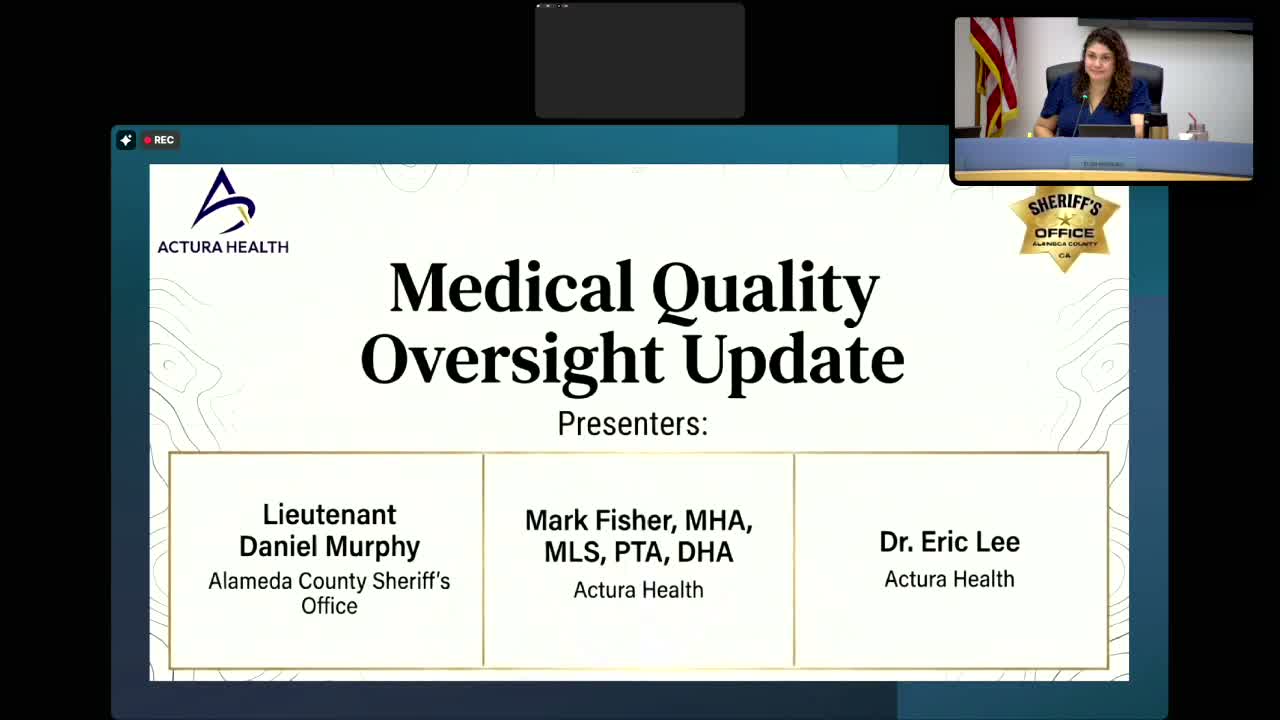
Actura Health’s CEO Mark Fisher told the committee the firm is shifting Santa Rita’s oversight from reactive corrective actions to a prevention‑oriented quality assurance and continuous quality improvement model aimed at achieving National Commission on Correctional Healthcare (NCCHC) accreditation. “There is no partial credit,” Fisher said. “Every single required standard must be fully met on the day the surveyors arrive.”
Dr. Eric Lee, Actura’s physician advisor, walked the committee through Section E (patient care and treatment) of the NCCHC standards and presented a dashboard that shows one area with 100% compliance (transfer screening) while several other measures are partially met or not met. Lee said nine of the ten Section‑E standards are “essential,” requiring 100% compliance, and noted that nurse‑initiated protocols had identified scope‑of‑practice concerns under California’s Nursing Practice Act. He said a corrective action plan addressing protocols was due the next day.
Actura described two operational “gears”: monthly detailed chart audits using NCCHC indicators (QA) and a continuous quality improvement process (CQI) that identifies root causes and tests changes. The firm recommended periodic mock surveys, multidisciplinary PDSA pilots and a multi‑partner quality committee to coordinate custody, medical and behavioral health partners so single fixes do not reoccur.
Supervisors asked whether the problems reflected staffing shortages, technology gaps, or both. Actura and sheriff’s staff said many failures were documentation or process issues that Epic and improved workflows are designed to mitigate, but staffing and frontline engagement are also critical. Lieutenant Dan Murphy said Actura’s site reviews include workflow observations with frontline staff.
Committee members also sought timeline clarity. Actura and ACSO staff said accreditation readiness realistically may take one to three years depending on provider transitions and Epic implementation; sustaining improvement month‑over‑month is essential to pass an NCCHC survey. Actura is producing quarterly reports; the first quarterly report covers work begun in January, with the next report scheduled for July.
The committee heard praise for the visibility the audits provide and criticism that current provider performance still shows multiple unmet measures. Actura’s contract was described in the meeting as a three‑year agreement costing approximately $1.2 million, with on‑site presence two to three days per month and ongoing remote work.
No formal action was taken; supervisors asked staff to continue tracking the corrective action responses and report back on sustainment metrics in subsequent quarterly updates.