Get Full Government Meeting Transcripts, Videos, & Alerts Forever!
Get email alerts on the Land Use topic
No spam. Unsubscribe anytime.
Alameda County approves Mosaic Project conditional use permit amid water and wildfire concerns
Summary
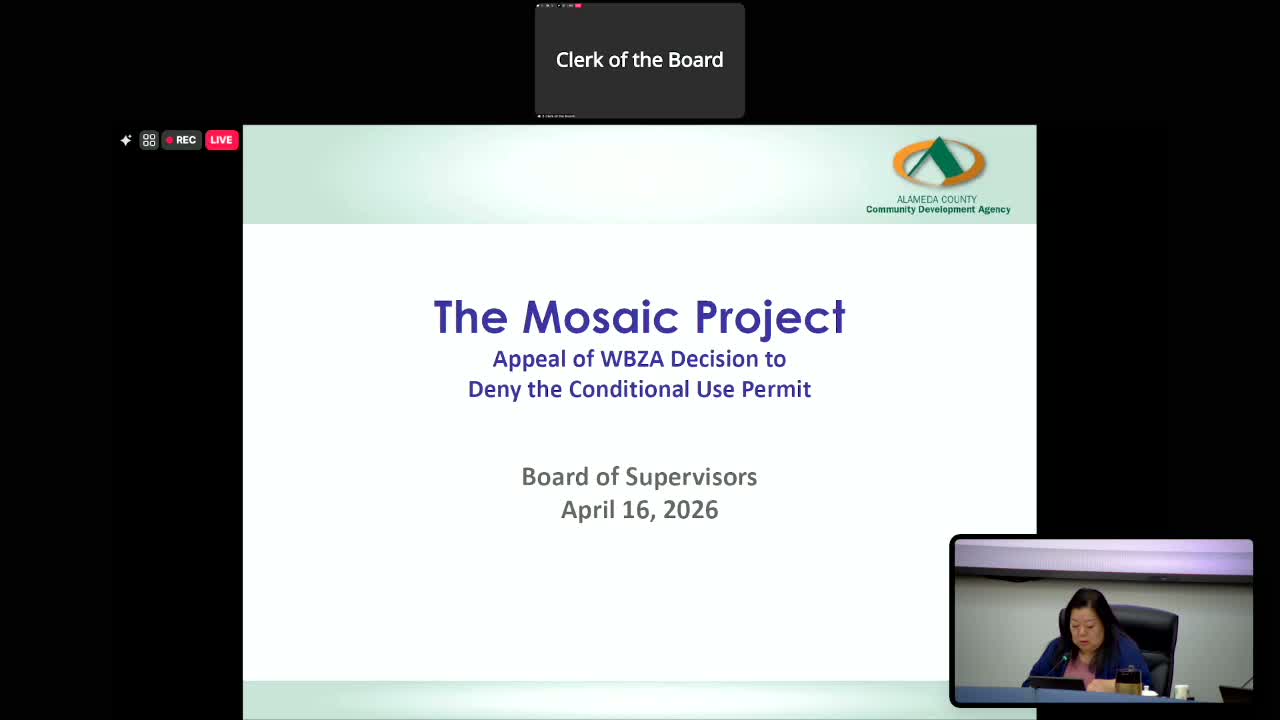
After hours of testimony from students, scientists and longtime canyon residents, the Alameda County Board of Supervisors voted 3–1–1 on April 16 to adopt staff findings, certify the environmental review and approve a conditional use permit for the Mosaic Project at 17015 Coal Canyon Road. The decision requires multiple state and county permits before construction can begin.
The Alameda County Board of Supervisors voted on April 16 to approve a conditional use permit (PLN 202093) for the Mosaic Project, a proposed outdoor education campus on a 37-acre site at 17015 Coal Canyon Road, near Castro Valley. The motion to adopt staff’s resolution — including the four CUP findings, certification of the final environmental impact report using the reduced-footprint alternative, and approval of mitigation and monitoring measures — passed on a roll-call vote: Supervisor Marquez: Aye; Supervisor Tam: Aye; Supervisor Miley: No; Supervisor Fortunato Bass: Aye; President Halbert: Abstain.
The Mosaic Project, which staff said would develop roughly 2 acres of the parcel and leave about 35 acres in open space, would host three classrooms per session (about 95 children and counselors), 12 camping cabins, a multiuse dining and meeting building, caretaker and staff housing, and agricultural activities including small-scale wild-harvest and a community-supported agriculture component. Planning Director Albert Lopez told the board that staff recommends the environmentally superior, reduced-footprint alternative, which shrinks some buildings by approximately 15–20 percent and relocates a council ring outside the creek slope.
Why it mattered: Supervisors, technical experts and hundreds of members of the public spent the hearing focused on three core issues: whether the proposed two private wells are demonstrably separate from Coal Creek and neighboring water users; whether the site’s one-way-in/one-way-out roadway and local topography allow safe and reliable evacuation during a wildfire; and whether the project complies with Williamson Act/Measure D and the county’s agricultural zoning rules.
Proponents said the record supports approval. Sabrina Moyle, Mosaic’s board president, reviewed the nonprofit’s 25-year history and urged the supervisors to ‘‘choose facts over fear,’’ saying the program serves tens of thousands of Alameda County children and relies on a site that preserves most land in its natural state. Retired Fire Chief Dave Winokur, retained by the applicant, testified that modeling and mitigation measures — structure hardening, extended defensible space and vegetation management — reduce wildfire risk. ‘‘In my professional opinion, wildfire is not one of the reasons this should be denied with the proposed mitigations,’’ Winokur said.
Opponents raised technical and safety objections. Suzanne Bradford, representing Friends of Castro Valley Canyonlands, submitted a hydrology memorandum that she said shows the public record lacks adequate evidence that the two proposed wells meet pump-test recovery standards or are not hydrologically connected to Coal Creek. Bradford said the EIR omitted canvassing of other local water users and climate-change stress testing of the aquifer. ‘‘There is no substantial evidence in the record that those impacts were adequately analyzed,’’ she told the board.
County and state-review roles: County staff and agency representatives described a layered permitting process. Environmental Health said it has given feasibility-level approval for an advanced on-site wastewater treatment system pending final design review; the building-permit process will route plans simultaneously through the county’s ‘‘one-stop’’ review so Public Works, Fire and other agencies can check compliance; and the state Division of Drinking Water must issue a drinking water permit for the private water system. Alameda County Fire Division Chief Bonnie Terram said the county enforces California WUI code standards on behalf of CAL FIRE and that the department will ensure required elements — including staff and resident training, fire drills and evacuation procedures written into the building permit — are present, though the fire code does not provide the county a separate discretionary ‘‘approval’’ step for an evacuation plan prior to building permits.
Board debate and conditions: Supervisor Miley said she was not convinced two of the CUP findings could be made: that the use would not materially affect the health and safety of nearby residents, and that the use would be compatible with the district’s standards. Miley cited concerns about one-way access, wildfire speed and the potential for water-supply impacts to neighboring wells. Supervisor Fortunato Bass urged rigorous monitoring if approved and proposed shortening the standard five-year mandatory review to three years and prioritizing evacuation and water monitoring during initial compliance checks. County staff said many of the project’s conditions — including bridge certification, roadway weight limitations (14,000-pound posted limit), pre- and post-construction road condition reviews, and multiple permits (building, grading, environmental health, drinking water) — must be satisfied before combustible construction can begin.
Public testimony: More than 80 people signed up to speak. Supporters included Mosaic alumni, educators and technical consultants who said the project will improve habitat, expand access to outdoor education and incorporates best-practice fire, waste and water systems. Several students testified in favor. Opponents included many Cole Canyon residents, local ranchers and members of the Castro Valley Municipal Advisory Council and West County Board of Zoning Adjustments, who pointed to a unanimous denial of the CUP at the lower-board level and urged the supervisors to preserve Measure D protections.
What the approval does and does not do: The board’s approval adopted staff findings and certified the final EIR under CEQA, but several state and local permits remain required and must be secured before construction: a state drinking water permit for private wells, environmental health approvals for the advanced on-site wastewater system, building permits and title-14/fire-code compliance for access, water-supply and hazard mitigation systems. Staff said the project’s implementation timeline is three years to pull a permit, and permits can be denied or withheld by other agencies, in which case the project could not proceed.
Next steps: With the CUP approved, the applicant must obtain the listed permits, finalize design elements such as bridge certification and evacuation details, and comply with the mitigation monitoring and reporting program. Several supervisors signaled interest in a closer early review schedule for monitoring and enforcement if the project proceeds.
(Reporter’s note: all quotes in this article are attributed to speakers who identified themselves in the record. The board recorded the motion and roll-call vote in the public transcript.)