Get Full Government Meeting Transcripts, Videos, & Alerts Forever!
Get email alerts on the School Evaluation topic
No spam. Unsubscribe anytime.
Committee approves amendments to raise academic weight in statewide school evaluations to 70%
Summary
House Bill 1582 was amended and advanced March 26 to increase the academic portion of Maryland's school evaluation system from 65% to 70%, set a 10% minimum for nonacademic indicators, cap any single indicator at 20%, and allow a staffing measure as a school-quality indicator; the committee recorded several named oppositions.
The House Ways and Means Committee on March 26 voted to advance House Bill 1582, as amended, changing how Maryland calculates school evaluation scores by shifting more weight to academic indicators. Chair Janelle Wilkins presided over the session.
Delegate Delia Ebersole, explaining the bill, said HB 1582 raises the share of academic quality indicators from 65% to 70% and reduces the nonacademic share from 35% to 30%. She listed possible academic indicators that can be used — achievement, year-over-year academic progress, English-learner proficiency, growth for the lowest-performing students and a high-school on-track measure for ninth graders — and said the amendments set a 20% maximum on any single academic indicator so no one measure dominates the composite.
An amendment presented by Alex removed references to national board certification and advanced accreditation for teachers and added that one school-quality indicator could be a staffing measure. The amendments also expanded reporting requirements to include data on indicators not chosen and the correlation between school poverty concentration and both composite and individual indicator scores.
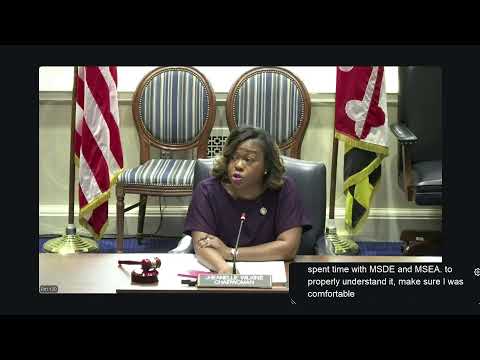
The committee moved the amendments and recorded opposition to them from Delegates Hornberger, Miller, Hartman and Long; the chair ruled the amendments adopted. During subsequent discussion Delegate Miller reiterated his concerns that subcommittee questions about academic progress remained unresolved and said, "that's why I'm voting no on this." Chair Wilkins acknowledged those concerns, said she had spent time with MSDE and the Maryland State Education Association to better understand the policy, and asked MSDE to follow up with committee members on implementation specifics.
The committee then voted to report HB 1582 favorable with amendments. The chair announced that Delegates Buckle, Hornberger, Miller, Long and Hartman were opposed; she declared the ayes carried the motion. The transcript does not include a full roll-call tally of yes votes.
The amendments change the balance of measures used to evaluate schools and add staffing and reporting elements; the transcript does not specify statutory language beyond those provisions, exact scoring formulas, or funding implications. The bill was reported favorable with amendments and will proceed to the next steps in the legislative process.