Get AI Briefings, Transcripts & Alerts on Local & National Government Meetings — Forever.
Administration seeks $100 million to expand dual enrollment; LAO urges rejection, agencies call for technical support
Summary
The governor's budget proposes a one‑time $100 million Proposition 98 investment to expand dual enrollment (CCAP, early/middle college) with program changes including ROCP eligibility, targeted funding for justice‑involved youth, and a move to align daily instructional minutes to 180. The Legislative Analyst's Office recommended rejecting the one‑time funding; community colleges and the California Department of Education pushed for targeted technical assistance.
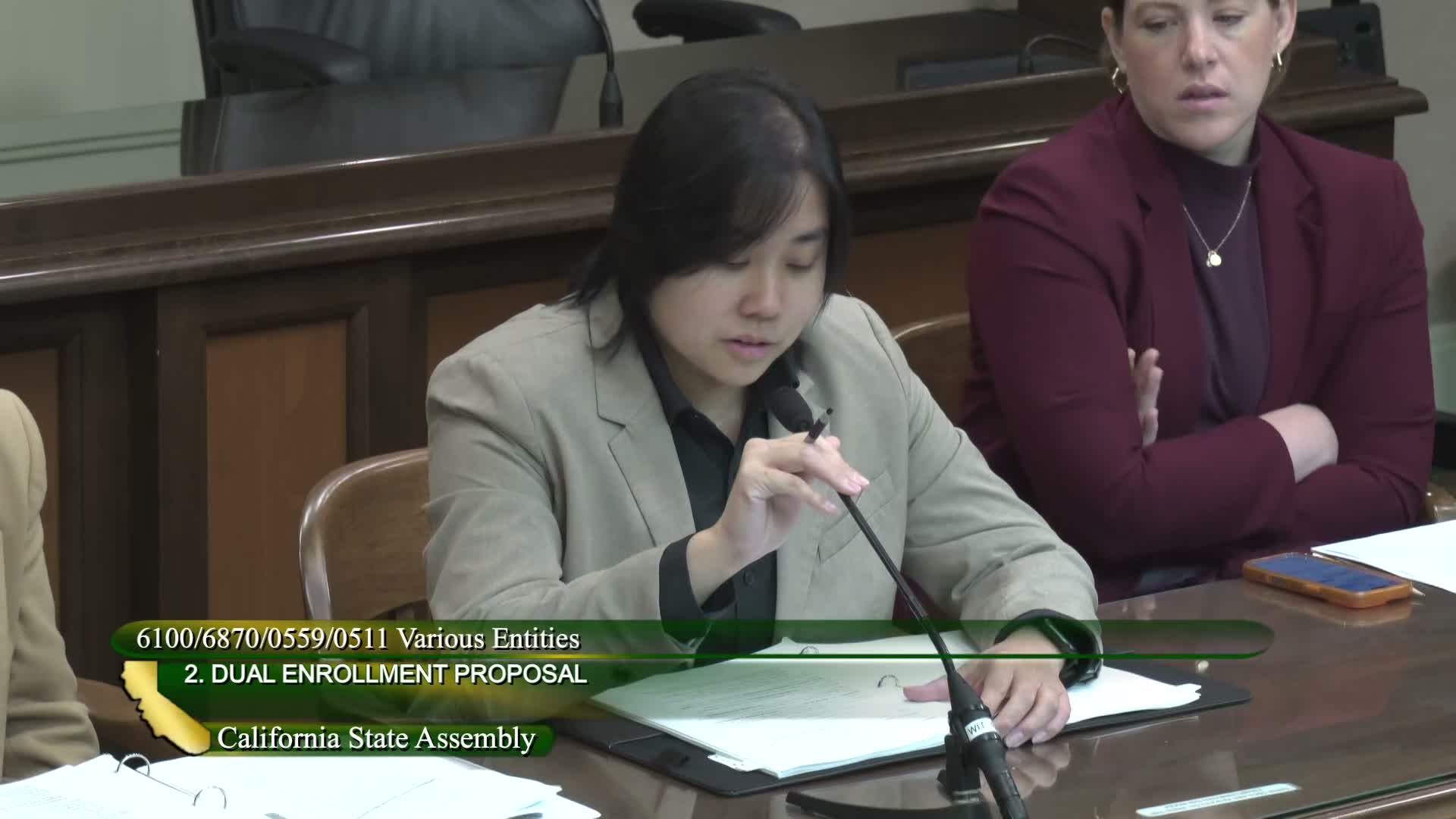
The Department of Finance proposed a one‑time $100 million Proposition 98 grant program to expand dual enrollment opportunities for high school students, aiming to scale community college partnerships and CCAP agreements statewide. "The governor's budget builds on this prior investment by including an additional 100,000,000 of 1 time proposition 98 general fund available through 06/30/2029 to support more grants to LEAs," Department of Finance analyst Melody Jimenez told the subcommittee.
Supporters said the funding would remove implementation barriers and help underserved students access college coursework. "By connecting high school learning to college‑level coursework, dual enrollment extends academic pathways, reduces excess units and accelerates students' progress," said Chris Ferguson of the California Community College Chancellor's Office, which supports the proposal but stressed the need for targeted strategies to reach low‑income and rural students.
The proposal includes several program changes: clarifying that regional occupational centers and programs are eligible applicants; adding a $50,000 supplemental award for LEAs that expand dual enrollment for justice‑involved youth; prioritizing LEAs with above‑average unduplicated pupil rates; and allowing grant funds for teacher professional development to meet minimum qualifications for dual enrollment instruction. Finance also proposed reducing the minimum daily instructional minute requirement for CCAP and similar dual enrollment programs from 240 to 180 minutes to align attendance/ADA counting and reduce scheduling barriers.
The Legislative Analyst's Office recommended rejecting the one‑time appropriation. "We recommend that the legislature reject the 100,000,000 in 1 time funding as we think that it would not address any barriers to implementing dual enrollment programs," Michael Oferos of the LAO said, noting that CCAP full‑time‑equivalent enrollment rose about 82% from 2020–21 to 2023–24 and that existing funding rules already enable districts and community colleges to be paid for participation.
Education agencies urged the committee to pair any new investment with technical assistance and reporting requirements. "We are recommending that 10,000,000 of that 100,000,000 go to establish a dual enrollment technical assistance system," said Kimberly Rosenberg of the California Department of Education, citing district requests for help with scheduling, staffing and compliance. DOF representatives said reporting requirements from the prior grant carry over to this round to monitor use of funds.
Members questioned whether lowering daily minute requirements would shortchange students' high school instruction. CDE and the Chancellor's Office said the 180‑minute floor would give local schools flexibility to offer college coursework without losing ADA and disrupt fewer school day activities such as staggered lunches and transportation schedules.
The subcommittee did not take a final funding vote on this item at the hearing. The agencies said they will refine reporting and program details ahead of the May Revision and urged legislative staff to add targeted technical assistance and monitoring provisions to ensure the one‑time funds support sustainable expansion rather than short‑term expenditures.