Get Full Government Meeting Transcripts, Videos, & Alerts Forever!
Get email alerts on the Land Use topic
No spam. Unsubscribe anytime.
Committee upholds staff, denies appeal over Asilomar Drive revisions
Summary
Oakland’s Residential Appeals Committee voted 2-0 on April 15, 2026 to deny an appeal of a zoning manager’s minor-change determination for 1901 Asilomar Drive, finding staff had substantial evidence that small retaining walls and grading changes do not alter the building envelope or require discretionary review.
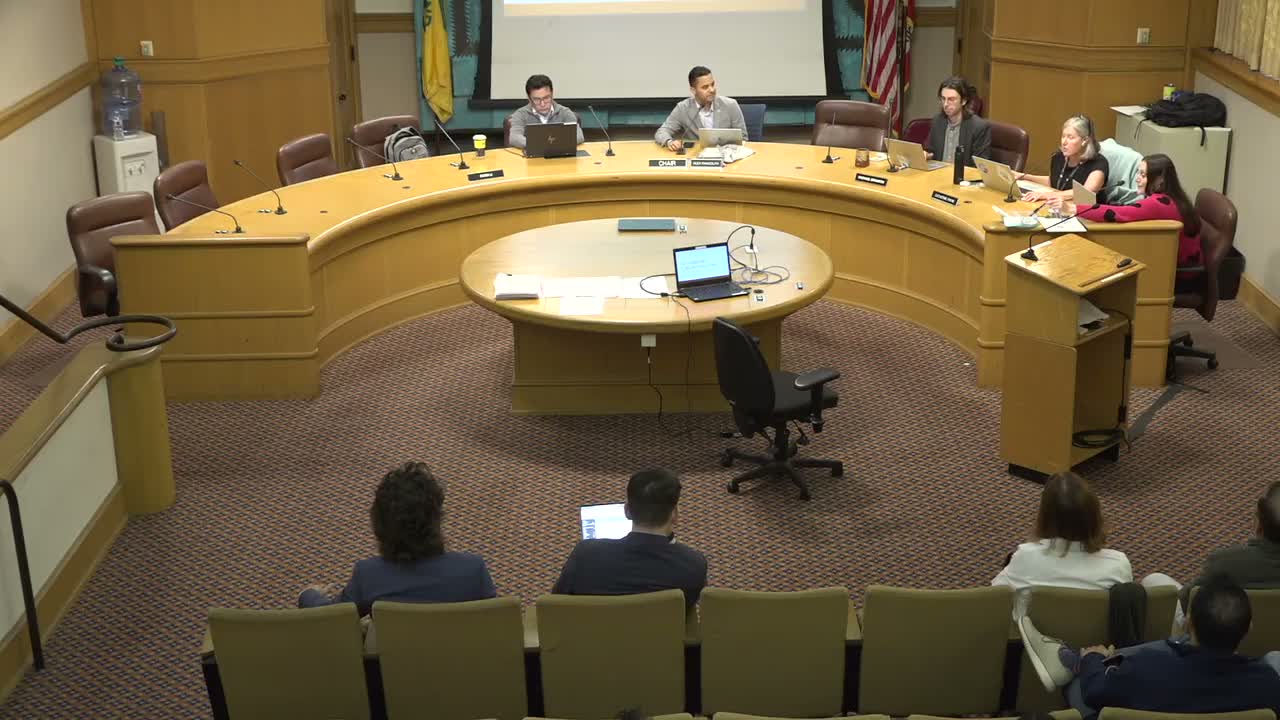
The Residential Appeals Committee of the Oakland Planning Commission on April 15, 2026 voted 2-0 to deny an appeal challenging a zoning manager’s determination that grading and low retaining walls at 1901 Asilomar Drive constitute a minor change and may be approved administratively. Commissioner Lee moved to affirm staff’s environmental determination and that the revisions can be approved administratively; Chair Randolph seconded and both voted yes (Commissioner Ahrens was absent).
Staff advised the committee that the project (PLN 23090), approved in December 2023 and under construction since August 2024, was revised in January 2026 after staff discovered a lot-area discrepancy. Planner 1 explained staff’s calculation that the revised project would result in 3,206 square feet of total floor area and a 0.43 floor-area ratio (FAR) because the lower level meets the city’s code definition of a basement and therefore is excluded from FAR calculations.
Appellants, represented by Robert Martinez of the Cerrone Montclair Coalition, argued the permit was obtained through “material misrepresentations,” that applicants artificially added soil and a planter to reclassify a full story as a basement, and that the project should undergo major design review. Martinez told the committee, “There is no dispute that this permit was only obtained through material misrepresentations. It should be deemed void ab initio.” He urged the committee to vacate the minor determination, issue a stop-work order and require a full public review.
Applicant counsel Justin Zucker of Patterson and O'Neil countered that an appeal must identify an error or abuse of discretion by the zoning manager and that appellants had not met that standard. Zucker said the revisions do not change the building’s height, envelope, footprint or massing and argued the zoning manager’s decision is supported by substantial evidence. Owner Bhavi Sadhglecha described the project as “socially conscious” multigenerational housing and said delays are financially and personally burdensome. Architect Cindy Stary noted the project was approved amid planning-office disruptions and that staff and building inspectors verified key field measurements.
Public commenters were split. Turner, speaking for the Housing Action Coalition, urged the committee to reject the appeal and stressed the risk to housing supply from late-stage challenges. Neighbor Joshua Sanchez asked the committee to reconsider on public-safety and neighborhood-compatibility grounds, saying the structure appears as a three‑story building from the street and urging a fire-evacuation study before completion.
During questioning commissioners pressed appellants and staff about the scope of deviations, the size of the lot-area discrepancy (staff described it as “a few hundred” square feet), and whether the revised finished grade along retaining walls remains lower than the street. Staff and the applicant said alternatives had been considered and that, if the changes are deemed minor, the submitted revisions would be approved ministerially under objective design standards.
City attorney Brian Mulry cautioned about vested-rights and state-law implications: the city takes the view the original project had vested status and noted that challenging an unappealed 2023 approval is constrained by Government Code timelines. He also warned that counting a qualifying ADU toward FAR in a way that would deny the project could put the city at legal risk under state ADU law (Gov. Code §66323).
After brief deliberation the committee voted to affirm staff’s determination that the grading and low retaining walls are a minor change that can be approved administratively. The motion passed 2-0; the decision was announced as not appealable. The committee then adjourned.
Next steps: staff may proceed with ministerial approval of the submitted revisions unless further enforcement action or new appeals are filed under applicable statutes.