Get Full Government Meeting Transcripts, Videos, & Alerts Forever!
Get email alerts on the General Plan topic
No spam. Unsubscribe anytime.
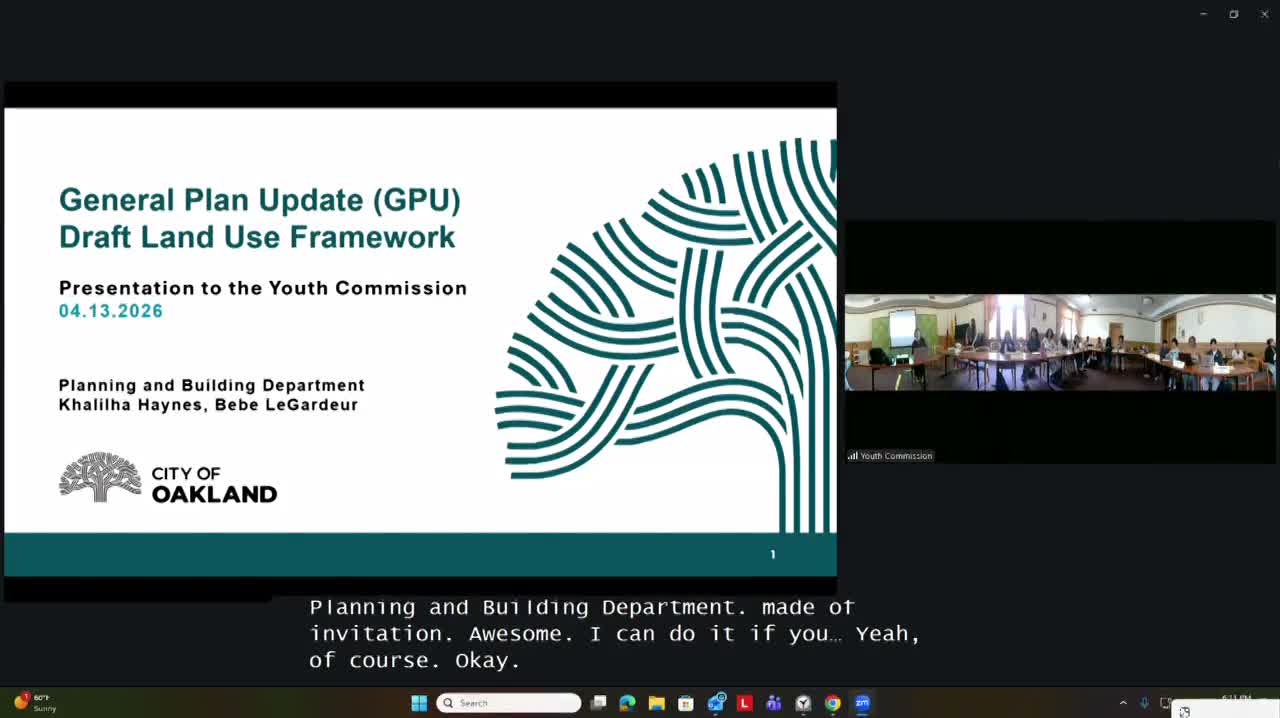
Oakland planners present draft land-use framework to Youth Commission, highlight transit and equity goals
Summary
City planning staff briefed the Youth Commission on a newly released draft land-use framework, emphasizing mixed-use neighborhoods, transit coordination (including long-term interest in an infill BART station) and targeted investments in underserved parks and climate resilience.
City of Oakland planning staff presented a draft land-use framework to the Youth Commission that lays out strategies intended to guide growth, equity and infrastructure investments over the next 20-plus years. "The general plan is the guiding document for how the city grows and develops. It's kind of like the constitution in the city," said Phoebe, a planning staffer with the City of Oakland Planning & Building Department's Strategic Planning Division.
The draft framework, which planners said was developed after outreach that began in 2024 and a 2025 report of big-picture ideas, proposes mixed-use, walkable neighborhoods; improved bicycle and pedestrian connections; targeted neighborhood centers; and investments in parks and open space in underserved communities. Planners described examples such as the Ohlone Greenway and Brooklyn Basin as illustrative of networked open spaces and connections between neighborhoods.
Why it matters: The general plan guides zoning, policy and capital decisions that affect housing, parks, transportation and resilience work citywide. Planners said the update will be used to prioritize investments meant to address historic inequities in how city resources and services have been distributed.
Planned strategies and specifics cited at the meeting included creating street designs that favor walking and biking, working with AC Transit to identify routes for improvement, and using street closures and small park interventions to create more local green space. Planners also discussed displacement risks associated with investment and described policies intended to protect residents from speculative displacement as neighborhoods change.
On transit, commissioners asked about an infill BART station in the San Antonio neighborhood. Planning staff said station construction is a long process that depends on demonstrating sufficient local density; as an interim measure they are considering improved bus connections. "Creating a BART station is a much longer process than the 20 years that this general plan looks at," the planner said, but added the plan can set land-use signals—such as housing density targets—that support future transit investments. Staff also warned that transit funding is uncertain and noted "there's gonna be something on the ballot in November to fund transportation," and that the framework may be revisited depending on that outcome.
Planners emphasized climate and resilience priorities—stormwater management, shade trees, and plans to address flooding and heat—and said the land-use framework will feed into more detailed implementation documents released this fall. They encouraged Youth Commission members to review the draft, submit comments, and suggest specific policy language to ensure commission priorities are reflected.
Next steps: Planners said a longer draft with maps and implementation measures will be released in the fall and invited commissioners and the public to comment on the current framework. Commission leadership closed by thanking the presenters and moving to subsequent agenda items.