Get Full Government Meeting Transcripts, Videos, & Alerts Forever!
Get email alerts on the County Budget topic
No spam. Unsubscribe anytime.
Spokane County reports stronger-than-expected sales-tax receipts while warning of a looming budget gap
Summary
County budget staff told commissioners that April sales-tax collections and year-to-date retail gains have improved revenue projections, but rising medical and liability costs and a widening gap between revenue and expenditures mean commissioners must consider revenue options and cuts before the budget is finalized.
Presenter (S6) told the Spokane County Board of County Commissioners on May 4 that April sales-tax collections came in at about $6 million — "the highest we've ever had" for April — and that year-to-date collections were about $2 million higher than the same period last year. "Sales tax is doing phenomenal," the presenter said, highlighting retail trade (up about 7.3%) and a 14% rise in the "other miscellaneous retailers" category, which includes many online purchases.
County staff said the average sales-tax growth rate used in forecasts is roughly 4%, with a rolling growth figure near 5.3%. At the same time, staff warned the board that overall revenue growth across all sources is projected at about 1.2% while expenditure growth could run near 6.3% over the forecast window, producing a multi-year shortfall in illustrative scenarios. "Roughly three quarters of our budget is law and justice," a staff member (S1) said, noting that salaries and benefits account for about two-thirds of county operating costs.
Why it matters: The gap between slow revenue growth and faster projected expense growth — driven in part by assumptions of a roughly 7% average salary increase and a 12% rise in benefits, plus growing liability costs — forces the county to weigh revenue options, targeted cuts and other budget levers for 2027 and beyond.
Staff outlined revenue levers and timing. A councilmanic or voter action to add a full 1% sales tax is estimated to generate about $7.2 million on a full-year basis, but collections depend on when the Department of Revenue can implement the change (staff explained a one-quarter implementation lag). Staff also listed other options such as a road-levy shift (up to about $7.5 million) and incremental property-tax moves, while cautioning that property-tax increases can trigger voter requirements depending on whether funds back debt or operations.
On uses and risks, staff and commissioners discussed a 2025 legislative provision that created a local law-enforcement one-tenth sales-tax slice and a related $100 million grant program. Staff noted the county believes it is currently eligible for that program but must file documentation; if a jurisdiction enacts a tax without meeting statutory eligibility requirements, the state could withhold roughly $100,000 per month until eligibility is resolved, staff said.
Commissioners pressed on options and trade-offs. Several commissioners favored target-based budgeting — assigning department targets rather than accepting department-submitted increases — as a way to manage expectations and focus cuts on larger cost centers. Board members also noted that cutting non-mandated services such as parks (about $4 million) alone would not close large gaps because criminal-justice spending represents the bulk of the general fund.
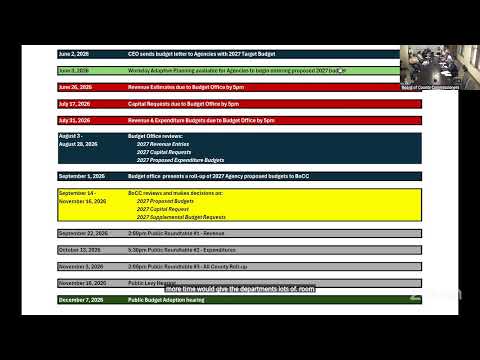
What happens next: Staff proposed additional revenue and departmental reviews during the 2027 budget process, roundtables in the fall and follow-up strategic sessions on May 18 and June 1 to present refined target options. The public portion of the meeting recessed into an hour of executive sessions for potential litigation with no action anticipated.
Quotes (selected): "April collections came in a little shy of $6,000,000, which is, for April, the highest we've ever had," Presenter (S6) said. "Roughly three quarters of our budget is law and justice," Staff member (S1) said when explaining why cuts will be challenging to achieve without service impacts.
Ending: County staff emphasized that the timing of any revenue decision matters to next year’s collections and urged commissioners to provide early guidance on target-based approaches so departments can adjust revenue and expenditure assumptions before the budget decisions later in the year.