Get Full Government Meeting Transcripts, Videos, & Alerts Forever!
Get email alerts on the Broadband topic
No spam. Unsubscribe anytime.
Duarte City Council receives regional broadband study presentation; agrees to file update
Summary
Consultants presented a seven-city regional broadband study commissioned by Monrovia and funded by a CPUC technical-assistance grant. Council voted to receive and file the presentation while staff pursue industry engagement and code review to attract providers.
Brenda Trainor, a consultant with Frontier Trail Strategies, presented a regional broadband study commissioned by the City of Monrovia and involving seven neighboring cities. Council members received the presentation and voted to "receive and file" the report.
Trainor said the project—funded through a California Public Utilities Commission LATA technical-assistance grant—aims not to build a city-owned network but to "identify the challenges" preventing better service and to bring providers to the table. She described work to compare municipal codes across participating cities, assess market demand and regulatory barriers, and explore opportunities to encourage fiber and other providers to expand service to underserved neighborhoods.
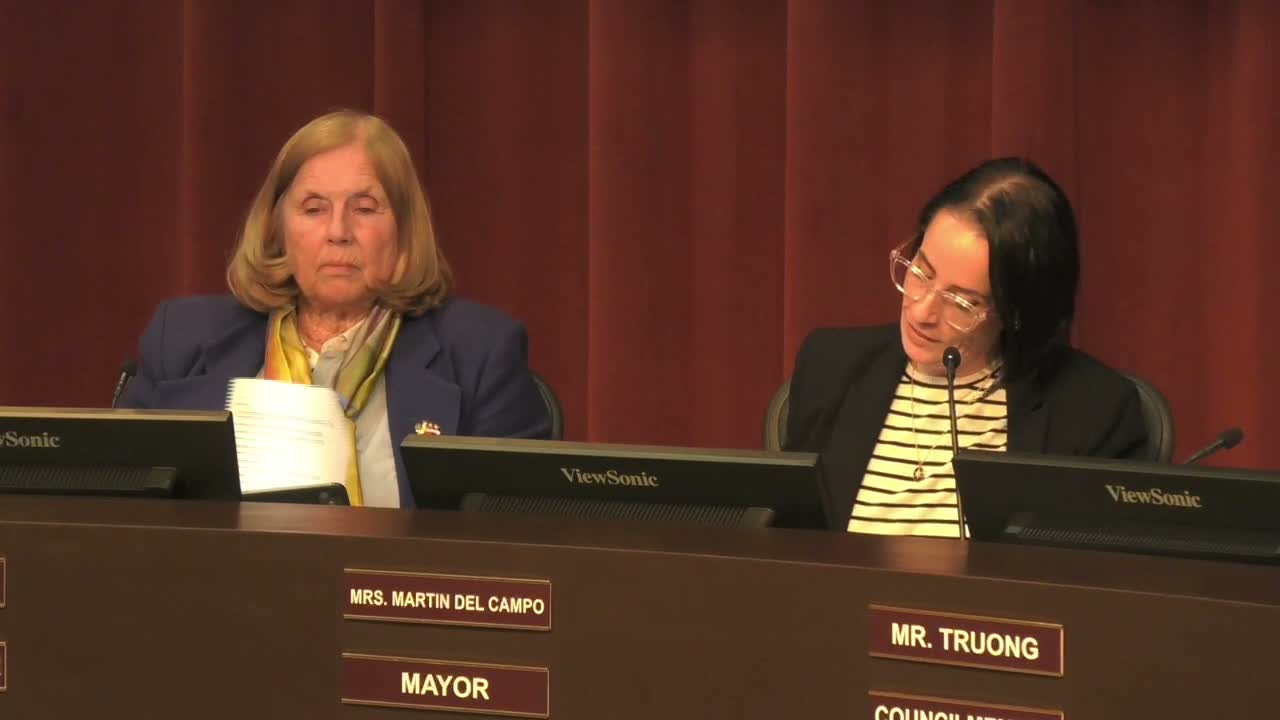
Council members pressed for local detail. Council member Truong urged the consultant to account for Duarte's foothill geography and unique needs, saying prior countywide studies had not captured the city's reception and terrain. Trainor replied that the study will highlight regional commonalities and specific local constraints and that staff will share Duarte's independent study data to refine market analysis.
Several council members asked whether the study would pursue providers including fiber, cellular and satellite. Trainor said the objective is to "bring people to the table"—including smaller fiber providers and larger incumbents—so cities can better present their market and regulatory conditions. She said the region's market size (presented in the study as roughly a quarter of a million residents across the participating cities, about 82,000 housing units and roughly 12,000 businesses) could be used to attract investment, though she cautioned the work is exploratory and not a promise of building a new municipal network.
Council member Finley moved to receive and file the presentation; Council member Lewis seconded. The motion passed by voice vote with no opposition recorded.
Next steps, as described in the presentation, include continued municipal-code review, outreach to potential providers, and coordination among the seven jurisdictions to present a unified case to industry and investors.
A city staff note: the presentation and consultant name appeared in the transcript with several spelling variations ("Madia," "Madea," "Badia"); the consultant and staff used "Frontier Trail Strategies" and identified the project origin as the Monrovia-led regional effort. The council vote was procedural—receive and file—so no new regulatory authority or budget commitment was adopted that night.