Get Full Government Meeting Transcripts, Videos, & Alerts Forever!
Get email alerts on the Public Defense topic
No spam. Unsubscribe anytime.
Public Defender warns of rising felony referrals, staffing shortfalls and expanding diversion programs
Summary
Chief Public Defender Ellen McDonnell told supervisors caseloads and post-conviction work have surged, citing an 18% increase in misdemeanor referrals and a spike in felony referrals in early 2026; she said public defense faces a 45-position support-staff gap and that retroactive Racial Justice Act work will generate ongoing workload.
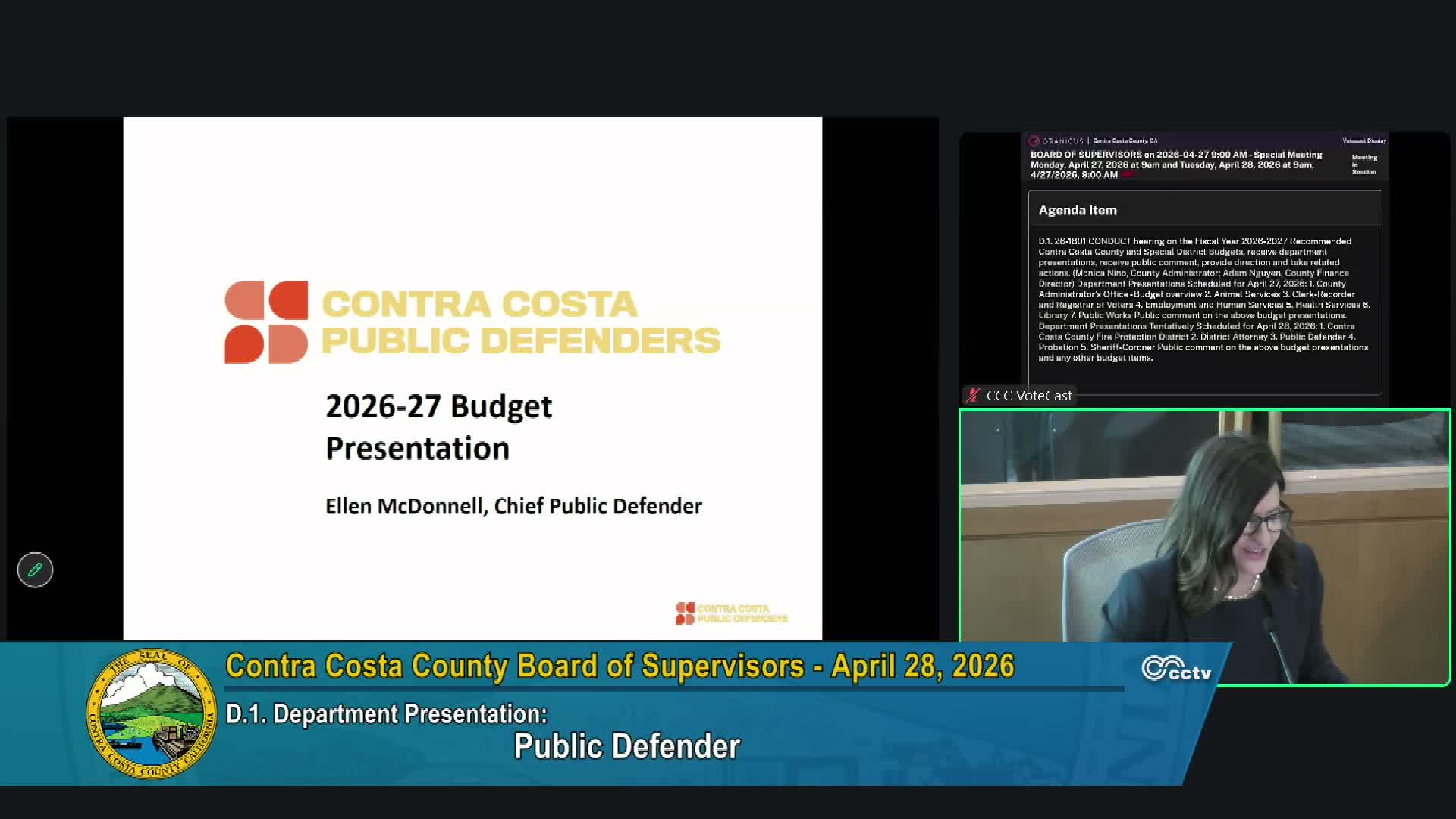
Chief Public Defender Ellen McDonnell presented the Office of the Public Defender's FY26-27 budget to the board on April 28, arguing that rising referral volumes, extensive post-conviction work and new mandates have created sustained staffing and resource pressures.
McDonnell said the office handled nearly 13,000 referrals last year and has seen sharply higher caseloads in 2026: "we receive on average about 250 felony cases a month" in 2025, and that average rose to about 335 per month in early 2026. She also said misdemeanor referrals rose 18% year-over-year, intensifying pressure on misdemeanor units.
The public defender highlighted staffing mismatches with prosecutors: she described a support-staff gap of roughly 45 positions against recommended ratios and said the office is short on investigators, social workers and legal assistants. On post-conviction work, McDonnell emphasized retroactive Racial Justice Act petitions and said the county successfully secured state reimbursement for retroactive RJA work effective 07/01/2023, which will partially offset retroactive workloads.
McDonnell described care court and mental-health diversion programs as successful early interventions: the county's care court had 122 referrals and 100 active participants and the mental-health diversion program had 140 active participants. She said those programs are intensive but produce better outcomes than incarceration.
Supervisors and the public urged additional funding for public defense support staff; board members asked for comparative caseload and staffing metrics versus other Bay Area counties. The board did not adopt separate appropriations at the hearing; the public defender's requests will be considered as part of the countywide budget adoption and follow-up in June.