Get Full Government Meeting Transcripts, Videos, & Alerts Forever!
Get email alerts on the Oig Independence topic
No spam. Unsubscribe anytime.
Oakland police commission ad hoc plans court letter stressing inspector general’s independence
Summary
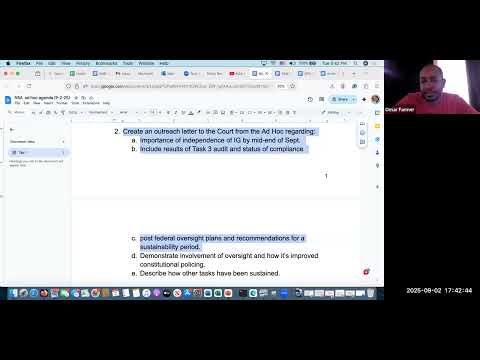
At an ad hoc meeting on Sept. 2, commissioners and the inspector general agreed to draft a concise letter to the federal court emphasizing the inspector general’s independence and a process for sustaining oversight after the negotiated settlement; the group set a drafting and review schedule and debated how forcefully to frame its call to action.
Commissioners and the inspector general at a Sept. 2 Police Commission NSA ad hoc meeting agreed to prepare a short letter to the federal court that would emphasize maintaining the Office of Inspector General’s independence and outline how civilian oversight could sustain reforms after federal monitoring ends.
Inspector General Malouf told the group that independence is “critically important” because it preserves public trust and enables unbiased oversight: “Oversight without independence is merely observation. It’s not accountability,” Malouf said, and urged the commission to include task 3 audit findings that show both compliance and areas of lapse so the court can see how OIG oversight prevents backsliding.
Commissioner Farmer led the discussion and proposed that the commission use the letter to ask the OPC chair to raise charter amendments that could affect the police commission with the core group and the city’s monitors. Farmer said the commission’s primary call to action should be ensuring the court can pass the baton to an independent inspector general once federal oversight ends.
Tony Lawson, CPRA director, advised keeping the letter narrowly focused on the OIG’s authority and audit capabilities rather than on funding requests. Lawson said if the court assigns the OIG specific post‑oversight duties, the city will be required to fund those responsibilities. Malouf echoed that message while warning the office cannot perform sustained audits without adequate staffing: he described having effectively a single staff member available to assist critical oversight work.
The ad hoc reviewed a list of draft recommendations from the task 3 audit that Malouf said the office would include in communications to the court: revise DGO 3.3 to set frequency standards and selection methods for integrity testing, implement a regular three‑year DGO review cycle, retrain supervisors on integrity tests, and require commanders to document monitoring of integrity‑test operations so findings can be supported.
Not all participants agreed on tone. Public commenter Rajni Mandel urged the commission to demonstrate strong civilian oversight and organizational effectiveness rather than adopt a confrontational “call to action,” saying that the court is closely watching CPRA and that focusing on CPRA’s work may be more productive. Contreras, a commission member, argued the commission must address deep cultural problems he described as planting evidence, beatings, coverups and racially offensive texting — a list he said reflected the problems the NSA was designed to fix.
The group set a schedule for the letter and related review: the inspector general will draft a one‑page letter this week, the ad hoc will review a draft at the next meeting (Monday), the group will tentatively finalize by Sept. 15, present to the full commission Sept. 25, revisit Sept. 29 if needed, and send the letter to the court on Sept. 30. Commissioners also agreed to continue fleshing out a director action plan (KPIs, audits including militarized‑equipment and dedicated‑arrest‑team policies, wellness KPIs) to support the claim that civilian oversight can sustain reforms.
Next procedural steps: IG Malouf will prepare the draft and circulate it for comment; the ad hoc will reconvene to review the draft and the commission will consider the statement at its upcoming full meeting.