Get Full Government Meeting Transcripts, Videos, & Alerts Forever!
Get email alerts on the Israel Palestine Crisis topic
No spam. Unsubscribe anytime.
Israel's U.N. ambassador says Israel expanded defenses in southern Lebanon after Hezbollah rocket barrage; accuses Iran of striking civilian sites
Summary
Israel's U.N. ambassador, Danny Donon, told reporters Israel expanded forward defenses in southern Lebanon to counter Hezbollah rocket launches that he said violated U.N. commitments. He accused Iran of striking civilian infrastructure and defended cooperation with U.S. efforts in the region.
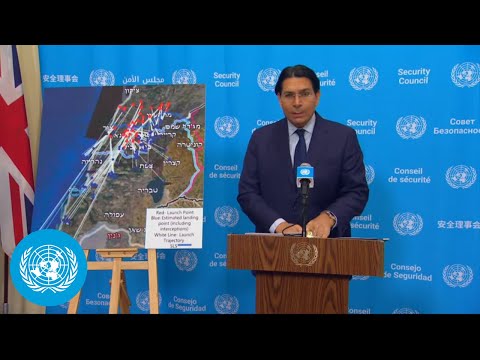
Israel's U.N. ambassador Danny Donon said Israel expanded its forward defense area in southern Lebanon overnight to remove "immediate terrorist threats" near the border and provide an additional layer of security for residents of northern Israel. Donon told reporters the move was a response to sustained rocket fire by Hezbollah from areas south of the Litani River that he said violated U.N. Security Council commitments.
Donon cited what he described as Israeli military-intelligence data and said "in this map, you can see 213 Hezbollah launches" in a single evening. "This is not precision targeting. This is indiscriminate fire, chaotic, deadly missiles launched with the intent to kill civilians," he said, adding that Hezbollah operates "from within civilian areas" and "hides behind civilians, launch[es] rockets at Israeli communities, and then blame[s] Israel."
He framed the deployments as a last resort when diplomacy fails. "Israel did not choose this situation. Hezbollah did," Donon said. He invoked U.N. Security Council commitments (referred to in the transcript as "17 o 1") and urged Lebanon to "step up" and mobilize its forces to restrain Hezbollah.
Turning to Iran, Donon challenged an on-the-record claim by Iran's foreign ministry (named in the transcript as "Abbas Arachih") that Iran had not targeted civilian or residential areas. "That claim is laughable and completely disconnected from reality," he said, and accused Iran of strikes on airports, ports, energy infrastructure and homes. Donon said an Iranian missile struck an Israeli town he named in the briefing as "Zazir," injuring "nearly 60 people" and damaging "around 300 homes," and that a religious site in the town was also damaged.
Donon warned of Iran's growing missile capability, saying without action it "could have reached 8,000 missiles by 2027," and said Israel would continue to act to "defend our people and to eliminate terrorist threats."
In the question-and-answer session, Pamela Falk of U.S. News & World Report noted a U.N. Security Council resolution condemning the recent Iranian attacks and asked why more countries had not moved to secure the Strait of Hormuz; Donon welcomed that Security Council vote (he said 135 states supported it), described Iran as "isolated," and said Israel would support U.S. efforts while urging a global response. Gabriel Zondo of Al Jazeera asked whether Israel would send naval forces to the Strait of Hormuz; Donon said he had not ruled anything out and described Israel as willing to support a broader international effort.
Reporters pressed about journalist access to Gaza; Donon said Israel coordinates reporter entry when requested but said Israel would not take responsibility for reporters' safety because "at the end of the day, Israel will be blamed" if something happened. Asked whether there were talks between Israel and Lebanon, Donon said mediators were trying to host talks but that, based on Israeli experience, productive negotiations typically follow after an adversary's capabilities have been "degraded."
When asked by Masumoto of Kyodo News about displacement inside Lebanon, Donon said Israel had asked civilians to evacuate south of the Litani River where operations were ongoing and said NGOs were assisting those moving north; he urged the Lebanese government to mobilize its military to allow displaced people eventually to return.
The briefing included direct accusations of violations of U.N. commitments, fielded questions about international military coordination, and raised humanitarian concerns for displaced civilians in Lebanon. The ambassador closed by reiterating Israel's intent to protect its communities and continue operations until its stated objectives were achieved.