Get Full Government Meeting Transcripts, Videos, & Alerts Forever!
Get email alerts on the Land Use topic
No spam. Unsubscribe anytime.
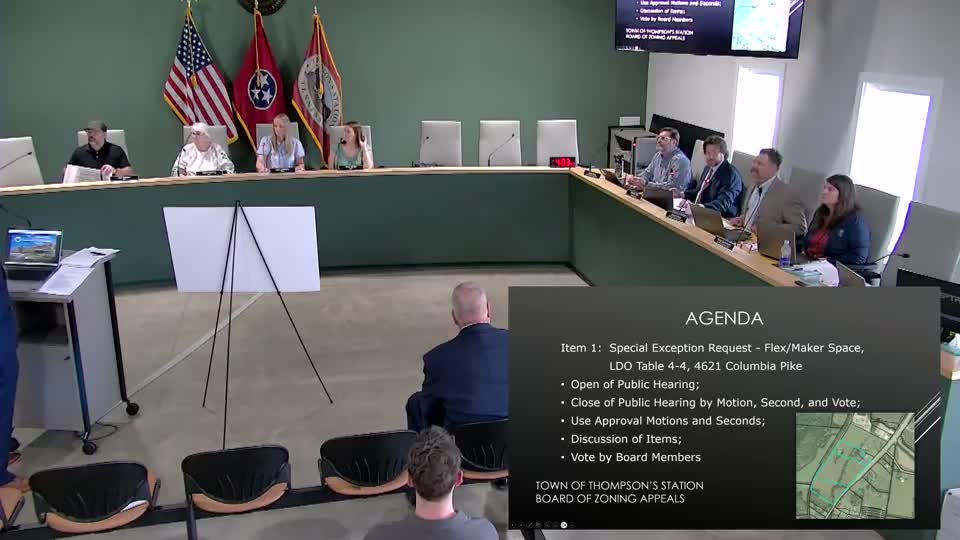
Thompson—s Station BZA approves 12 —flex makerspace— uses for Thompson—s Exchange, removes broad hours limits
Summary
Thompson—s Station—s Board of Zoning Appeals approved 12 special-exception subcategories allowing a mixed retail and flex-makerspace development at 4621 Columbia Pike; the board removed proposed uniform hours-of-operation limits and adopted conditions requiring noise, odor and hazardous-material protocols to be incorporated into the PDP.
The Thompson—s Station Board of Zoning Appeals voted unanimously to approve a package of 12 special-exception subcategories that will allow the Thompson—s Exchange development at 4621 Columbia Pike to include a mix of retail and flex "makerspace" uses.
The board approved each of the applicant—s proposed subcategories —including office/storage hybrids, construction contractor spaces, laboratories and R&D, EV centers, collaborative fabrication and craft spirits makers —with staff-recommended conditions but removed several blanket hours-of-operation limits that staff had suggested. During the meeting, town staff told the board the draft conditions generally limited operations to 6 a.m. to 8 p.m. for several uses; the board amended many items to eliminate that fixed cap and instead relied on targeted conditions (design and noise/odor mitigation, building-specific protocols and permitting) and the town—s existing nuisance and noise rules.
Why it matters: The approvals let Saint John Properties and the property owners (Fields Family Trust) proceed with a Planned Development Plan (PDP) for a roughly 63.31-acre site with a front row of retail buildings and six larger "flex" buildings behind a stream and next to a railroad. Proponents said the flex product is intended to house a wide range of businesses (contractors, small-batch manufacturers, specialty materials makers, EV service/showrooms, small labs) that will create local daytime jobs and sales-tax revenue. Opponents were not present during public comment; one speaker, JB Brook, told the board he supported the project and its buffering and design.
Applicant and board debate: Jonas Asner of Saint John Properties told the board the hours constraints would "materially undermine the commercial viability of the development" and said many tenants require overnight or early-morning access for deliveries, testing cycles or emergency service. "These are not gonna create noise," Asner said of the flex buildings, adding that lease provisions, building design, site buffers and the town—s noise ordinance provide multiple layers of protection.
Town staff and legal counsel pushed back that narrower, use-specific safeguards were appropriate. Legal counsel reminded the board it acts in a quasi-judicial capacity, asking members to "put on the record rationales for or against" conditions. For laboratory uses the board negotiated a revised condition requiring that any tenant conducting research or testing "comply with all applicable federal, state and local laws, codes, regulations, permitting and licensing requirements" and provide protocols to the town so first responders and staff have notice about materials on-site.
Electric-vehicle subcategory: The board also debated installer qualifications for EV chargers. Staff recommended chargers be installed by EVITP-certified electricians (a comprehensive program for EV installs); the applicant asked to allow state-licensed electricians instead. After staff and an EV expert explained EVITP—s role, the board amended to keep a high standard (EVITP or comparable verified training) while removing the hours cap for EV centers.
Votes at a glance: the board recorded roll-call approvals on each subcategory (all recorded votes were affirmative among present members): A (Flex makerspace) — approved as amended (item 3 removed); B (Office/storage hybrid) — approved; C (Construction contractors) — approved (hours removed); D (Laboratories / R&D) — approved (safety protocol language revised; hours removed); E (Studios/broadcasting) — approved; F (Non-retail pharmacies) — approved; G (EV centers) — approved as amended (installer qualification clarified; hours removed); H (Flex commercial) — approved; I (Collaborative fabrication) — approved; J (Craft spirits maker) — approved; K (Catering/culinary) — approved; L (Secure IT infrastructure) — approved.
What remains: The BZA—s determinations will be incorporated into the PDP and the Planning Commission and BOMA reviews. Several board members noted that lease provisions mentioned by the applicant are private agreements and are not binding conditions unless the board specifically incorporates comparable language into the permit; the board opted to rely primarily on code-required safeguards, targeted conditions and notice requirements incorporated into the PDP rather than landlord-tenant lease terms.
Quotes "We request the approval of this flex makerspace subcategory and removal of the proposed hours of operation limitations," applicant Jonas Asner said, arguing tenants would need after-hours access. (Jonas Asner, applicant) "You are a quasi judicial body," the town—s legal counsel said, urging members to record their rationales for any conditions they impose. (Legal counsel) "I see it as being a great asset to the community here," public commenter JB Brook said in support of the project. (JB Brook)
Next steps: Staff will incorporate the BZA—s added conditions and amended language into the Thompson—s Exchange PDP and present that package for Planning Commission and eventual BOMA review. The BZA made clear that individual tenants will also be subject to standard permitting and building-review processes, which may require further documentation of safety protocols, equipment certifications and any necessary utility coordination.