Get Full Government Meeting Transcripts, Videos, & Alerts Forever!
Get email alerts on the Impact Fees topic
No spam. Unsubscribe anytime.
Task force presses city staff on high park acquisition fee projection
Summary
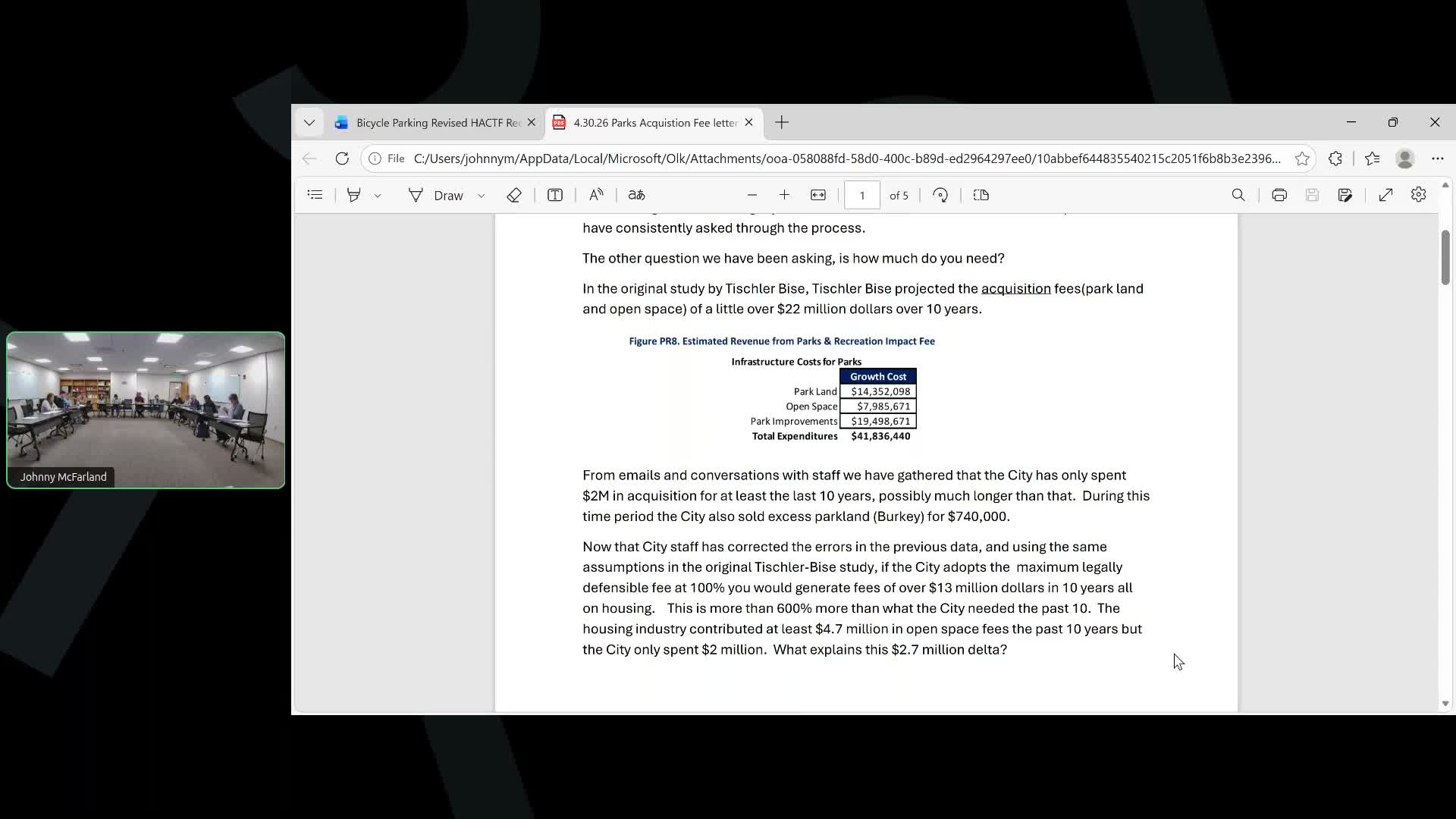
Task force members questioned a consultant-derived impact-fee estimate that initially projected roughly $22M (later reduced to about $13M after appraisal corrections), asked why the city’s 10-year acquisition spending had been only $2M, and requested staff explain the data and assumptions before council consideration.
Task-force members pressed city staff for clearer explanation of a parks/open-space impact-fee proposal and asked the task force to add a cautionary, directional voice to the council packet.
The chair summarized the issue: the consultant's proportionality study initially projected a high 10-year acquisition fee total (numbers in the packet showed $22 million under early inputs), which staff later reduced after correcting input errors and hiring an appraiser. Staff said corrected appraisal work put the per-acre acquisition value at about $89,000 and reduced the projection to a lower multi-million-dollar figure; staff described the study as the "maximum legally defensible" fee the city could charge under the methodology.
Members repeatedly asked why, if the city had spent roughly $2 million on acquisitions over the prior decade, the study now projected an order-of-magnitude higher need. Chair framed the request as a call for staff to explain the delta and consider whether the city should accept a lower fee and leave room to raise it later if justified. A developer urged staff and the task force to verify transactions used by the consultant: some transactions were internal transfers or outliers that skewed averages and an appraiser’s review was necessary to correct them.
After extended discussion about methodological limits of a proportionality study, the committee directed staff to prepare a short letter for council that urges clarification of data inputs, transparency about funding sources (gifts, capital funds, grants), and caution against adopting the maximum legal fee without demonstrated need. The impact-fee hearing at council was noted as rescheduled to June 3; task-force members asked staff to return with clearer documentation and, if needed, alternative fee scenarios.
No formal task-force vote on the fee was taken; the group asked staff to finalize materials for the council packet, to document assumptions and funding sources, and to return if legal or technical questions remain.