Get Full Government Meeting Transcripts, Videos, & Alerts Forever!
Get email alerts on the Public Records Law topic
No spam. Unsubscribe anytime.
State attorney briefs Levy County on public-records duties, redaction and fee practices
Summary
At a Levy County workshop, the state attorney reviewed what counts as a public record under Florida law, outlined requester categories and redaction best practices, warned about attorney-fee exposure for unlawful refusals, and advised agencies on deposits for large requests and preservation of records.
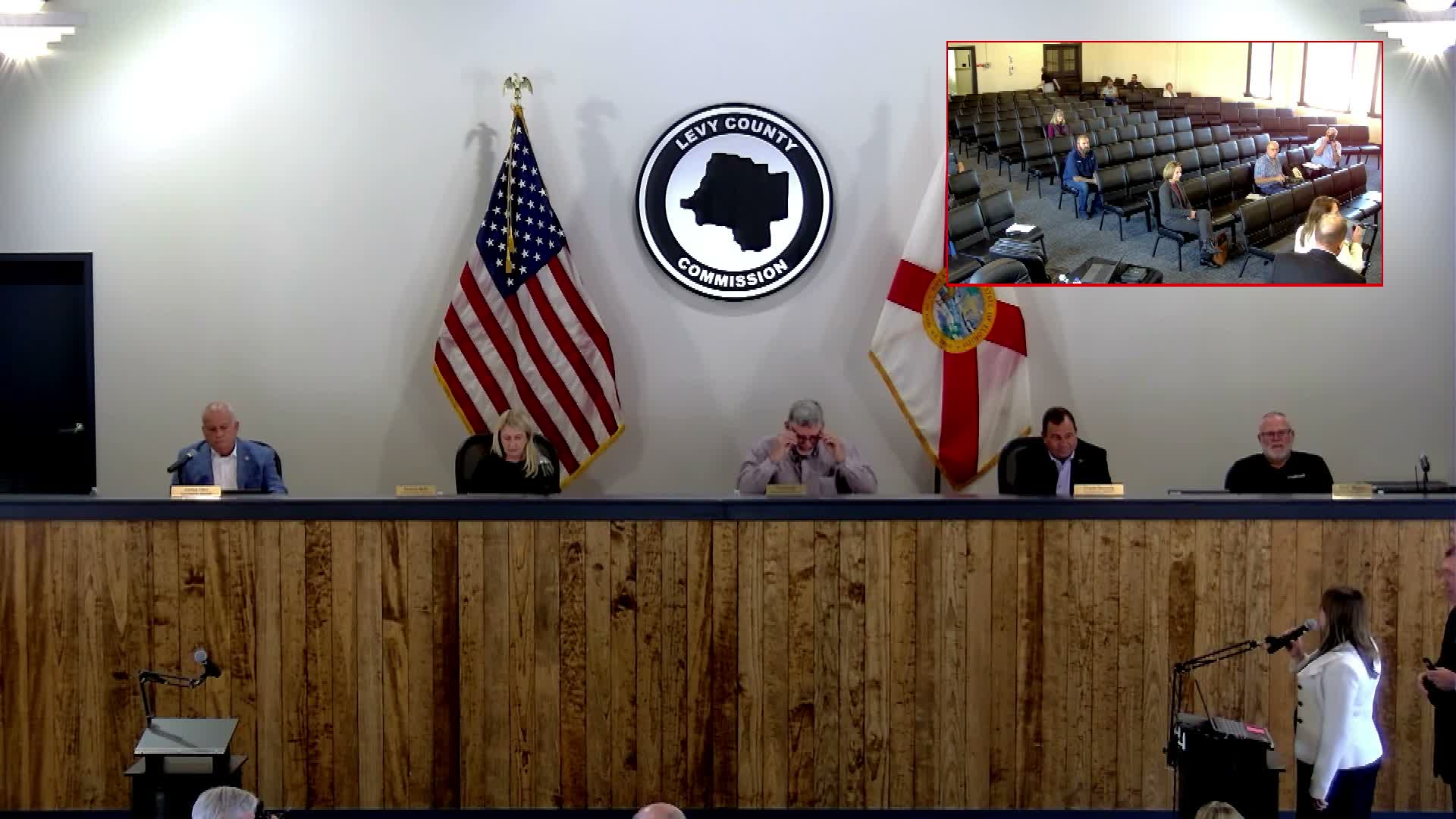
The state attorney for the Eighth Judicial Circuit told Levy County officials at a workshop that the default under Florida law is disclosure and that records created or received in connection with official business "belong to the citizens of the state of Florida." He urged county staff to treat public-records duties as a top-down responsibility and to document decisions about locating, redacting and preserving records.
The presenter summarized the statutory definition as covering "documents, papers, letters, maps, books, tapes, photographs, films, sound recordings, or other material, regardless of physical form" and said the correct starting point is to assume a record is public unless an exemption applies. He warned that while spoken words alone are not public records, recordings and most electronic material generally are.
Drawing on his office's experience, the state attorney outlined four broad requester categories: victims or witnesses whose needs are time-sensitive; law firms that make large, recurring requests; adversarial "bad actors" who test agencies for mistakes; and members of the press, who often have time-sensitive deadlines. For high-cost requests his office issues itemized estimates that reflect the lowest qualified staff salary required to do each task and typically requires a 50% deposit before beginning extensive work.
He illustrated the labor involved in redaction with body-camera footage examples, noting that even a 40-minute event can produce many hours of review and redaction. "Someone's got to watch every second of it, write down everything that they got to redact," he said, and added that complex requests can become very expensive. To reduce future costs he recommended adopting retention schedules that allow lawful deletion when records reach their "date of last usefulness."
On redaction procedures, he advised agencies to avoid inserting personal material into official emails and to use redaction software plus a clear key explaining why material was redacted. That key, he said, prevents unnecessary suspicion and is important because a requester has a right to know why material was removed.
The state attorney emphasized timing rules and the so-called "good-faith" standard: Florida does not impose a single fixed deadline for all final responses because agencies vary in staffing and in how accessible records are. Courts will examine accessibility, the need for legal research on exemptions, and the time required for statutory redactions when assessing whether a delay was reasonable.
He repeatedly warned about legal exposure: agencies bear the burden of proof in court to justify exemptions, redactions and any delay, and a court that finds an unlawful refusal must require production and award the requester's attorney fees. "Agencies are liable for fees even if they made an honest mistake or act in good faith," he said, and noted that intentional destruction of records (for example, shredding a known public record) can be a criminal misdemeanor.
The presentation included contract guidance: when private vendors "stand in the shoes" of a county agency (for example, full service providers or case-management vendors), contracts should include statutory language requiring the vendor to respond to public-records requests. The presenter said his office had negotiated such language into its case-management contract after resistance from a vendor that held the office's data.
On intake practices, he recommended a single, published point of contact for all requests, signage in lobbies and on websites identifying the public-records custodian, and training front-desk staff to accept requests without asking why the requester wants the records.
During the question-and-answer session, an attendee identified himself as Jeff Hardison and said journalists must ask tough questions; a code-enforcement officer asked whether an anonymous email that prompted staff to open a case is itself a public record. The state attorney replied that "anything that is received in the course of agency business is a public record" and that whether it must be produced depends on the scope of the request. He recommended consulting the agency attorney and, when in doubt, preserving the material rather than deleting it.
He closed by advising transparency, consistent treatment of all requesters, documenting actions and consulting counsel on potentially risky denials. The workshop finished after roughly an hour and five minutes and the board adjourned.