Get Full Government Meeting Transcripts, Videos, & Alerts Forever!
Get email alerts on the Child Protection topic
No spam. Unsubscribe anytime.
Safe Passage tells council it expanded free therapy and urges stronger community reporting
Summary
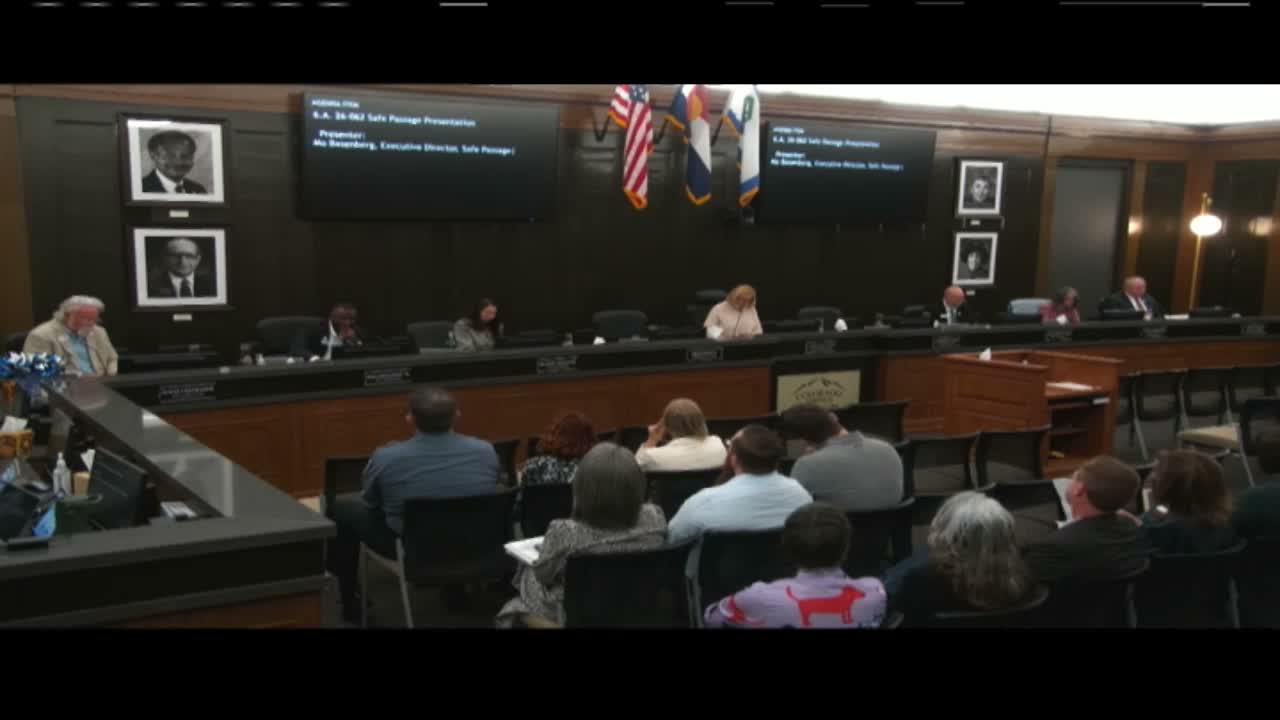
Safe Passage presenters told the Colorado Springs City Council on April 13 that the co-located child advocacy center expanded in‑house trauma therapy in 2025, served hundreds of children and caregivers, and continues to operate with a 12–15 child waitlist while seeking funding to hire more clinicians.
Safe Passage Child Advocacy Center representatives updated the Colorado Springs City Council on April 13 about services, growth and funding needs for children and caregivers in the Pikes Peak region.
The presenter said Safe Passage is the only co‑located child‑focused advocacy center in Colorado, bringing law enforcement investigators, forensic interviewers, medical staff and mental‑health providers together under one roof to reduce repeated interviews and to coordinate care for abused children and their families. The presenter described a 2025 service year that included hundreds of forensic interviews, about 36 forensic medical exams performed by UCHealth forensic nurses, and a substantial increase in on‑site mental‑health therapy from two children served in 2024 to 44 in 2025. The presenter said those therapy services are provided free of charge to children who come through the advocacy center.
Commander Dan Thompson of the Colorado Springs Police Department described the department’s role in the co‑location model, saying the Crimes Against Children unit and the forensic interview team work closely with Safe Passage. Thompson summarized investigative loads and practices, telling council that investigators handle roughly 650–800 felony investigations a year in the unit and that forensic interviewers conduct 450–600 interviews annually for children ages 3–17. "We are victim centered, trauma informed and offender focused," Thompson said, explaining that forensic interviewers use open‑ended, child‑led techniques to avoid leading questions.
Council members pressed staff on funding and capacity. The Safe Passage presenter said the organization has diversified funding streams — including state support, foundations and grants — but is watching operating reserves carefully while expanding services. The presenter said there is currently a mental‑health waitlist of about 12–15 children and that hiring an additional clinician would immediately reduce that waitlist but likely create another as demand grows.
On intake and caseflow, Safe Passage staff described coordination with mandated reporters, law enforcement and the Department of Human Services. They said most referrals come from school personnel or hotline reports; when an immediate safety risk is present the child is brought in right away and an investigative, medical and mental‑health workflow is activated for the family. Thompson urged community members to report concerns to law enforcement or DHS, saying detectives will investigate and that "we need somebody to give us that information at the onset so that we can start that investigation." He provided the non‑emergency number for the police department for concerns that do not require a 911 response.
Council members praised the center’s model and noted the program’s contributions to community safety, but several asked for additional detail about funding sustainability and how the city might help with workforce capacity as demand for therapy grows. The presenters said no service cuts were planned and that the organization continues outreach to secure grants and philanthropic support. They said the center is exploring satellite coverage for eastern growth areas as part of a longer‑term strategic plan.
The council did not take formal action on the presentation. The presenters invited members to tour the facility and thanked staff, local partners and police for their collaboration.