Get AI Briefings, Transcripts & Alerts on Local & National Government Meetings — Forever.
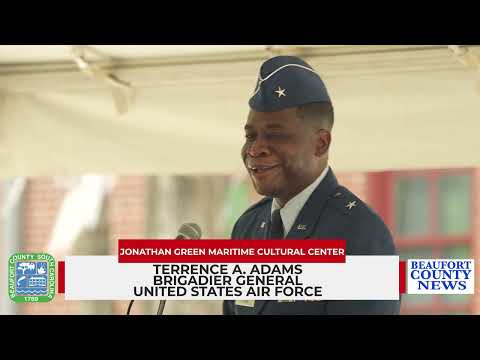
Former Joint Base Charleston commander Terrence Adams highlights Dr. Jonathan Green’s military service and art in Beaufort County
Summary
Terrence Adams, identified in the transcript as a former Joint Base Charleston commander, praised artist Dr. Jonathan Green’s service and described plans for a cultural center that will link his military experience with Lowcountry maritime heritage.
Terrence Adams, introduced in the program as “TA” and identified in the transcript as a former Joint Base Charleston commander, praised artist Dr. Jonathan Green’s military service and said Green’s wartime experience shaped his work. Adams said Green “started 1973 on the April 14” and “raised his hand to support the nation, like many people did.”
Adams, speaking about Green’s biography, said Green served at Grand Forks Air Force Base and worked as a cook and food service specialist early in his career. “Jonathan was … a cook food service specialist,” Adams said, and later earned an advanced degree, a progression Adams said informs the discipline and themes visible in Green’s paintings.
The interview linked Green’s military service to broader cultural aims. Adams described a planned museum or cultural center that would “combine maritime understanding here in the Lowcountry and combine his military service” to educate “men, women, boys, and girls around this region and beyond” about service, heritage and the role of art.
On the relationship between art and political or social power, Adams warned against single narratives and emphasized art’s capacity to convey multiple truths. “We just live where there’s a danger of a single narrative,” he said, adding that art’s “color, texture, [and] dynamics” allow viewers to see a multiplicity of things and that the medium can be intentionally subversive.
The moderator referenced local literary figure Pat Conroy to situate Green’s work within regional cultural traditions, and Adams noted that art appears in many settings, including cemeteries, as part of how communities record history.
The program closed with Adams inviting the public to engage with the displays and with a general thank-you from the moderator. No formal actions, votes, or legal references were discussed during the segment.