Get AI Briefings, Transcripts & Alerts on Local & National Government Meetings — Forever.
North Port board starts debate on Environmental Protection Fund use; defers allocation decisions until budget details arrive
Summary
Board members debated whether mitigation and enforcement fees in the Environmental Protection Fund should be spent on trees, land purchases or habitat restoration; members favored defining spending "buckets" rather than fixed percentages and asked staff to return with budget tracking details before making formal recommendations.
The North Port Environmental Advisory Board opened a substantive discussion on Monday about how the city's Environmental Protection Fund should be used but took no final votes.
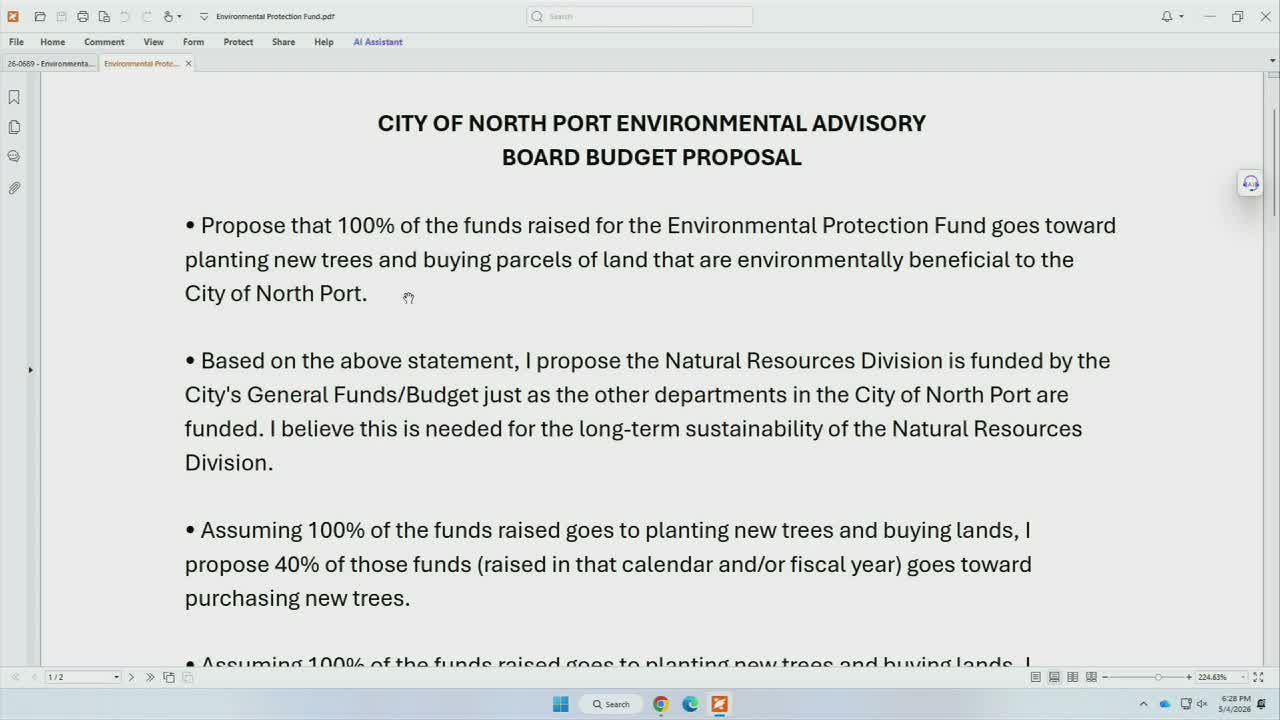
The chair introduced the item as a conversation starter and said the fund, which receives mitigation fees, inspection fees and enforcement fines, should be directed toward the intended purpose of repopulating trees or buying land. "These funds are raised when trees are removed, and I think we should make sure that they go back to repopulating," the chair said.
Other members urged caution. One member noted the board's original mandate does not require the fund be used exclusively for tree purchases and recommended formally proposing language changes if that is the intent. Members broadly supported the idea of defining categorical spending "buckets" (for example: trees, land acquisition, habitat restoration, education/partnerships) rather than rigid percentage splits, arguing that land purchases arrive unpredictably and could upset fixed allocations.
Stefan Caleb, natural resources manager, and Laurie Barnes, deputy director of development services, described how the Environmental Protection Fund is currently funded (mitigation fees, inspection fees and code-enforcement fines) and explained that finance tracks projects with project numbers and public records; Barnes said the general fund and departmental funding streams follow the city's standard budget process and noted the current target to reduce general-fund impact by approximately 5% this year.
Board members asked staff to propose a set of categories the fund could support and to return with options the city could feasibly track through finance and the departmental scorecard. Several members committed to drafting a framework for measuring natural-resources economic impact for the next meeting; the board also noted a planned meeting with the City Commission in early June to present goals.
No formal allocation or ordinance was adopted. Members agreed to continue the discussion as an ongoing agenda item, to consult detailed budget documents (the board was told budget review will continue through September), and to provide proposed category definitions at the next meeting.