Get Full Government Meeting Transcripts, Videos, & Alerts Forever!
Get email alerts on the Affordable Housing Preservation topic
No spam. Unsubscribe anytime.
Arapahoe County Housing Authority approves partnership with April Housing to preserve Reserve at South Creek
Summary
The board voted to use special limited partnerships and approved a front‑loaded compensation option with April Housing to finance renovations and convert market‑rate units at Reserve at South Creek into permanently affordable units. The project seeks tax‑exempt financing before a 2030 deed expiry.
The Arapahoe County Housing Authority voted on Jan. 12 to participate in special limited partnerships and to approve a front‑loaded cash fee plus a residual revenue share with April Housing to preserve Reserve at South Creek, a 168‑unit community in the Dove Valley area.
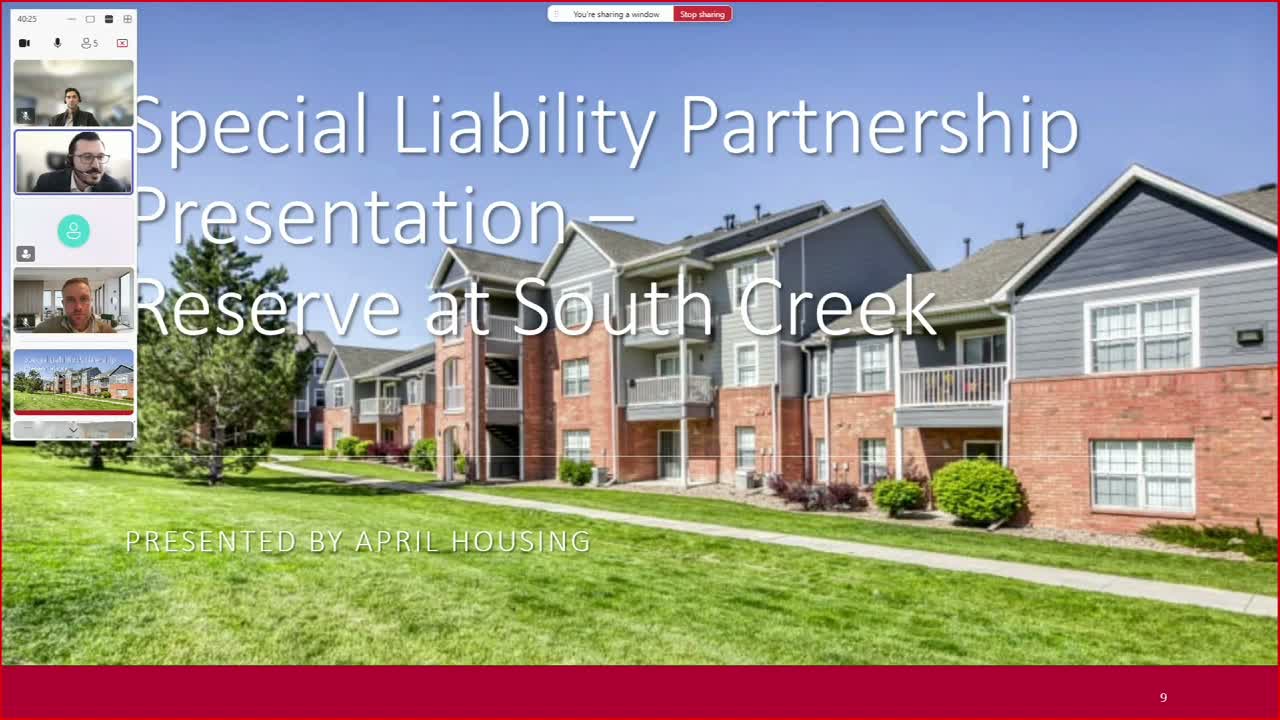
April Housing project manager Joseph Backlit told the board the development includes seven three‑story residential buildings and a community building, with 99 market‑rate units and 69 currently affordable units. He said the property’s land‑use regulatory agreement that preserves affordability expires in 2030, and the authority’s action will help secure tax‑exempt financing and low‑income housing tax credits needed for renovation and preservation. “Our goal here as part of receiving a property tax exemption through the county … is to renovate the community and convert those market rate units into affordable,” Backlit said.
Backlit estimated substantial rehabilitation needs — roughly $85,000 in hard costs per unit — covering new HVAC, water heaters, cabinets, flooring, exterior repairs and community‑space upgrades. He presented two compensation packages tied to the county’s property tax exemption: Option 1, an estimated $225,000 upfront at closing plus 40% of residual cash flow over an 18‑year period (presenter estimated about $400,000 total); and Option 2, a smaller upfront payment (about $25,000) with annual payments (about $25,000 per year escalating 3%) plus a back‑end residual (presenter estimated a higher total, roughly $660,000).
Commissioners pressed on income‑eligibility and tenant impacts. Commissioner Jessica Campbell asked whether the converted units would target a mix of income bands; Backlit said the plan is to set all 168 units at or below 60% of area median income (AMI), and that an initial analysis indicates roughly 90% of current market tenants would qualify for those units and be able to remain. For households that do not qualify, Backlit said the developer would offer relocation incentives and other supports to reduce displacement.
After discussion, the board adopted the use of special limited partnerships and approved Option 1 for the April Housing transaction. Commissioner Jessica Campbell moved to approve Option 1, which Commissioner Jeff Baker seconded; the motion passed by voice vote.
The action authorizes staff to proceed with closing steps to support the developer’s pursuit of tax‑exempt bonds and LIHTC financing; the project team said it expects to pursue sources later in the year in time to act before the 2030 restriction expiration. The board did not provide a detailed, line‑item breakdown of the full capital stack at the meeting.