Get Full Government Meeting Transcripts, Videos, & Alerts Forever!
Get email alerts on the Utilities topic
No spam. Unsubscribe anytime.
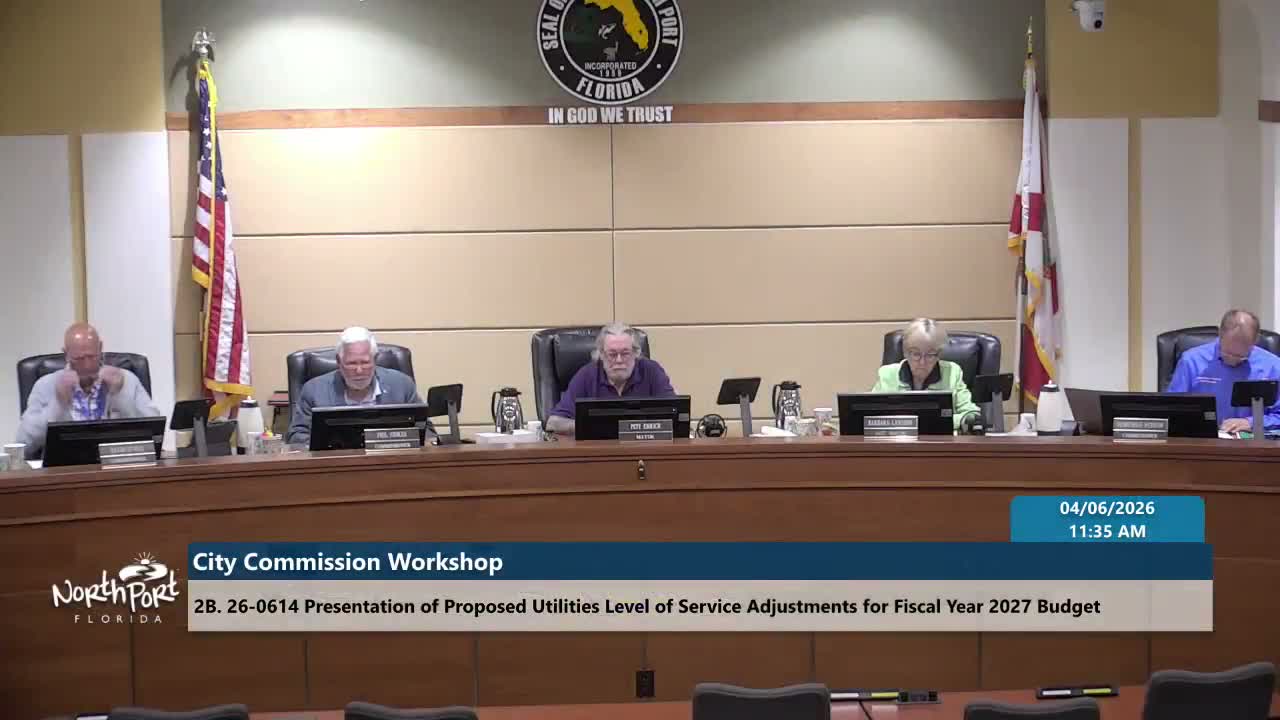
North Port staff weigh cutting water treatment or pressure to save roughly $400,000; fire safety and taste flagged as risks
Summary
Utilities director presented two FY27 savings options — reduced chemical dosing ($165,000) and lower system pressure (modeled at 45 psi for $250,000) — that would maintain regulatory compliance but could affect water taste and fire suppression; commissioners and fire staff urged caution.
Trisha Whisner, the city's utilities director, presented two level‑of‑service options to reduce utility operating costs as staff build the FY27 budget: reduced chemical dosing for aesthetic treatment (estimated savings ~$165,000) and a system pressure reduction (modeled to 45 psi, estimated savings ~$250,000). "If we were to produce water with reduced chemical dosing, it would still meet all the requirements for being safe to drink. It just might not look or smell like what we're used to," Whisner said.
Whisner described the utilities fund as an enterprise fund that must meet regulatory standards, and said staff had run a line‑by‑line efficiency review before proposing these options. She said both alternatives would maintain regulatory compliance and public‑health protections but could change customer experience and have technical ramifications.
Deputy Fire Chief (name not provided) warned of consequences to building fire‑suppression systems if pressure falls below design thresholds: "The lowest allowable pressure for that building would be 62 pounds. In the scenario of a 45 pound static pressure in the system, that would be far lower," the deputy chief said, noting that some buildings and sprinkler systems could need ancillary pumps to meet their stamped design pressures.
Why it matters: Commissioners raised concerns that the city would realize operational savings but homeowners would not see immediate bill reductions unless a later rate study supports lower rates. Mayor and several commissioners described the choices as unacceptable if they significantly degrade service or threaten safety. "Totally unacceptable," one commissioner said, summarizing the response from elected officials who prioritized maintaining water quality and public safety over short‑term savings.
City Manager Fletcher said the presentation was an exercise to inform the commission and that no budget numbers had been changed; staff sought guidance on whether to pursue further analysis of system consequences, fire impacts and legal liability. Whisner emphasized that savings from both options combined would be roughly $400,000 a year but that some impacts — on fire flow, customer perception and certain building systems — would need more study and cross‑departmental mitigation.
Next steps: Commissioners asked staff to proceed cautiously, to analyze phased approaches and to provide additional information on likely homeowner impacts, liability and any required investment to bring buildings up to lower‑pressure operating conditions before committing to changes.