Get Full Government Meeting Transcripts, Videos, & Alerts Forever!
Get email alerts on the Landman Code topic
No spam. Unsubscribe anytime.
Committee advances bill to formalize 'landman' code of conduct and ban threatening fee language
Summary
The House Natural Resources Committee advanced HB 841, a bill that adds negotiation and notice requirements for land agents negotiating easements and bars threatening language about landowners bearing court costs; amendments add graduated fines and give the department authority to rehear or revoke certificates that confer expropriation power.
House Bill 841, presented in committee as a measure to establish a code of conduct for land agents negotiating property interests, advanced with amendments after lawmakers and witnesses described cases where landowners felt intimidated by outreach letters and inspection procedures.
The bill, which sponsors said is "product agnostic," applies the code to any certificate that confers expropriation authority. Sponsor remarks and the bill text require written notice to known property owners, give owners the right to be present for inspections, call for good‑faith negotiations with no fewer than five in‑person documented attempts, require written offers showing compensation and legal description, and allow a minimum ten‑calendar‑day response window.
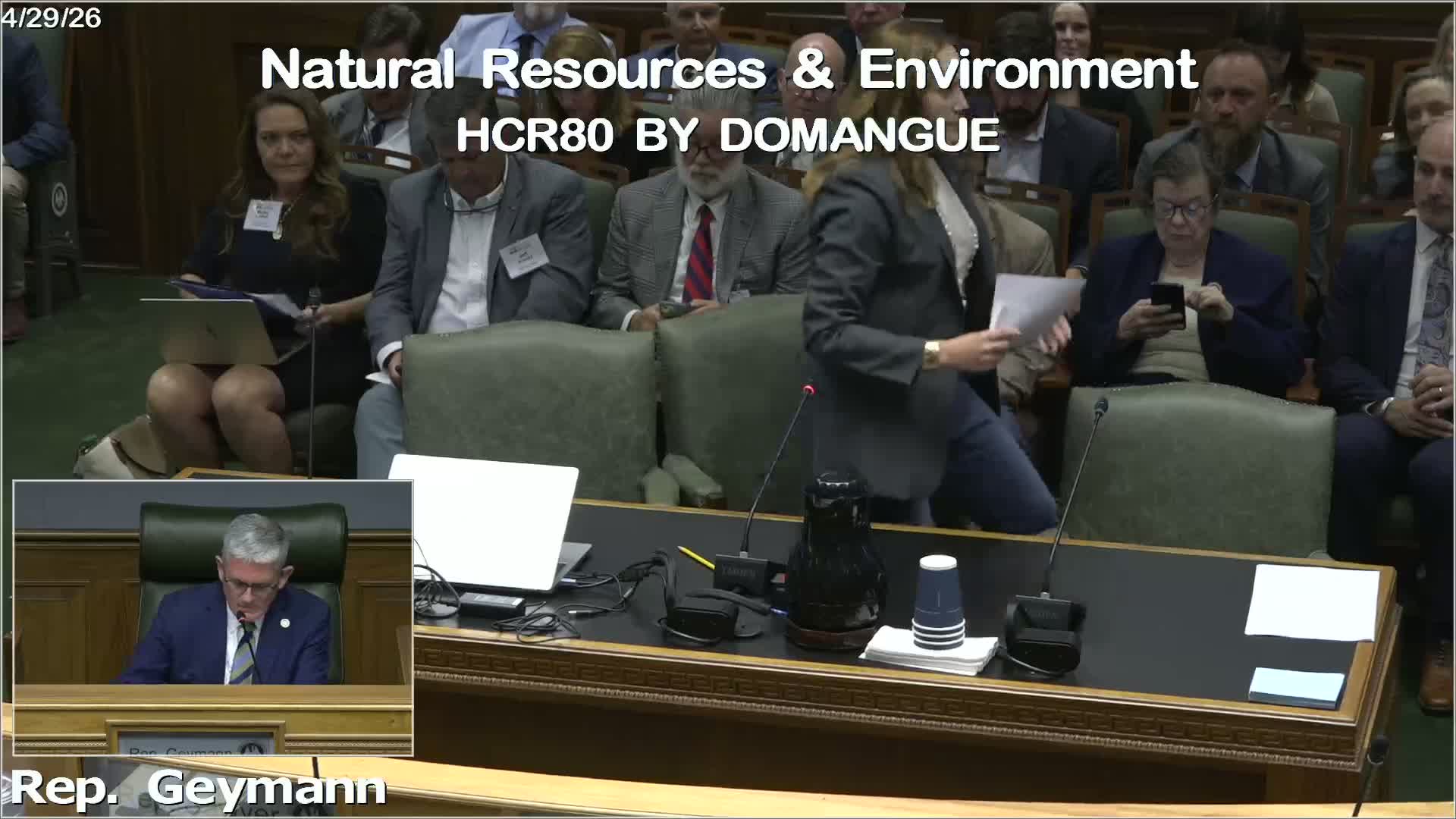
Representative Tief Domingue, who introduced a related concurrent resolution and testified for the changes, said the provision is intended to "put some guardrails on rogue landmen" after constituents received short, intimidating letters that suggested they could be forced to bear court costs. Representative Domingue also voluntarily deferred her concurrent resolution so the committee could take up HB 841.
The committee viewed a short video from affected landowners in which one speaker, John DuBose, said the property ‘‘means the world to me’’ and another, Nick Brown, described an explosion at his house and urged the company to move the line "a little bit further away." Committee members pressed sponsors on enforcement and scope.
Amendments adopted in committee removed a general new court‑costs provision, added a department authority to assess reasonable appraisal fees, removed an initial contest procedure that duplicated existing law, broadened the code from carbon‑capture pipelines to any certificate holder, prohibited threatening that landowners would be required to pay the company’s court costs and attorneys’ fees, shortened the landowner response period in one amendment (from 30 to 15 days in an earlier amendment set later adjusted in committee discussion), and added a graduated fine schedule and a publicly posted list of violators on the Department of Conservation & Energy website.
Industry witnesses and a land‑services expert testified that most land agents already follow best practices but supported codifying standards to address the few bad actors. Committee staff said the bill also provides the department secretary the authority to order rehearings or to revoke a certificate that confers expropriation power when a violation occurs.
The committee adopted the amendment package and voted to report the bill favorably as amended for further legislative consideration. The measure will proceed with the adopted enforcement provisions and language that sponsors said aims to protect landowners’ rights without preventing lawful expropriation when required by statute.