Get Full Government Meeting Transcripts, Videos, & Alerts Forever!
Get email alerts on the State Legislation topic
No spam. Unsubscribe anytime.
Arapahoe County seeks amendments to foster-youth benefits bill and signals opposition to expansion of civil-liability claims
Summary
County legislative staff recommended the board take an "amend" position on HB 26-1347 to protect counties from new administrative costs and to ensure foster youth retain savings; county attorneys urged opposing a draft civil-liability expansion that could shift federal constitutional claims into state court.
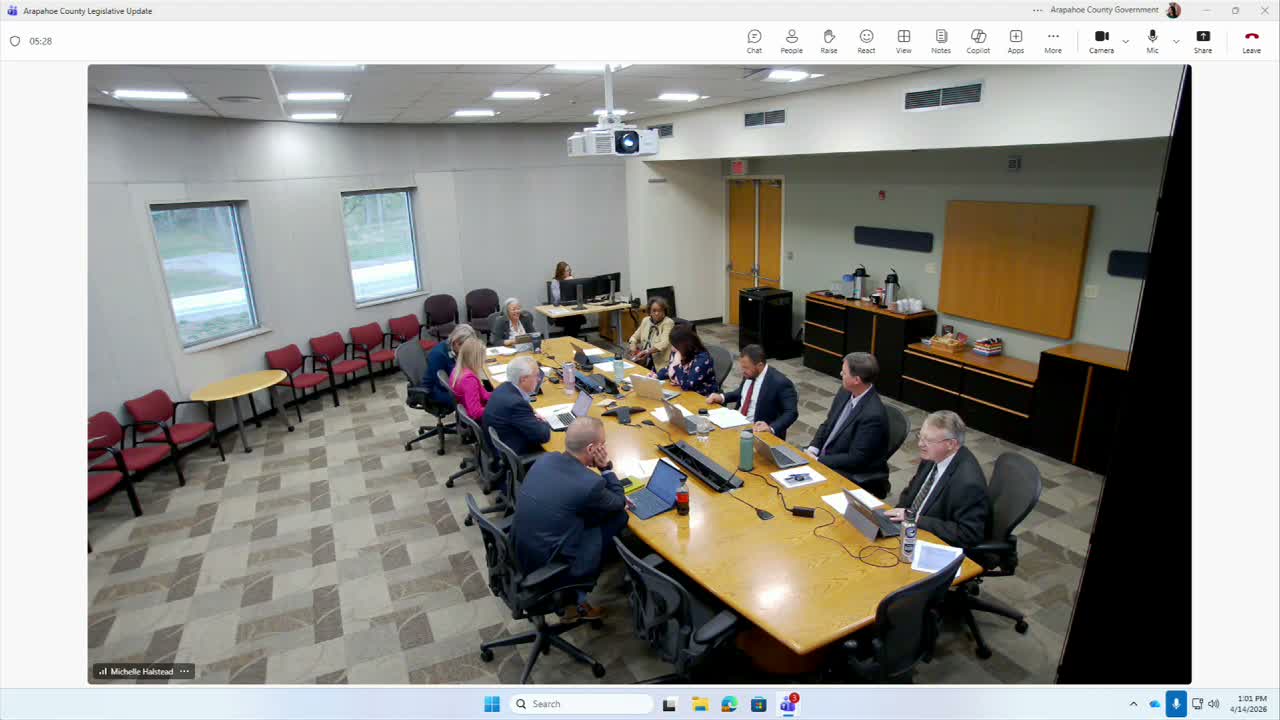
Arapahoe County commissioners on Monday directed staff to pursue amendments to HB 26-1347, a state bill that would change how counties manage federal disability and survivor benefits for foster youth, and endorsed a conceptual opposition to a separate draft that would expand state-level civil liability for alleged constitutional violations.
Nico Johnson of the commissioners’ office briefed the board that HB 26-1347 would require counties to screen foster youth for Social Security eligibility, file and track applications, maintain documentation in state systems, and establish savings-account requirements for youth transitioning out of care. "As written, the bill would expand workloads, increase administrative costs, and reduce funding for county child welfare services," Johnson said, and the legislative team recommended the county take an amend position to protect local operations.
Dan McKelke, a county Human Services official, told commissioners the federal administration has signaled a view that survivor and disability benefits should not be used to reimburse the cost of care. "The struggle is the federal administration fundamentally believes we should not be using survivor benefits for cost of care," McKelke said, adding that implementing the bill as drafted would be technically complex and would likely require more staff time, training and state-system changes.
County staff recommended amendments to (a) secure funding for additional staffing and training; (b) designate a better-trained team or entity to determine Social Security eligibility; (c) add county protections for trust-account investments that are outside county control; and (d) clarify contradictory bill language about when Social Security or survivor benefits may be used to offset foster-care costs. Commissioners indicated broad support for pursuing amendments; during the discussion the group registered informal assent—"four thumbs up for amend," according to the transcript.
Separately, county attorneys briefed the board on a draft replacement to SB 26-005 that would create a private cause of action in state court for alleged federal constitutional violations by people acting under color of law. County attorneys warned the draft could increase liability and insurance costs and would shift cases typically filed in federal court into state court, with unclear fiscal and staffing impacts on the judicial system. The board authorized staff and county counsel to speak negatively about the draft and to oppose it if introduced.
Other items flagged in the legislative update included sweeping of some Prop 1-23 housing funds into other uses this year and ongoing discussion of a Pinnacle privatization proposal that would require a sizable one-time payment to the state with a distribution "waterfall" for Medicaid provider increases and other items. Commissioners asked staff to continue monitoring the long bill, the human-services reorganization (HR 1) drafting timeline and potential late-session actions.
The next procedural step: county staff will work with CCAT and other county partners to track bill language, seek amendment text that secures staffing and liability protections, and continue outreach to the governor’s office and JBC drafters as needed. The board did not record a formal roll-call vote on these positions during the session; the transcript shows consensus and authorization for staff to act if the bills are filed in similar form.