Get Full Government Meeting Transcripts, Videos, & Alerts Forever!
Get email alerts on the Human Services Legislation topic
No spam. Unsubscribe anytime.
Commissioners briefed on state bills, child-welfare background-check deadline and human-services funding risks
Summary
Legislative staff and county human-services leaders warned that a state bill to standardize FBI fingerprint checks for child placements needs prompt amendment before an April waiver expiration; staff also flagged risks to federal human-services funding tied to payment-error rates and recommended automation and regional planning.
Arapahoe County legislative and human-services staff updated the board on several bills and budget risks at the March 18 meeting.
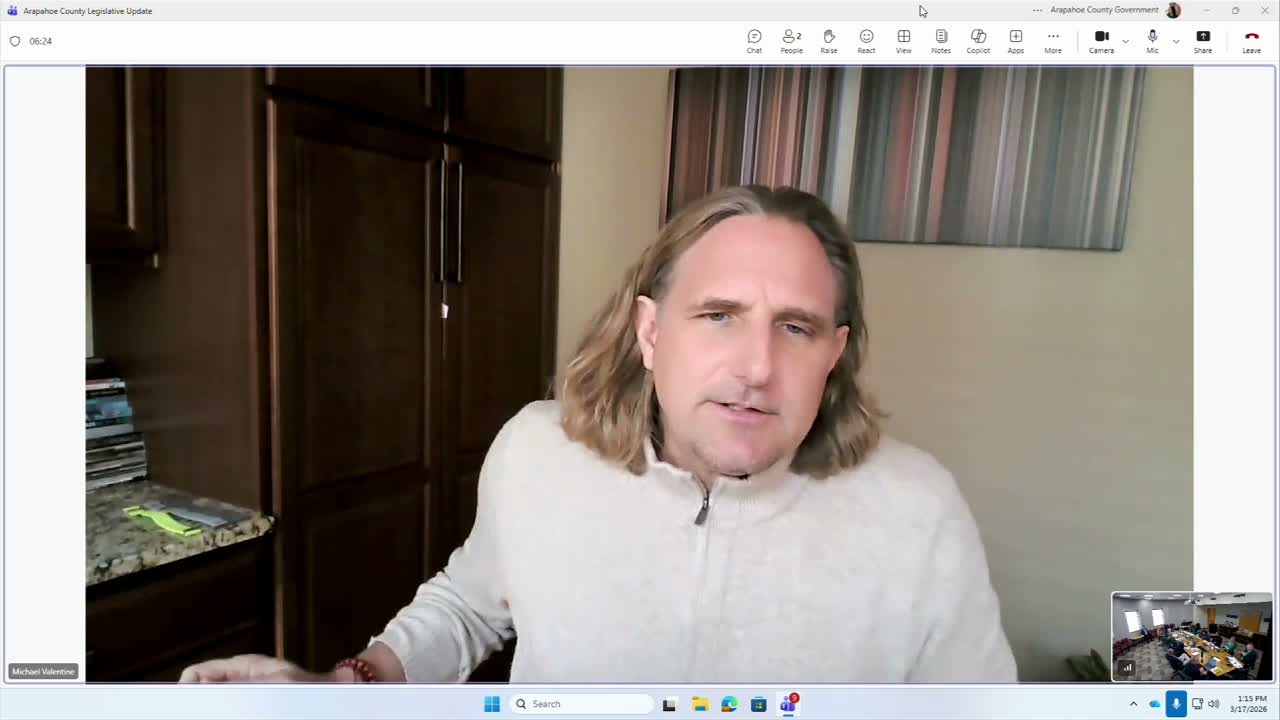
Staff described HB 26 1298, a bill to require FBI fingerprint-based background checks for child-welfare out-of-home placements and related household members. Mike Valentine, deputy county attorney, explained that Colorado’s current FBI/CBI sharing operates under a temporary waiver that expires in April. He told the board county ability to run required national fingerprint checks depends on corrected statutory language and a timely amendment. The county’s legislative team recommended an "amend" position and commissioners indicated consensus support for pursuing amendments that resolve drafting problems and preserve local operational ability; staff said CDHS had accepted some but not all requested fixes and negotiations were ongoing.
Separately, staff reviewed SB 26080 (a CDHS grant program to support child and family economic mobility) and asked the board to request amendments to ensure workforce boards and local workforce areas are explicitly eligible and represented on any advisory council. Commissioners voted informally to pursue an amend position; legislative staff said the bill’s initial fiscal note is restricted ($1.5 million in gifts/grants) with potential later general-fund requests.
Human-services leadership gave a more urgent update on federal-payment error rates. Dan (human-services speaker) said Colorado is trending toward missing federal payment-error targets, which could expose the state to federal funding reductions on the order of $120–$140 million in a future federal fiscal year unless error rates improve. Staff discussed automation, benefits-management-system replacement (CBMS) plans and interim measures such as pre-checks and post-eligibility reviews. Commissioners asked about regionalization, minimum standards, and legal limits on state pass-throughs; staff said many options are still being negotiated and that some form of coordination or new field staffing is likely if the state implements HR 1-related requirements.
On the child-welfare bill staff also noted operational impacts beyond placements: the proposed language would affect “anyone around the child” (household members) and could change background-check logistics for county employees and contracted service providers. County attorneys advised commissioners the matter is time sensitive because the current information-sharing waiver expires in April.
No formal votes were taken; the board signaled support for staff efforts to pursue targeted amendments and continue monitoring a suite of state and federal bills that could affect county budgets and operations.